Microprocessor Potentiometer Manufacturer,Supplier and Exporter in India
Product Code : EL-PM-2181
Jlab Export is a leading Microprocessor Potentiometer Manufacturer,and suppliers in India
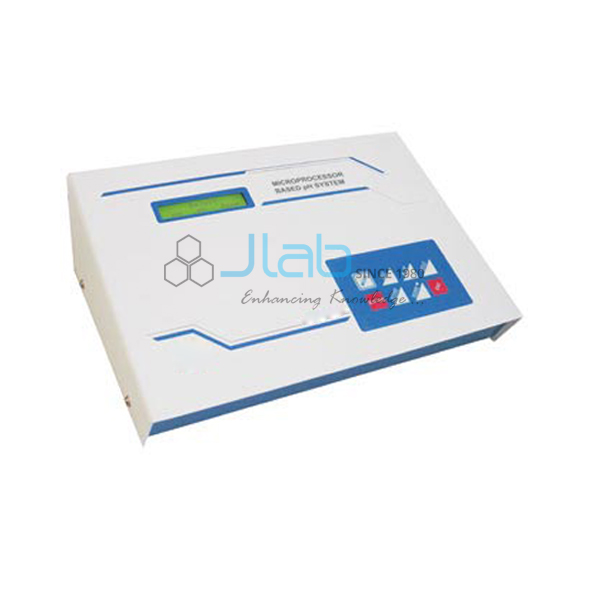
For potentiometric titrations, this microprocessor instrument reads the mV between an indicator electrode and a reference electrode, along with the sample temperature. It comes with four electrodes (reference, platinum, silver and glass) and its own variable-speed magnetic stirrer. Readings show on a 16 x 2 line backlit LCD, and up to 90 results stay in memory after switch-off.
Specifications
| Measures | mV and temperature, for potentiometry |
| mV range | 0 to ±1999.9 mV, resolution 0.1 mV, accuracy ±0.1 mV ±1 digit |
| Temperature | 0–100 °C, resolution 0.1 °C, accuracy ±0.1 °C |
| Input impedance | Above 10^12 ohms |
| Display and keys | 16 x 2 line alphanumeric backlit LCD, 8 soft-touch membrane keys |
| Memory and output | Up to 90 samples, kept after switch-off; Centronics interface for a dot matrix printer |
| Stirrer | Magnetic stirrer, variable speed set on its front panel, powered from the STIRRER socket |
| Power | 230 V ±10% AC, 50 Hz |
| Size and weight | 285 x 190 x 90 mm, 2.5 kg (approx.) |
| Supplied with | Reference, platinum, silver and glass electrodes, temperature probe, magnetic stirrer, electrode stand and clamp, mains lead, instruction manual, dust cover |
| Minimum order quantity | 1 unit |
| Dispatch time | Usually 7–10 working days |
| Manufacturer | JLab (Jain Laboratory Instruments Pvt Ltd), Ambala, India |
Potentiometric Titration Practicals
A standard redox exercise titrates a solution of Ferrous Ammonium Sulphate with Potassium Permanganate from a Burette, using the platinum and reference electrodes. Students record the mV after each addition and see a sharp jump at the end point.
Swapping in the silver electrode turns the same set-up into a precipitation titration of chloride with Silver Nitrate. With the glass electrode, the class follows an acid-base titration in mV. Each group then compares the three curves and explains why each pair of electrodes suits its reaction.
Frequently Asked Questions
Which electrode do I use for each titration?
Use the glass electrode for acid-base work, the platinum electrode for redox (ORP) titrations and the silver electrode for titrations with silver nitrate. In every case the indicator electrode is paired with the reference electrode.
How do I find the end point from my readings?
Plot mV against titrant volume. The end point is where the mV changes most steeply. For a sharper answer, plot the change in mV per unit volume against volume and take the peak, or find where the second derivative crosses zero. Add titrant in small portions near the end point.
How fast should the stirrer run?
Fast enough to mix each addition within a few seconds, but not so fast that a vortex forms or air bubbles reach the electrodes. Set the speed on the stirrer front panel and wait for the reading to settle before you note it.
Can it show pH directly?
No. It measures mV and temperature. In acid-base titrations the glass electrode signal is followed in mV, and the end point comes from the curve just as in pH work. For pH readings, use the Microprocessor pH Meter.
What happens to stored results?
Up to 90 sample results are kept in memory even when the instrument is switched off. Any stored result can be printed through the Centronics interface on a dot matrix printer.
Other Electrochemistry Instruments
- Digital Potentiometer (3½-digit LED, two mV ranges)
- Platinum Electrode
- Digital pH Meter
- pH/mV/Temperature Meter
For a quote, use Add To Cart or send us a message through the contact page.
Last updated: 6 November 2026