Microprocessor pH Meter Manufacturer,Supplier and Exporter in India

Product Code : EL-PM-2176
Jlab Export is a leading Microprocessor pH Meter Manufacturer,and suppliers in India
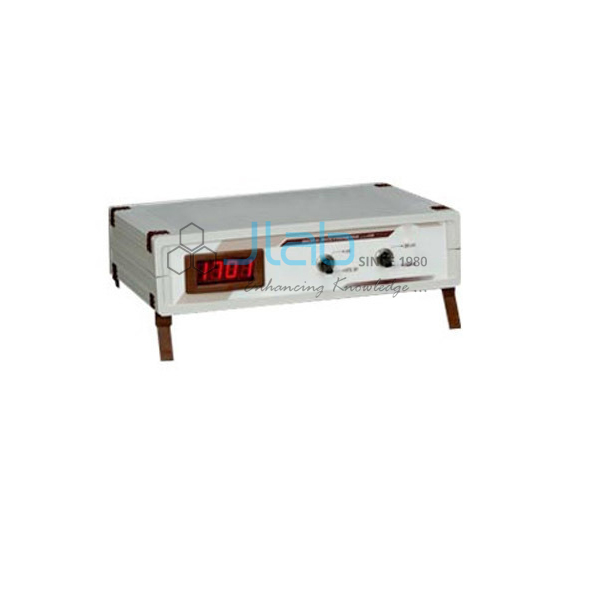
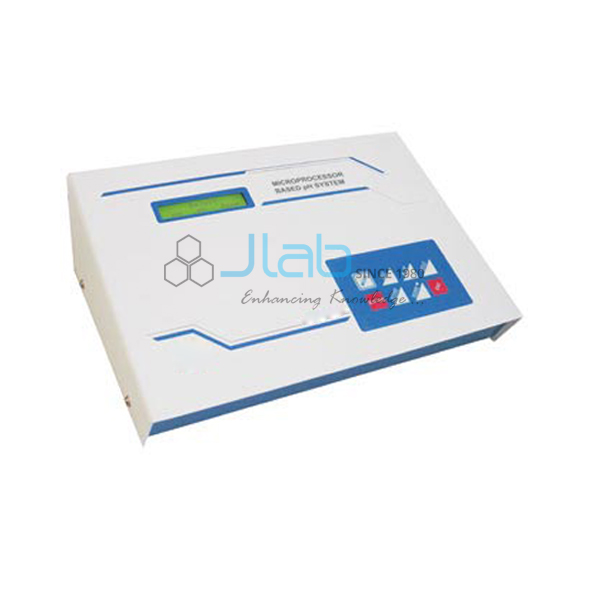
A pH meter reads the small voltage from a glass combination electrode and converts it to pH. This microprocessor bench meter also shows mV and temperature on a 16 x 2 line backlit LCD. It recognises 4.00, 7.00 and 9.20 pH buffers during a 3-point calibration, stores up to 90 readings and connects to a dot matrix printer.
Specifications
| Range | pH 0–14.00, mV 0 to ±1999.9, temperature 0–100 °C |
| Resolution | 0.01 pH (0.001 pH on the high-resolution version), 0.1 mV, 0.1 °C |
| Accuracy | ±0.01 pH ±1 digit, ±0.1 mV ±1 digit, ±0.1 °C |
| Calibration | 3-point, with auto recognition of 4.00, 7.00 and 9.20 pH buffers |
| Temperature compensation | Automatic or manual, 0–100 °C |
| Display and keys | 16 x 2 line alphanumeric backlit LCD, 8 soft-touch membrane keys |
| Memory and output | Up to 90 samples, Centronics interface for a dot matrix printer |
| Power | 230 V ±10% AC, 50 Hz |
| Size and weight | 285 x 190 x 90 mm, 2.5 kg (approx.) |
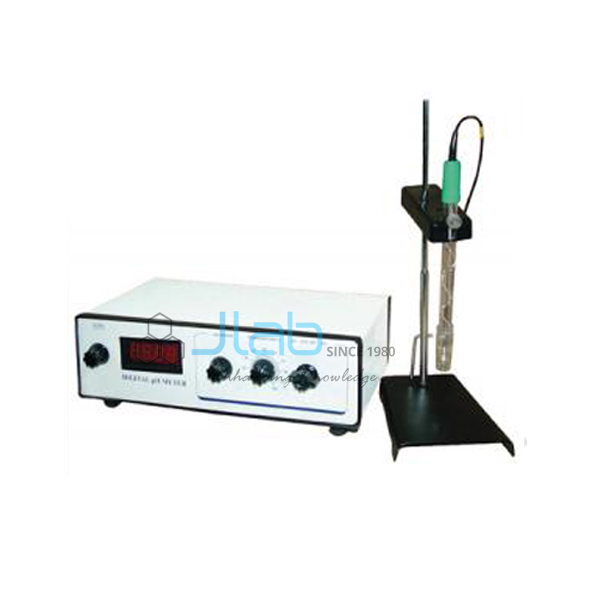
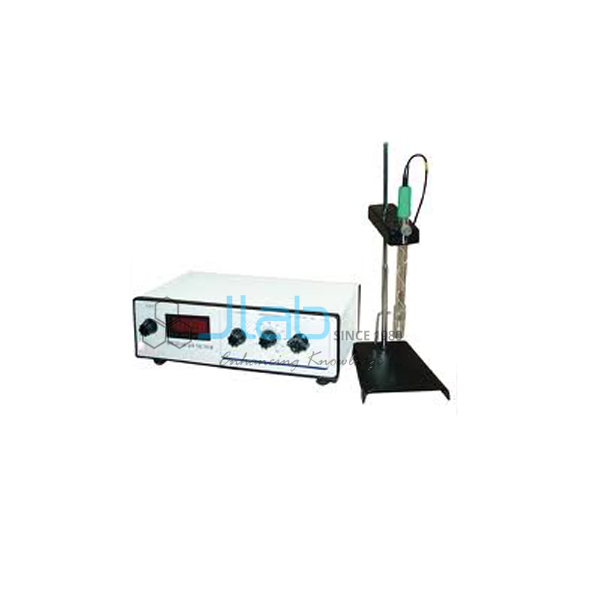
| Supplied with | Combination pH electrode, temperature probe, electrode stand, buffer tablets (4.0 and 7.0 pH), operation manual, dust cover |
| Minimum order quantity | 1 unit |
| Dispatch time | Usually 7–10 working days |
| Manufacturer | JLab (Jain Laboratory Instruments Pvt Ltd), Ambala, India |
Practicals with the Microprocessor pH Meter
Every session starts with calibration. Students dissolve the buffer tablets as the label directs, rinse the electrode from the Wash Bottle, Plastic between buffers and follow the prompts on the display. The meter flags a wrong buffer with an error code, which is a good teaching point in itself.
The main college practical is an acid-base titration curve. Students place Hydrochloric Acid Dilute in a beaker on the Magnetic Stirrer and add Sodium Hydroxide solution from a Burette in small portions. They store the pH after each addition and plot pH against volume. The end point is where the curve rises most steeply. In environmental work, the same meter checks the pH of soil suspensions and water samples.
Frequently Asked Questions
What does auto buffer recognition do?
When the electrode is placed in a 4.00, 7.00 or 9.20 pH buffer during calibration, the meter identifies the buffer itself, so no value has to be keyed in. If the buffer does not match, an error code appears instead of a false calibration.
Do I need 2-point or 3-point calibration?
Calibrate with 7.00 and 4.00 pH buffers for acidic samples. Add the 9.20 pH buffer when samples run into the alkaline side, or when one batch covers both sides. Always calibrate with buffers that bracket the expected sample pH.
Should I use automatic or manual temperature compensation?
Use automatic compensation with the temperature probe in the sample. Without the probe, enter the sample temperature by hand. Compensation corrects the electrode slope for temperature. It does not convert the sample pH to a reference temperature, so note the temperature with each reading.
How should the pH electrode be stored?
Keep the glass bulb wet in electrode storage solution between sessions. Do not leave it in distilled water for long, and do not let it dry out. Rinse it between samples and blot it dry rather than wiping the bulb.
What does the high-resolution version offer?
It reads 0 to 14.000 pH with 0.001 pH resolution and ±0.001 pH ±1 digit accuracy. The standard version reads to 0.01 pH, which covers school and most college work. Both have the same memory, printer interface and buffer recognition.
Other pH and Electrochemistry Meters
- Digital pH Meter (3½-digit LED, slope control)
- pH/mV/Temperature Meter (waterproof pocket tester)
- Microprocessor Potentiometer
- Digital pH, Conductivity & Temperature Meter
For a quote, use Add To Cart or send us a message through the contact page.
Last updated: 6 November 2026