Series and Parallel Resonance Manufacturer,Supplier and Exporter in India
Product Code : EL-AET-1453
Jlab Export is a leading Series and Parallel Resonance Manufacturer,and suppliers in India
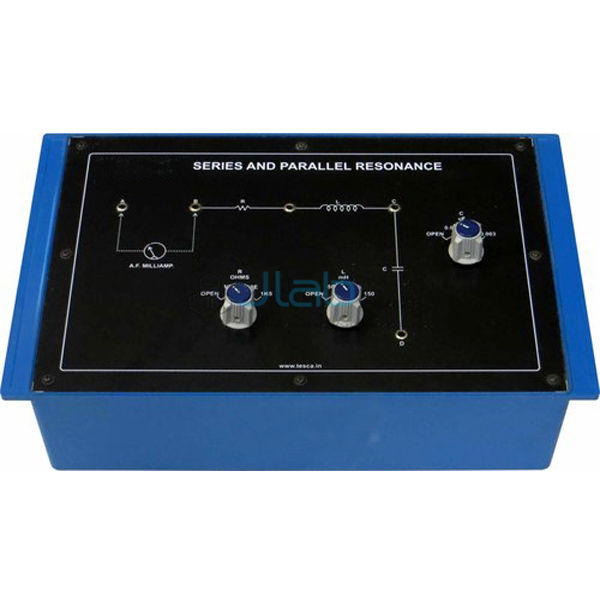
Series and Parallel Resonance (code EL-AET-1453) is an analog electronics training board for plotting series and parallel resonance curves with different values of resistance, capacitance and inductance, measuring Q for both circuits and measuring the dielectric constant of a liquid. Three ferrite-core inductances, three low-loss capacitances and three resistances are each chosen with a selector switch. It is made by Jain Laboratory Instruments Pvt Ltd (JLab) at its works in Ambala, India.
Specifications
| Parameter | Detail |
|---|---|
| Experiments | Series resonance and parallel resonance for different values of resistance, capacitance and inductance, with plotting of resonance curves; measurement of Q for series and parallel resonance; measurement of the dielectric constant (relative permittivity) of a liquid |
| Inductances | Three, made on ferrite cores, selectable by a switch |
| Capacitances | Three, low loss factor, selectable by a switch |
| Resistances | Three, selectable by a switch |
| Patch cords | Stackable from the rear at both ends, 4/2 mm spring-loaded plugs, ½ metre long |
| Terminals | Terminals/sockets on the panel for connections and observation of waveforms |
| Operating instructions | Detailed, giving the object, theory, design procedure, report suggestions and book references |
| Weight | 3 kg (approx.) |
| Dimensions | (W) 340 × (H) 110 × (D) 210 |
| Other apparatus required | Decade audio frequency generator; AC millivoltmeter; AF millivoltmeter |
| Quality check | Each board is visually inspected before dispatch |
| Pack quantity | Each (sold individually) |
| Minimum order quantity | 10 units |
| Dispatch time | Usually 7–10 working days |
| Product code | EL-AET-1453 |
| Manufacturer | Jain Laboratory Instruments Pvt Ltd (JLab) — OEM |
| Country of origin | India (made in Ambala, Haryana) |
How Does It Compare with the JLab LCR Resonance Apparatus?
| Model | Components | Signal source | Meters | Experiments |
|---|---|---|---|---|
| This board (EL-AET-1453) | Three ferrite-core inductances, three low-loss capacitances and three resistances, each switch-selected | External decade audio frequency generator | External AC and AF millivoltmeters | Series and parallel resonance curves, Q, dielectric constant of a liquid |
| LCR Resonance Apparatus Series and Parallel | One resistance, one capacitor and one inductance, brought out to terminals | Built-in audio frequency function generator | Two AC moving-coil meters, for voltage and current | Frequency against current for series and parallel LCR circuits |
Choose this board when students should compare resonance curves for several inductance, capacitance and resistance values and go on to measure Q and the dielectric constant of a liquid. The LCR Resonance Apparatus has its own function generator and two AC meters with one resistance, one capacitor and one inductance.
What Is the Series and Parallel Resonance Board Used For?
At resonance the inductive and capacitive reactances are equal. In a series circuit the impedance then falls to its minimum and the current peaks; in a parallel circuit the impedance rises to its maximum and the supply current is smallest. Plotting the response against frequency for each switch setting shows how the inductance and capacitance move the resonant frequency and how the resistance changes the sharpness of the peak. Dielectric constant measurements of this kind rely on the change in capacitance, and so in resonant frequency, when a liquid replaces air as the dielectric. These experiments belong to AC circuit and network courses in BSc physics and electronics, diploma and engineering labs.
Frequently Asked Questions
What is Q and how is it found from a resonance curve?
Q, the quality factor, describes how sharp a resonance is. It equals the resonant frequency divided by the bandwidth between the two half-power points on either side of the peak, so a narrow, tall curve means a high Q.
Why does the board have three switch-selected resistances?
Resistance sets the losses in the circuit. In the series circuit a larger resistance gives a lower, broader resonance curve and a smaller Q, while in either circuit the resonant frequency is set mainly by the inductance and capacitance.
What other apparatus is needed?
A decade audio frequency generator, an AC millivoltmeter and an AF millivoltmeter. JLab’s audio signal generator and AC millivoltmeter are separate items, linked below, that can be quoted on the same enquiry.
What information is needed for an export quotation?
The number of boards, the destination country and port or city, delivery terms such as FOB or CIF, and any packing, labelling or tender requirements.
Who manufactures the Series and Parallel Resonance board?
Jain Laboratory Instruments Pvt Ltd (JLab) makes it at its works in Ambala, Haryana, India.
OEM Manufacturer
JLab is the trading name of Jain Laboratory Instruments Pvt Ltd, a physics and electronics trainer manufacturer in India, incorporated in 2017 and based on Hargolal Road, Ambala, Haryana. The board is made at JLab’s own works rather than sourced from a trader, so colleges, institutes, dealers and importers buy it direct from the manufacturer, each board is visually inspected before dispatch, and repeat orders are handled by the same works. JLab exports worldwide and ships to buyers in every region — for example Bahrain in the Middle East, Ireland in Western Europe, Paraguay in South America, Gabon in Central Africa and Finland in Northern Europe. Tender details are on the JLab lab tenders page.
Related Resonance and Measurement Equipment
- Dielectric Constant Apparatus — finds the dielectric constant of liquids and solids by a tuning method with a high-frequency oscillator and gang condenser.
- Measurement of Inductance and Capacitance — a board for measuring unknown capacitance and inductance, with a built-in sine-wave oscillator and an audio amplifier and speaker for null detection.
- Audio Signal Generator — an AF oscillator with sine, square and triangular outputs.
- A.C. Milli Voltmeter Type — a mains-operated digital AC millivoltmeter with three selectable ranges.
See all Analog Electronics Trainer models or the full Electronics Lab Equipments range.
Request a Quote
For a quotation, use the Add To Cart enquiry button or the contact page, giving the number of boards, the destination and any generator or millivoltmeter to be quoted with them.
Last updated: 22 October 2026