Anderson Bridge Manufacturer,Supplier and Exporter in India
Product Code : EL-AET-1454
Jlab Export is a leading Anderson Bridge Manufacturer,and suppliers in India
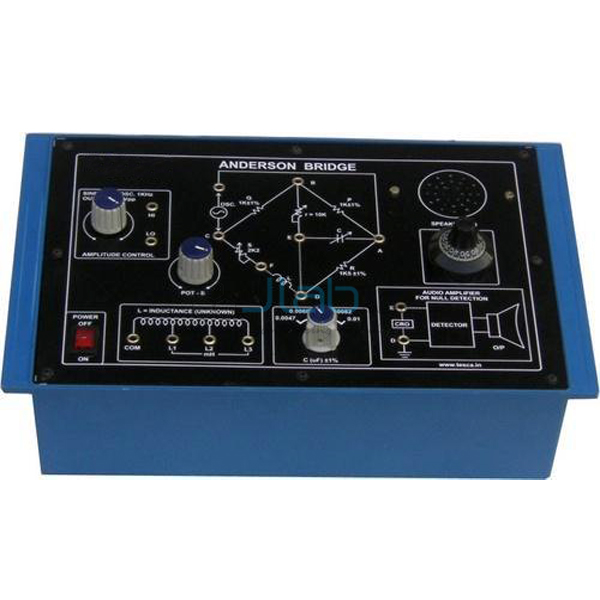
Anderson Bridge (code EL-AET-1454) is an analog electronics training board for measuring the inductance of a given coil by the Anderson bridge method. The bridge circuit, a 1 kHz sine-wave oscillator, an audio amplifier with speaker for detecting the null, two potentiometers, three inductances and five band-switched capacitors are all on the board. It is made by Jain Laboratory Instruments Pvt Ltd (JLab) at its works in Ambala, India.
Specifications
| Parameter | Detail |
|---|---|
| Experiment | Measurement of the inductance of a given coil by the Anderson bridge method |
| Bridge circuit | Anderson bridge circuit with arm values |
| Potentiometers | One for varying one arm; one with a calibrated dial |
| Inductances | Three, of different values |
| Capacitors | Five, selected by a band switch |
| Signal source | 1 kHz sine-wave oscillator with its own IC-regulated power supply |
| Null detection | Audio amplifier with its own IC-regulated power supply, and speaker |
| Mains controls | Mains on/off switch, fuse and jewel light |
| Mains supply | 230 V ±10%, 50 Hz AC |
| Patch cords | Stackable from the rear at both ends, 4/2 mm spring-loaded plugs, ½ metre long |
| Terminals | Terminals/sockets on the panel for connections and observation of waveforms |
| Operating instructions | Detailed, giving the object, theory, design procedure, report suggestions and book references |
| Quality check | Each board is visually inspected before dispatch |
| Pack quantity | Each (sold individually) |
| Minimum order quantity | 10 units |
| Dispatch time | Usually 7–10 working days |
| Product code | EL-AET-1454 |
| Manufacturer | Jain Laboratory Instruments Pvt Ltd (JLab) — OEM |
| Country of origin | India (made in Ambala, Haryana) |
How Does It Compare with Other JLab Inductance Bridges?
| Model | Bridge | AC source | Null detector | Adjustable elements | Inductances |
|---|---|---|---|---|---|
| This board (EL-AET-1454) | Anderson | 1 kHz sine-wave oscillator | Audio amplifier and speaker | Two potentiometers (one with calibrated dial); five band-switched capacitors | Three of different values |
| Self Inductance Anderson Bridge | Anderson, in a teak wood case | Built-in 1 kHz sine-wave source | Null detector with digital display | Decade dials for R1, M and C | Four unknown values supplied |
| Maxwell Inductance Bridge | Maxwell, against a standard inductance | 1 kHz sine-wave source | Null detector with digital display | Decade inductance dial L2 in 10 mH steps; dials R2, R3 and R4 | Four unknown values supplied |
Choose this board for an Anderson bridge practical with an audible null, where students hear the tone from the speaker fade as the bridge comes into balance. The Self Inductance Anderson Bridge sets R1, M and C on decade dials and shows the null on a digital display, while the Maxwell Inductance Bridge measures inductance by comparison with a decade standard inductance.
What Is the Anderson Bridge Used For?
The Anderson bridge is a modification of Maxwell’s bridge that measures the self-inductance of a coil in terms of resistances and a fixed capacitor. Because it needs no variable standard inductance and its balance is reached by adjusting resistances, it suits coils over a wide range of inductance and is a standard experiment in BSc physics and in electrical measurement courses at diploma and engineering level. The 1 kHz signal lies in the audio range, which is why the null can be found by ear through the amplifier and speaker.
Frequently Asked Questions
How is the balance point found on this bridge?
By listening. The 1 kHz tone from the speaker gets quieter as the potentiometers bring the bridge towards balance, and the point of minimum sound is the null at which the inductance is calculated.
Why use an Anderson bridge instead of a Maxwell bridge?
The Anderson bridge compares the coil with a capacitor rather than with a standard inductance, and capacitors of known value are easier to make and keep stable. Its balance is also easier to reach for coils with a low ratio of reactance to resistance.
What supply does the board need?
It runs on 230 V ±10%, 50 Hz AC mains; the oscillator and the audio amplifier each have their own IC-regulated power supply.
What information is needed for an export quotation?
The number of boards, the destination country and port or city, delivery terms such as FOB or CIF, and any packing, labelling or tender requirements.
Who manufactures the Anderson Bridge?
Jain Laboratory Instruments Pvt Ltd (JLab) makes it at its works in Ambala, Haryana, India.
OEM Manufacturer
JLab is the trading name of Jain Laboratory Instruments Pvt Ltd, an Indian manufacturer of electrical measurement and electronics teaching equipment, incorporated in 2017 and based on Hargolal Road, Ambala, Haryana. The board is built at JLab’s own works rather than bought in, so colleges, institutes, dealers and importers buy it straight from the manufacturer, every board is visually inspected before dispatch, and repeat orders are handled by the same team. JLab exports worldwide and ships to buyers in every region — Kuwait in the Middle East, Ghana in West Africa, Malaysia in Southeast Asia, Lesotho in Southern Africa and Sri Lanka in South Asia, for example. Tender details are on the JLab lab tenders page.
Related Bridge Trainers
- Measurement of Inductance and Capacitance — a board for measuring unknown capacitors and inductors selected by band switches, with speaker null detection.
- Schering Bridge Trainer — measures unknown capacitance by the Schering bridge, with an audio amplifier and speaker as null detector.
- DE Sauty Bridge — compares the capacitance of two capacitors, using a high-impedance headphone to find the null.
See all Analog Electronics Trainer models or the full Electronics Lab Equipments range.
Request a Quote
Request a quotation with the Add To Cart enquiry button or through the contact page, giving the number of boards, the delivery destination and any other bridge trainers you want included.
Last updated: 22 October 2026