De Sauty Bridge Manufacturer,Supplier and Exporter in India
Product Code : EL-AET-1463
Jlab Export is a leading De Sauty Bridge Manufacturer,and suppliers in India
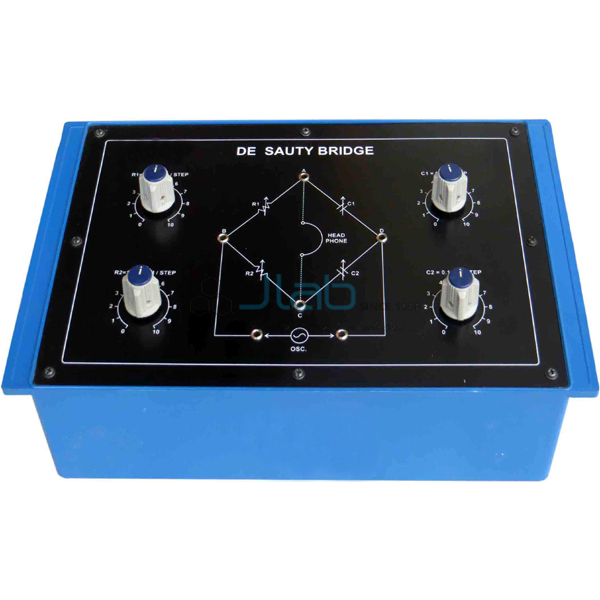
De Sauty Bridge (code EL-AET-1463) is an analog electronics training board for studying the working of a De Sauty bridge and comparing the capacitance of two capacitors. Its four arms are formed by two single-dial decade resistances and two single-dial decade capacitors, and a high-impedance headphone serves as the null detector. The board is a JLab product, made by Jain Laboratory Instruments Pvt Ltd at its works in Ambala, India.
Specifications
| Parameter | Detail |
|---|---|
| Experiment | Working of a De Sauty bridge; comparison of the capacitance of two capacitors |
| Resistance arms | Two decade resistances, each with a single dial in 100 Ω steps, total 1 kΩ |
| Capacitance arms | Two decade capacitors, each with a single dial in 0.1 µF steps, total 1 µF |
| Null detector | High-impedance headphone |
| Patch cords | Adequate number, stackable from the rear at both ends, 4 mm spring-loaded plugs, ½ metre long |
| Operating instructions | Detailed, with the object, theory, design procedures, report suggestions and book references |
| Weight | About 3 kg |
| Dimensions | W 340 x H 110 x D 210 |
| Other apparatus required | Bridge oscillator |
| Quality check | Each board is visually inspected before dispatch |
| Pack quantity | Each (sold individually) |
| Minimum order quantity | 10 units |
| Dispatch time | Usually 7–10 working days |
| Product code | EL-AET-1463 |
| Manufacturer | Jain Laboratory Instruments Pvt Ltd (JLab) — OEM |
| Country of origin | India (made in Ambala, Haryana) |
How Does It Compare with Other JLab Capacitance Bridges?
| Model | Measurement | Signal source | Null detector |
|---|---|---|---|
| This bridge (EL-AET-1463) | Comparison of two capacitances (De Sauty bridge) | External bridge oscillator | High-impedance headphone |
| Schering Bridge Trainer | Unknown capacitance by the Schering bridge; three unknown capacitors on a band switch | Built-in 1 kHz sine-wave oscillator | Audio amplifier with speaker |
| Measurement of Inductance and Capacitance | Unknown capacitance and unknown inductance; five capacitors and three inductors on band switches | Internally connected 1 kHz sine-wave oscillator | Audio amplifier and speaker |
Choose the De Sauty bridge for a straightforward four-arm comparison of two capacitances set on decade dials, with the balance found by ear on a headphone. The Schering Bridge Trainer and the Measurement of Inductance and Capacitance board each have a 1 kHz oscillator and a speaker null detector on the board and measure capacitors selected by band switch.
What Is the De Sauty Bridge Used For?
The board shows how a four-arm AC bridge compares two capacitances, an experiment in BSc physics, electrical measurements and diploma electronics practicals. Because both the resistance and the capacitance arms are on decade dials, students can set different ratios and repeat the balance quickly, then check how closely the capacitance ratio follows the resistance ratio.
What to Specify When Ordering
- Number of boards for the laboratory.
- Signal source — a bridge oscillator is required as other apparatus; JLab’s Bridge Oscillator, linked below, is a separate item that can be added to the same enquiry.
- Other bridge trainers for the same course, such as the Schering, Wien or Anderson bridges.
Frequently Asked Questions
How does a De Sauty bridge work?
Two arms of the bridge are resistances and the other two are capacitances, and an AC signal from an oscillator is applied across it. At balance no signal reaches the detector, and the ratio of the two capacitances is then fixed by the ratio of the two resistances, so a capacitance can be found by comparison with a known one.
Why is a headphone used to find the null?
At audio frequencies the out-of-balance signal is heard as a tone, and the ear is very sensitive to small changes in it. A high-impedance headphone draws little current from the bridge, and the balance point is where the tone fades to a minimum.
What are the limitations of the method?
The simple De Sauty bridge assumes loss-free capacitors. With capacitors that have noticeable dielectric loss, a sharp null cannot be reached, which is why bridges such as the Schering bridge are used to measure loss.
What information is needed for an export quotation?
Tell us the number of boards, the destination country and port or city, the delivery terms you prefer, such as FOB or CIF, any packing or labelling requirements, and the tender reference if there is one.
Who manufactures the De Sauty Bridge?
Jain Laboratory Instruments Pvt Ltd, trading as JLab, manufactures it in Ambala, Haryana, India.
OEM Manufacturer
JLab is the trading name of Jain Laboratory Instruments Pvt Ltd, a physics and electronics laboratory equipment manufacturer in India, incorporated in 2017 and based on Hargolal Road, Ambala, Haryana. The De Sauty board is made at JLab’s own works, not bought in from a trader, so colleges, universities, dealers and importers buy it direct from the manufacturer; each board is visually inspected before dispatch, and repeat orders and spares come from the same works. JLab exports worldwide and ships to buyers in every region — for example Peru in South America, Latvia in Northern Europe, Malawi in East Africa, Guinea in West Africa and Congo in Central Africa. Tender buyers can find details on the JLab lab tenders page.
Related Bridge Trainers and Accessories
- Bridge Oscillator — a fixed 1 kHz pure sine-wave source built as an op-amp Wien bridge oscillator, for four-arm bridge experiments.
- Wien Bridge — capacitance measurement by the Wien series and Wien parallel bridges, with its own oscillator and speaker null detector.
- Anderson Bridge — measures the inductance of a coil, with a 1 kHz oscillator and an audio amplifier and speaker on the board.
See the complete Analog Electronics Trainer range or all Electronics Lab Equipments.
Request a Quote
Request a quotation with the Add To Cart enquiry button, or send your requirement through the contact page — the number of boards, the delivery destination and any other items to be quoted together.
Last updated: 22 October 2026