Unijunction Transistor Manufacturer,Supplier and Exporter in India
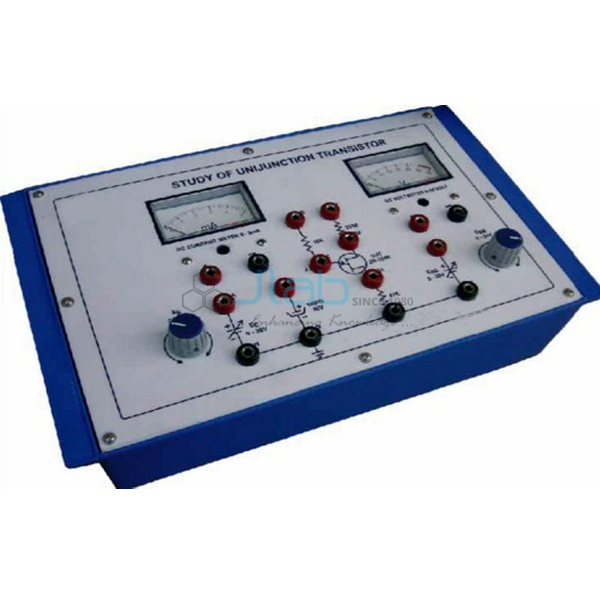
Product Code : EL-AET-1465
Jlab Export is a leading Unijunction Transistor Manufacturer,and suppliers in India
Unijunction Transistor (code EL-AET-1465) is an analog electronics training board for plotting the V-I characteristics of a unijunction transistor (UJT) and using the device as a relaxation oscillator. Two variable 0–30 V regulated DC supplies, a DC voltmeter and a 0–5 mA DC ammeter with 65 mm rectangular dials are on the board. Jain Laboratory Instruments Pvt Ltd, which trades as JLab, makes it in Ambala, India.
Specifications
| Parameter | Detail |
|---|---|
| Experiments | V-I characteristics of a UJT; the UJT as a relaxation oscillator |
| DC power supplies | Two, each 0–30 V DC at 50 mA, continuously variable, regulated |
| Voltmeter | DC, 65 mm rectangular dial, reading 0–30 V |
| Ammeter | DC, 65 mm rectangular dial, reading 0–5 mA |
| Device and components | Unijunction transistor; adequate number of other electronic components |
| Switch, protection and indicator | Mains ON/OFF switch, fuse and jewel light |
| Mains supply | 230 V ±10%, 50 Hz AC |
| Patch cords | Adequate number, stackable from the rear at both ends, 4 mm spring-loaded plugs, ½ metre long |
| Terminals | Terminals and sockets on the panel for connections and observation of waveforms |
| Operating instructions | Detailed, covering the object, theory, design procedures, report suggestions and book references |
| Weight | About 3 kg |
| Dimensions | W 340 x H 110 x D 210 |
| Other apparatus required | Cathode ray oscilloscope, 20 MHz |
| Quality check | Each board is visually inspected before dispatch |
| Pack quantity | Each (sold individually) |
| Minimum order quantity | 10 units |
| Dispatch time | Usually 7–10 working days |
| Product code | EL-AET-1465 |
| Manufacturer | Jain Laboratory Instruments Pvt Ltd (JLab) — OEM |
| Country of origin | India (made in Ambala, Haryana) |
How Does It Compare with Other JLab UJT Trainers?
| Model | Studies | Supplies | Meters and other parts |
|---|---|---|---|
| This board (EL-AET-1465) | V-I characteristics; relaxation oscillator | Two 0–30 V DC at 50 mA, variable, regulated | 0–30 V DC voltmeter and 0–5 mA DC ammeter; external 20 MHz oscilloscope |
| UJT Characteristics Apparatus | V-I characteristics; interbase resistance | Two DC regulated supplies, one of them 0–10 V DC, 30 mA | Three round meters for voltage and current |
| UJT Relaxation Oscillator | Static emitter characteristics on an oscilloscope; relaxation oscillator as an SCR trigger circuit; three oscillator configurations | Isolation transformer, 230 V AC at 100 mA; 20 V DC at 100 mA, IC regulated | Pulse transformer; band switches for resistance and capacitance values |
Choose this board for a two-part UJT practical — the V-I curve read on its own dial meters, then a relaxation oscillator viewed on an oscilloscope. The UJT Characteristics Apparatus covers the V-I study together with interbase resistance measurement, and the UJT Relaxation Oscillator board covers SCR triggering and three oscillator configurations.
What Is the UJT Training Board Used For?
A unijunction transistor has one emitter and two base connections. With a voltage across the two bases, the emitter draws almost no current until its voltage reaches the peak point; the device then fires, the emitter voltage falls as the current rises, and conduction continues down to the valley point. Plotting this curve shows the negative resistance region that makes the UJT useful as a pulse generator. In the second experiment the same device is wired as a relaxation oscillator, producing a sawtooth across a timing capacitor and sharp pulses of the kind used to trigger SCRs. Both are standard practicals in electronics and power electronics courses at diploma, BSc and engineering level.
What to Specify When Ordering
- Model — this board or one of the other UJT trainers compared above.
- Number of boards for the laboratory.
- Other apparatus and companion thyristor trainers to be quoted on the same enquiry.
Frequently Asked Questions
What are the peak point and valley point of a UJT?
The peak point is the emitter voltage and current at which the UJT switches on. The valley point is the lowest emitter voltage reached after switching, at the end of the negative resistance region; beyond it the emitter behaves like an ordinary forward-biased diode.
What is the intrinsic stand-off ratio?
It is the fraction of the interbase voltage that appears at the emitter junction, set by the two base resistances inside the UJT. The peak point voltage is roughly this fraction of the interbase voltage plus one diode drop, so it largely decides when the device fires.
How does a UJT relaxation oscillator work?
A capacitor charges through a resistance until its voltage reaches the peak point; the UJT then fires and discharges the capacitor through its base circuit, switches off at the valley point, and the cycle repeats. The capacitor voltage forms a sawtooth, and the discharge produces a sharp pulse in the base circuit; the frequency depends mainly on the resistance and capacitance.
Is an oscilloscope needed?
Yes. A 20 MHz cathode ray oscilloscope is required as other apparatus for viewing the oscillator waveforms. It is a separate item that can be added to the same enquiry.
What information is needed for an export quotation?
The number of boards, the destination country and port or city, delivery terms such as FOB or CIF, any packing or labelling instructions, and the tender reference if one applies.
Who manufactures this UJT board?
JLab (Jain Laboratory Instruments Pvt Ltd) manufactures it at its works in Ambala, Haryana, India.
OEM Manufacturer
JLab is the trading name of Jain Laboratory Instruments Pvt Ltd, an electronics trainer and physics apparatus manufacturer in India, incorporated in 2017 and based on Hargolal Road, Ambala, Haryana. The UJT board comes from JLab’s own works and is not resold from a trader, so engineering colleges, polytechnics, dealers and importers buy direct from the maker, each board is visually inspected before dispatch, and repeat orders and spares are handled by the same works. JLab exports worldwide and ships to buyers in every region — for example Canada in North America, Belize in Central America and the Caribbean, Rwanda in East Africa, Sri Lanka in South Asia and Tajikistan in Central Asia. Tender information is on the JLab lab tenders page.
Related Trigger and Thyristor Trainers
- Training Board for DIAC — another negative-resistance trigger device, studied for its V-I curve and as a sawtooth and pulse train generator.
- Silicon Controlled Rectifier — gate control, anode current, holding current and phase firing characteristics of an SCR.
- Triac AC Line Switching — triac power-switch experiments that include UJT-triggered switching.
See all Analog Electronics Trainer models or the full Electronics Lab Equipments range.
Request a Quote
To get a quotation, use the Add To Cart enquiry button or the contact page, and include the number of boards, the delivery location and any other trainers you want on the same quote.
Last updated: 22 October 2026