UJT Characteristics Apparatus Manufacturer,Supplier and Exporter in India

Product Code : EL-SI-1088
Jlab Export is a leading UJT Characteristics Apparatus Manufacturer,and suppliers in India
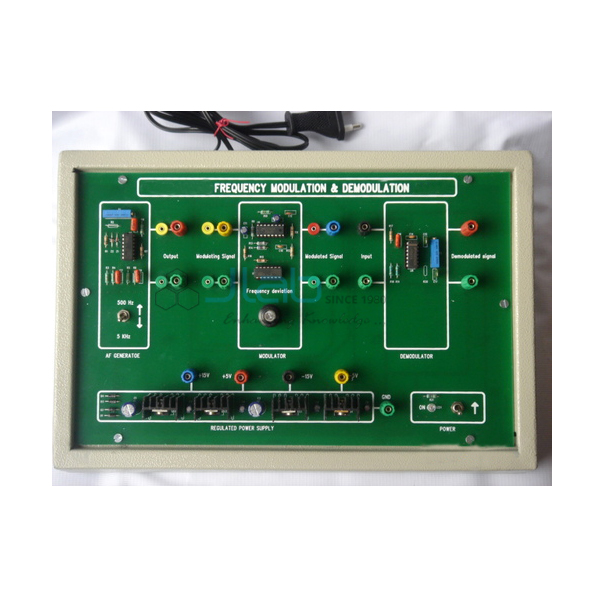
UJT Characteristics Apparatus (code EL-SI-1088) is a panel-mounted experiment for plotting the V-I characteristics of a unijunction transistor (UJT) and measuring its interbase resistance in college physics and electronics laboratories. It carries a 2N2646 UJT, two regulated DC power supplies and three round meters for voltage and current, with every connection brought out to terminals. It is made by Jain Laboratory Instruments Pvt Ltd (JLab) at its works in Ambala, India.
Specifications
| Parameter | Detail |
|---|---|
| Experiments | V-I characteristics of a UJT; measurement of interbase resistance |
| Device under test | One UJT, type 2N2646, mounted on the panel |
| Power supplies | Two DC regulated supplies, one of them 0–10 V DC, 30 mA |
| Meters | Three round meters for voltage and current measurement |
| Connections | Supplies, meters and UJT brought out to terminals |
| Dimensions | 15 x 8 x 4 inches |
| Quality check | Each apparatus is visually inspected before dispatch |
| Pack quantity | Each (sold individually) |
| Minimum order quantity | 10 units |
| Dispatch time | Usually 7–10 working days |
| Product code | EL-SI-1088 |
| Manufacturer | Jain Laboratory Instruments Pvt Ltd (JLab) — OEM |
| Country of origin | India (made in Ambala, Haryana) |
What Is the UJT Characteristics Apparatus Used For?
A unijunction transistor has one emitter and two base connections, B1 and B2. With a fixed voltage across the two bases, the emitter draws almost no current until its voltage reaches the peak point; the device then switches on, and the emitter voltage falls while the current rises — the negative resistance region — until the valley point, beyond which the UJT behaves like a forward-biased diode. With this apparatus students set the interbase voltage, raise the emitter voltage step by step, record emitter voltage and current on the meters, and plot the characteristic for one or more interbase voltages. From the peak-point voltage they can work out the intrinsic stand-off ratio, and with the emitter open they measure the interbase resistance from the interbase voltage and current.
The experiment is part of undergraduate physics and electronics practicals on semiconductor devices, and it explains why UJTs are used in relaxation oscillators and as trigger devices for SCRs. Start each run with both supplies at zero, increase the voltages gradually, and watch the meters as the UJT switches at the peak point.
What to Specify When Ordering
- Quantity — the minimum order is 10 units; plan one for each student group.
- Other device characteristics — FET, MOSFET and transistor characteristics apparatus are separate items that can be quoted together for a complete semiconductor practical set.
- Delivery details — destination country and city or port, delivery terms (for example FOB or CIF) and any tender reference.
Frequently Asked Questions
Which UJT is fitted to the panel?
A 2N2646 unijunction transistor, mounted on the panel with its connections brought out to terminals.
What can students measure with it?
The emitter V-I characteristic, including the peak and valley points and the negative resistance region between them, and the interbase resistance. The intrinsic stand-off ratio can be calculated from the readings.
Which supplies and meters are built in?
Two regulated DC power supplies, one of them 0–10 V DC at 30 mA, and three round meters for voltage and current.
Is an oscilloscope needed for this experiment?
No. The static characteristic is plotted from the meter readings. An oscilloscope is only needed if you go on to build a UJT relaxation oscillator and view its waveform.
Who manufactures the apparatus?
JLab, the trading name of Jain Laboratory Instruments Pvt Ltd, makes it at its works in Ambala, Haryana, India, and sells it directly.
OEM Manufacturer
JLab is the trading name of Jain Laboratory Instruments Pvt Ltd, a manufacturer of electronics and physics laboratory apparatus in India, incorporated in 2017 and based on Hargolal Road, Ambala, Haryana. This apparatus is wired and assembled in JLab’s own works rather than bought in, so colleges, universities, dealers and importers deal directly with the maker, each unit is visually inspected before dispatch, and repeat orders are handled by the manufacturer. Its registrations include GSTIN 06AADCJ9848D1ZE and Legal Entity Identifier 549300DTGS77DGYD6N03. JLab exports worldwide and can deliver to every region — Jordan in the Middle East, Cambodia in Southeast Asia, Tunisia in North Africa, the UK in Western Europe and Ivory Coast in West Africa, to name a few. Tender details are on the JLab lab tenders page.
Related Semiconductor Experiments
- UJT Relaxation Oscillator — takes the UJT further: relaxation oscillator operation, its use as an SCR trigger circuit and the emitter characteristic viewed on an oscilloscope.
- FET Characteristics Apparatus — static and transfer characteristics of a BFW10 FET, with two regulated supplies and three meters.
- Transistor Characteristics Apparatus — input and output characteristics of PNP and NPN transistors in common base and common emitter modes.
- Thermistor Characteristics Apparatus — resistance–temperature characteristics of a thermistor, with oven and thermometer.
See the Semi Conductor Devices range, the complete Scientific Instrument range or the Indian Instruments section.
Request a Quote
Quotes come direct from the manufacturer. Use the Add To Cart enquiry button on this page, or send the number of units (minimum 10), any other characteristics apparatus you need, and your delivery location through the contact page.
Last updated: 8 October 2026