Potentiometer Single wire Manufacturer,Supplier and Exporter in India
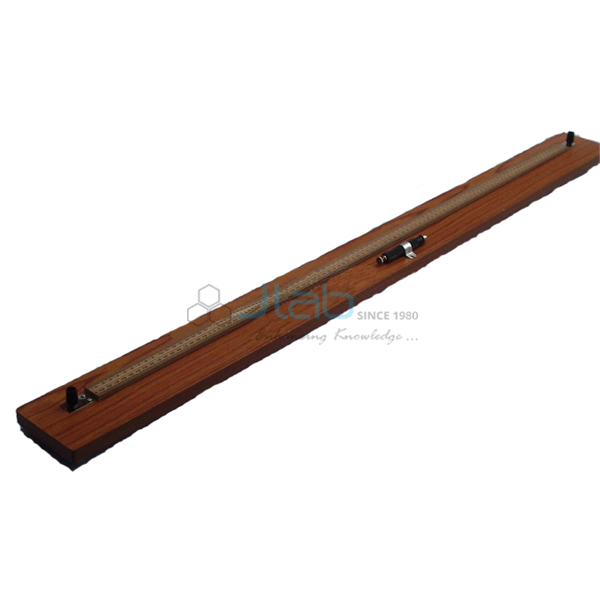
Product Code : EL-SI-8117
Jlab Export is a leading Potentiometer Single wire Manufacturer,and suppliers in India
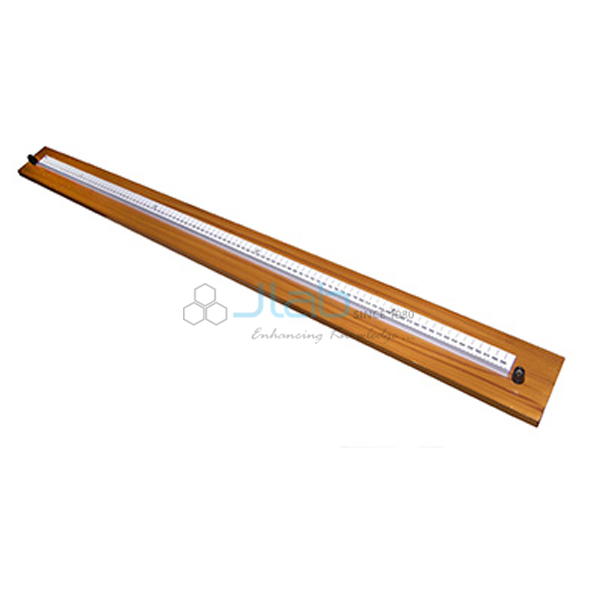
Potentiometer Single wire (code EL-SI-8117) is a one-wire potentiometer for measuring and comparing emfs in school and college physics practicals. A 0.56 mm constantan wire is stretched along a metre scale marked in millimetres and centimetres, between plated brass end plates on a laminated board, and it comes with a pencil jockey and lead. It is made by Jain Laboratory Instruments Pvt Ltd (JLab) at its works in Ambala, India.
Specifications
| Parameter | Detail |
|---|---|
| Wire | One constantan wire, 0.56 mm diameter (about 24 SWG) |
| Scale | Metre scale subdivided into millimetres and centimetres, running along the wire |
| Wire ends | Clamped to stout, plated brass end plates |
| Terminals | Heavy-duty brass terminals on the terminating strips |
| Base | 18 mm laminated board |
| Supplied with | Pencil jockey and lead |
| Quality check | Each potentiometer is visually inspected before dispatch |
| Pack quantity | Each (sold individually) |
| Minimum order quantity | 10 units |
| Dispatch time | Usually 7–10 working days |
| Product code | EL-SI-8117 |
| Manufacturer | Jain Laboratory Instruments Pvt Ltd (JLab) — OEM |
| Country of origin | India (made in Ambala, Haryana) |
How Does It Compare with Other JLab Potentiometers?
| Model | Wires | Jockey | Other listed details |
|---|---|---|---|
| This potentiometer (EL-SI-8117) | One 0.56 mm constantan wire along a metre scale | Pencil jockey and lead supplied | Plated brass end plates; heavy-duty brass terminals; 18 mm laminated board |
| Potentiometer with Pencil Jockey | Four constantan wires of 24 SWG, one metre long (a 10-wire model is also listed) | Pencil jockey with lead | Wires under brass strips, easily replaceable; ply board with mica on top; working manual supplied |
| Potentiometer with Spring Type Press Jockey | Four-wire or ten-wire models | Spring-type brass sliding press jockey on a metal rod | Raised scale with overlapping Perspex pointer; pulley arrangement to tighten the wires |
The single-wire board is the simplest layout: one wire, one scale and a clear circuit that students can trace easily, which suits introductory practicals and smaller benches. Choose a multi-wire model when you want a longer total wire on the board and finer balancing.
What Is the Single Wire Potentiometer Used For?
A potentiometer compares an unknown emf with the steady fall of potential along a uniform wire. A driver cell, key and rheostat send a constant current through the wire; the cell under test is connected through a galvanometer to the jockey, and the jockey is tapped along the wire until the galvanometer shows no deflection. Because no current flows from the test cell at balance, the method gives its true emf rather than its terminal voltage. Class 12 students use it to compare the emfs of two primary cells and to find the internal resistance of a cell, and college labs use the same board for checking voltmeters and measuring small potential differences.
Constantan is used for potentiometer wire because its resistivity is high and changes very little with temperature, so the potential gradient stays steady while readings are taken. The millimetre divisions let the balancing length be read to the nearest millimetre. Tap the pencil jockey on the wire rather than sliding it while pressed, as scraping thins the wire locally and spoils its uniformity, and open the key between readings so the wire does not heat up.
What to Specify When Ordering
- Quantity — the minimum order is 10 units; many labs order one board per student pair plus a spare.
- Spare pencil jockeys — worth adding for class sets, since jockeys see the most handling.
- Circuit items — galvanometer, rheostat, keys, driver cell or eliminator, cells for comparison and a standard cell are separate items.
Frequently Asked Questions
What wire does this potentiometer use?
A single constantan wire of 0.56 mm diameter, which is close to 24 SWG, stretched along a metre scale and clamped to plated brass end plates.
Is the jockey included?
Yes. The potentiometer is supplied with a pencil jockey and a lead. Replacement jockeys are listed separately.
How is the scale divided?
The metre scale is subdivided into millimetres and centimetres, so balancing lengths can be read to the nearest millimetre.
How is it different from the four-wire potentiometer?
This board has one constantan wire; the Potentiometer with Pencil Jockey has four wires of one metre each (and a 10-wire version), giving a longer total wire for finer balancing. Both use a pencil jockey.
Who manufactures it?
JLab (Jain Laboratory Instruments Pvt Ltd) makes the single-wire potentiometer at its works in Ambala, Haryana, India, and quotes for it as the manufacturer.
OEM Manufacturer
JLab is the trading name of Jain Laboratory Instruments Pvt Ltd, a physics lab equipment manufacturer in India, incorporated in 2017 and based on Hargolal Road, Ambala, Haryana. This potentiometer is assembled in JLab’s own works, not sourced from a trader, so schools, colleges, dealers and importers buy direct from the maker; every board is visually inspected before dispatch, and repeat orders and spare jockeys come from the same source. JLab exports worldwide and ships to buyers in every region, for example Canada in North America, Saudi Arabia in the Middle East, Botswana in Southern Africa, Congo in Central Africa and Hong Kong in East Asia. See the JLab lab tenders page for tender supply.
Instruments for Potentiometer Practicals
- Potentiometer with Pencil Jockey — the four-wire (or ten-wire) board for a longer total wire.
- Potentiometer with Spring Type Press Jockey — multi-wire model with a brass sliding press jockey and Perspex pointer.
- Spare Pencil Jockey — a replacement jockey with Bakelite handle and brass-plated contact.
- Standard Cell — a stable voltage reference for standardising potentiometers.
- Moving Coil Galvanometer — a centre-zero DC galvanometer on a stand for finding the null point.
- Daniell Cell — a zinc–copper primary cell whose emf can be compared on the potentiometer.
Browse the Scientific Instrument range or the wider Indian Instruments section.
Request a Quote
Quotes come straight from the manufacturer. Use the Add To Cart enquiry button on this page, or send the quantity (minimum 10 units), any spare jockeys or circuit items you want with it and the delivery city and country through the contact page.
Last updated: 8 October 2026