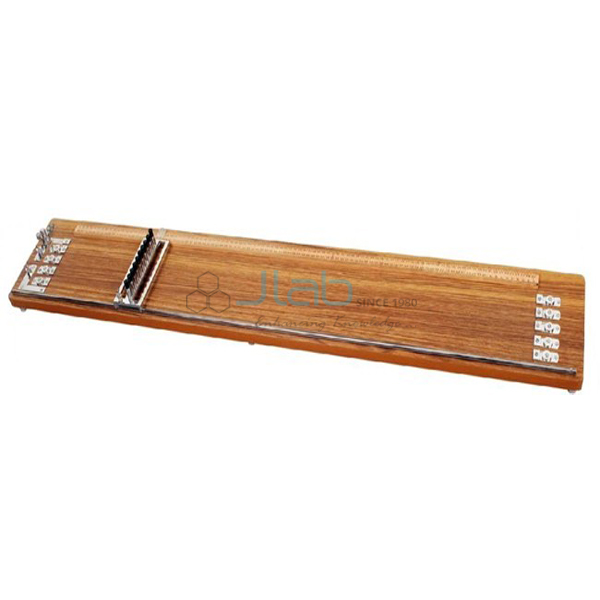
Callender & Griffith Bridge Manufacturer,Supplier and Exporter in India
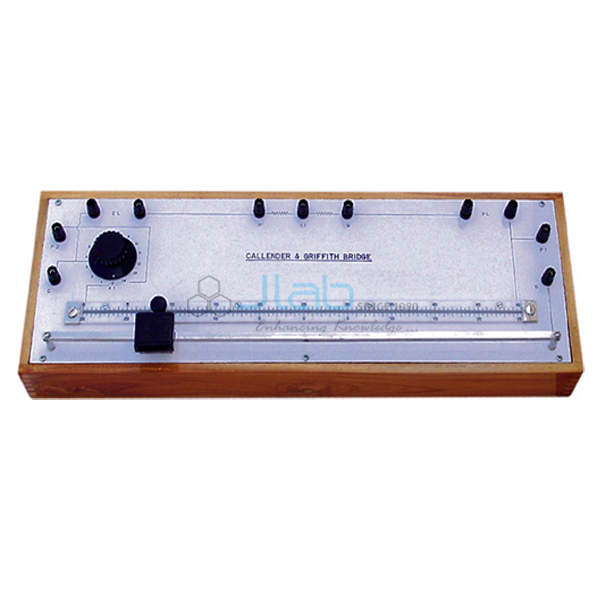
Product Code : EL-SI-8063
Jlab Export is a leading Callender & Griffith Bridge Manufacturer,and suppliers in India
Callender & Griffith Bridge (code EL-SI-8063) is a three-in-one resistance bridge that works as a Callender and Griffiths bridge, a Carey Foster bridge and a potentiometer, used for resistance thermometry and resistance measurement in BSc physics and engineering labs. It has 14 series-connected 1 ohm coils in dials and a 50 cm slide wire of 1 ohm divided into 100 parts, with the jockey sliding on a brass rod. It is made by Jain Laboratory Instruments Pvt Ltd (JLab) at its works in Ambala, India.
Specifications
| Parameter | Detail |
|---|---|
| Functions | Three in one: Callender and Griffiths bridge, Carey Foster bridge and potentiometer |
| Resistance coils | 14 coils of 1 ohm each, arranged in series in dials |
| Slide wire | 50 cm long, 1 ohm resistance, calibrated into 100 equal parts |
| Value of one division | 0.5 cm of wire, equal to 0.01 ohm (from the listed wire length and resistance) |
| Jockey | Slides on a brass rod |
| Terminals | Arranged for working the instrument in each of its three modes |
| This listing covers | The bridge; galvanometer, cells, resistance thermometer and steam boiler are separate items |
| Quality check | Each bridge is visually inspected before dispatch |
| Pack quantity | Each (sold individually) |
| Minimum order quantity | 10 units |
| Dispatch time | Usually 7–10 working days |
| Product code | EL-SI-8063 |
| Manufacturer | Jain Laboratory Instruments Pvt Ltd (JLab) — OEM |
| Country of origin | India (made in Ambala, Haryana) |
What Is the Callender & Griffith Bridge Used For?
As a Callender and Griffiths bridge (also written Callender and Griffith’s bridge), it measures the resistance of a platinum resistance thermometer at the ice point, the steam point and an unknown temperature. In this method a pair of compensating leads sits in the arm next to the thermometer, so changes in lead resistance cancel out and the temperature follows from the platinum resistance alone. As a Carey Foster bridge, it compares two nearly equal resistances, or finds the resistance per unit length of the wire, from the shift of the balance point when the two resistances are interchanged. As a potentiometer, it compares emfs or measures small potential differences by balancing them against the drop along the slide wire, with no current drawn at balance.
In each mode, connect a cell and a sensitive galvanometer to the marked terminals, set the coil dials, and slide the jockey along the brass rod to find the null point on the 100-division wire. Press the jockey gently rather than dragging it, so the wire is not scraped or kinked, and keep the slide wire clean, as dirt changes contact resistance. The listing describes the design as an improvement over the potentiometer; in practice its value for a teaching lab is that one instrument covers three standard practicals.
What to Specify When Ordering
- Quantity — the minimum order is 10 bridges, supplied individually.
- Thermometry set — add a platinum resistance thermometer and a steam boiler if you will run the Callender and Griffiths experiment.
- Null detector and cells — include a galvanometer, cells or a standard cell if your lab does not already have them.
- Resistance standards — add resistance boxes for the Carey Foster and bridge work if required.
Frequently Asked Questions
What experiments can be done with this bridge?
Three groups of practicals: platinum resistance thermometry as a Callender and Griffiths bridge, comparison of nearly equal resistances as a Carey Foster bridge, and emf or potential-difference measurement as a potentiometer.
What is the slide wire’s length and resistance?
It is 50 cm long with a resistance of 1 ohm, calibrated into 100 equal parts. Each division is therefore 0.5 cm of wire, or 0.01 ohm.
How many resistance coils does it have?
Fourteen coils of 1 ohm each, connected in series in dials, giving 14 ohm in all.
Are the platinum thermometer, galvanometer and steam boiler included?
No. This listing covers the bridge. The thermometer, steam boiler, galvanometer and cells are separate items and can be added to the same enquiry.
What should an export quotation request include?
The quantity, destination country and port or city, the delivery terms you want (for example FOB or CIF), any packing or labelling requirements and the tender reference, if any.
Who manufactures it?
Jain Laboratory Instruments Pvt Ltd, trading as JLab, at its works in Ambala, Haryana, India.
OEM Manufacturer
JLab is the trading name of Jain Laboratory Instruments Pvt Ltd, a physics lab instruments manufacturer in India that was incorporated in 2017 and operates from Hargolal Road, Ambala, Haryana. This bridge is made in JLab’s own works instead of being bought from a trader, so universities, colleges, dealers and importers get it straight from the maker, each one is visually inspected before dispatch, and repeat orders are handled by the manufacturer. JLab exports worldwide and ships to buyers in every region — Mongolia in East Asia, Paraguay in South America, Morocco in North Africa, the Dominican Republic in Central America and the Caribbean, and Uzbekistan in Central Asia are a few examples. For tenders, see the JLab lab tenders page.
Accessories for the Three Experiments
- Steam Boiler Element — a 2 to 3 litre boiler with heating element for the steam-point reading.
- Platinum Resistance Thermometer — fine platinum wire wound non-inductively on a mica frame, for resistance thermometry.
- Spot Reflecting Galvanometer — a DC null detector for bridges and potentiometers.
- Standard Cell — a stable voltage reference for standardising potentiometers.
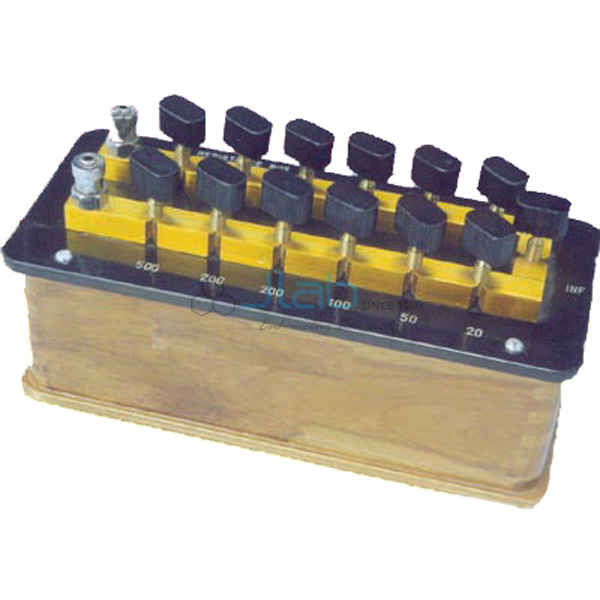
- Resistance P.O. Box — a brass-block resistance box with constantan coils for bridge work.
Find more in the Scientific Instrument range and the Indian Instruments section.
Request a Quote
JLab quotes for this bridge directly as its manufacturer. Use the Add To Cart enquiry button on this page, or send the quantity (minimum 10 units), the accessories you need for each experiment and your delivery location through the contact page.
Last updated: 8 October 2026