Electrical Vibrator Manufacturer,Supplier and Exporter in India
Product Code : EL-SI-8026
Jlab Export is a leading Electrical Vibrator Manufacturer,and suppliers in India
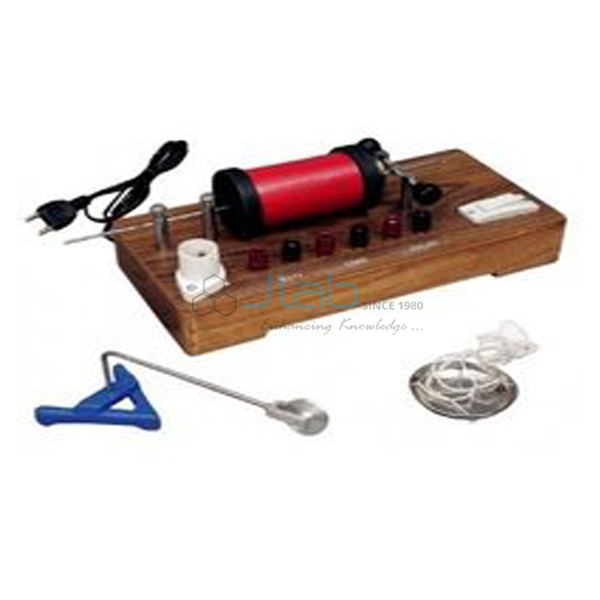
Electrical Vibrator (code EL-SI-8026) is a physics apparatus in which a thin steel rod, clamped at one end and magnetised along its length by a small solenoid on the AC mains, vibrates between the poles of a horseshoe magnet at the frequency of the supply. A string tied to its free end runs over a pulley to a pan, so physics students can set up stationary waves and find the mains frequency. It is made by Jain Laboratory Instruments Pvt Ltd (JLab) at its works in Ambala, India.
Specifications
| Parameter | Detail |
|---|---|
| Vibrator | Thin steel rod, clamped at one end and magnetised longitudinally |
| Free end of rod | Slightly flattened, with a drilled hole for tying the string |
| Drive | Small solenoid around the rod plus a permanent horseshoe magnet on the base board, with the rod passing between its poles |
| Supply | Solenoid connected to the AC mains through a suitable lamp resistance |
| Vibration frequency | The frequency of the AC supply |
| Tuning | Vibrating length adjustable until the rod’s natural frequency matches the supply |
| Base | Polished wooden base |
| Supplied with | Pulley, pan and cord |
| Quality check | Each vibrator is visually inspected before dispatch |
| Pack quantity | Each (sold individually) |
| Minimum order quantity | 10 units |
| Dispatch time | Usually 7–10 working days |
| Product code | EL-SI-8026 |
| Manufacturer | Jain Laboratory Instruments Pvt Ltd (JLab) — OEM |
| Country of origin | India (made in Ambala, Haryana) |
What Is the Electrical Vibrator Used For?
Its main use is the classic practical to determine the frequency of AC mains, done in B.Sc. physics labs and in senior school physics as an extension of the work on waves. The alternating current in the solenoid magnetises the rod along its length, so the polarity of its free end reverses every half cycle; the horseshoe magnet on either side then pulls the rod first one way and then the other, giving one complete vibration per cycle of the supply. The vibrating length is adjusted until the rod resonates with the mains, the string from its tip is led over the pulley, and weights are added to the pan until clear loops of a stationary wave appear. From the loop length, the tension and the mass per unit length of the string, students calculate the frequency and compare it with the nominal mains value.
The same set-up shows how the number of loops changes with tension, linking the experiment to the laws of vibrating strings studied with a sonometer. The lamp resistance limits the current the solenoid draws from the mains; because the apparatus is mains-connected, the teacher should check the wiring first, and students should handle only the string, pan and weights while it is on.
What to Specify When Ordering
- Quantity — the minimum order is 10 units; labs usually plan one vibrator per practical bench.
- Your mains supply — state the supply voltage at your site so JLab can confirm the lamp resistance arrangement.
- Weights and string — slotted weights and spare cord are not part of this listing; ask for them in the same enquiry if needed.
Frequently Asked Questions
What experiment is the electrical vibrator used for?
Mainly for finding the frequency of the AC mains with stationary waves on a string, in the manner of Melde’s experiment. It also demonstrates how tension changes the wave pattern on a string.
Why does the rod vibrate at the mains frequency?
The solenoid magnetises the rod along its length, and with an AC supply the polarity of the free end reverses every half cycle. Because that end lies between the poles of a permanent horseshoe magnet, it is pulled towards one pole and then the other, once per cycle.
What is included?
The vibrator with its solenoid and horseshoe magnet, mounted on a polished wooden base and supplied complete with pulley, pan and cord. Slotted weights are not part of this listing.
Who manufactures the electrical vibrator?
JLab — Jain Laboratory Instruments Pvt Ltd — makes it at its works in Ambala, Haryana, India.
OEM Manufacturer
JLab is the trading name of Jain Laboratory Instruments Pvt Ltd, a school and college physics apparatus manufacturer in India, incorporated in 2017 and based on Hargolal Road, Ambala, Haryana. The vibrator is built in JLab’s own works, not bought from a trader, so schools, colleges, dealers and importers buy it factory-direct, each unit is visually inspected before dispatch, and repeat orders are handled by the maker. JLab exports worldwide and ships to buyers in every region — for example Norway in Northern Europe, Algeria in North Africa, Kuwait in the Middle East, Indonesia in Southeast Asia and Ireland in Western Europe. Tender information is on the JLab lab tenders page.
Apparatus for Vibrating-String Experiments
- Sonometer — a string stretched over a hollow box, for studying how pitch depends on length and tension.
- 3 Wire Pattern Sonometer — hollow wooden resonance box with wires over fixed bridges and one wire loaded over a pulley.
- Electromagnet with Transformer for Sonometer — an electromagnet and transformer for use with a sonometer.
Browse the complete Scientific Instrument range or all Indian Instruments.
Request a Quote
Quotes come direct from the manufacturer. Use the Add To Cart enquiry button on this page, or send the quantity (minimum 10 units), your mains voltage, any weights or accessories, and your delivery location through the contact page.
Last updated: 8 October 2026