Hall Effect Experiment Manufacturer,Supplier and Exporter in India
Product Code : EL-SI-1091
Jlab Export is a leading Hall Effect Experiment Manufacturer,and suppliers in India
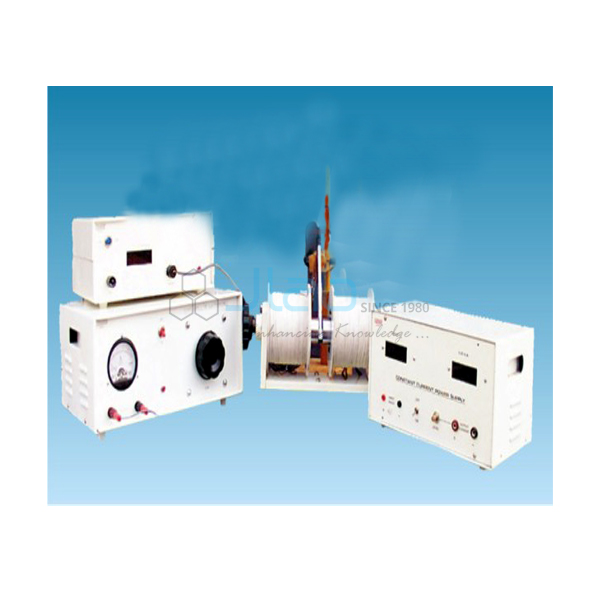
Hall Effect Experiment (code EL-SI-1091) is a complete set-up for measuring the Hall voltage in a germanium crystal and finding its Hall coefficient and carrier type in college physics laboratories. It comprises an electromagnet with its 0–100 V, 4 A power supply and meter, a mounted germanium crystal with a 0–20 mA constant current supply, two digital meters for Hall voltage and crystal current, and a digital gauss meter (0–20 kG) with Hall probe. It is made by Jain Laboratory Instruments Pvt Ltd (JLab) at its works in Ambala, India.
Specifications
| Parameter | Detail |
|---|---|
| Electromagnet | 7.5 kG (0.75 T) |
| Electromagnet power supply | 0–100 V, 4 A, with meter |
| Sample | Germanium crystal, mounted |
| Crystal current supply | Constant current, 0–20 mA |
| Meters | Two digital meters, for Hall voltage and crystal current |
| Gauss meter | Digital, 0–20 kG (0–2 T), with Hall probe |
| Quality check | Each set-up is visually inspected before dispatch |
| Pack quantity | Each (sold individually) |
| Minimum order quantity | 10 units |
| Dispatch time | Usually 7–10 working days |
| Product code | EL-SI-1091 |
| Manufacturer | Jain Laboratory Instruments Pvt Ltd (JLab) — OEM |
| Country of origin | India (made in Ambala, Haryana) |
What Is the Hall Effect Experiment Used For?
When a current flows through a semiconductor placed in a magnetic field at right angles to it, the moving charge carriers are pushed to one side and a small voltage — the Hall voltage — appears across the crystal. In this set-up the germanium crystal sits between the electromagnet’s pole pieces, the constant current supply drives a known current through it, and the two digital meters read the crystal current and the Hall voltage, while the gauss meter and its Hall probe measure the field. Students vary the current and the field, check that the Hall voltage is proportional to each, and calculate the Hall coefficient. The sign of the Hall voltage shows whether the crystal is n-type or p-type, the Hall coefficient gives the carrier concentration, and together with the resistivity of the same material it gives the carrier mobility.
The Hall effect experiment is a core solid-state physics practical in B.Sc., M.Sc. and engineering physics courses, and it pairs naturally with the four probe resistivity experiment on germanium. Increase and reduce the magnet current gradually, keep the crystal current within the supply’s 0–20 mA range, and reverse the field or current between readings to cancel offset voltages.
What to Specify When Ordering
- Quantity — the minimum order is 10 set-ups; tell us how many student stations you are equipping.
- Companion experiments — the four probe resistivity set-up and the susceptibility apparatus are separate items and can be quoted together.
- Delivery details — destination country and city or port, delivery terms (for example FOB or CIF) and any tender reference.
Frequently Asked Questions
What is included in the Hall effect set-up?
An electromagnet with a 0–100 V, 4 A power supply and meter, a mounted germanium crystal with a 0–20 mA constant current supply, two digital meters for Hall voltage and crystal current, and a digital gauss meter (0–20 kG) with Hall probe.
Which sample does it use?
A germanium crystal, mounted for the experiment. Germanium is a semiconductor, so it shows a much larger Hall voltage than a metal for the same current and field.
What results can students obtain?
The Hall voltage at different currents and fields, the Hall coefficient, the type of charge carrier from the sign of the voltage, and the carrier concentration. With a resistivity value they can also find the carrier mobility.
How is the magnetic field measured?
With the digital gauss meter supplied with the set-up, which reads 0–20 kG through its Hall probe placed between the pole pieces.
Who manufactures this set-up?
JLab (Jain Laboratory Instruments Pvt Ltd) makes it at its works in Ambala, Haryana, India, and supplies it directly as the manufacturer.
OEM Manufacturer
JLab is the trading name of Jain Laboratory Instruments Pvt Ltd, a physics laboratory instrument manufacturer in India, incorporated in 2017 and based on Hargolal Road, Ambala, Haryana. The Hall effect set-up comes out of JLab’s own works rather than from a trader, so universities, colleges, dealers and importers buy it direct from the maker; each set-up is visually inspected before dispatch, and repeat orders and spares are handled by the manufacturer. JLab exports worldwide and can deliver to any region — Gabon in Central Africa, Afghanistan in South Asia, South Africa in Southern Africa, Libya in North Africa and Belgium in Western Europe, for example. Tender buyers can refer to the JLab lab tenders page.
Related Solid-State and Magnetism Experiments
- Resistivity of Semiconductors by Four Probe Method — four probe set-up with germanium crystal and oven, for resistivity and band gap; its resistivity value is used with the Hall coefficient to find mobility.
- Susceptibility of FeCl3 Solution — a 7.5 kG electromagnet set with gauss meter and graduated capillary for the Quincke method.
- Digital Flux Meter, Gauss Meter — a direct-reading digital gauss meter complete with Hall probe.
- Energy Band Gap of PN Junction Diode — band gap from reverse saturation current against temperature, with the diode in an oven.
See the full Scientific Instrument range or the Indian Instruments section.
Request a Quote
Quotes come direct from the manufacturer. Use the Add To Cart enquiry button on this page, or send the number of set-ups (minimum 10 units), any companion experiments you want quoted, and your delivery location through the contact page.
Last updated: 8 October 2026