Susceptibility of FeCl3 Solution Manufacturer,Supplier and Exporter in India

Product Code : EL-SI-1090
Jlab Export is a leading Susceptibility of FeCl3 Solution Manufacturer,and suppliers in India
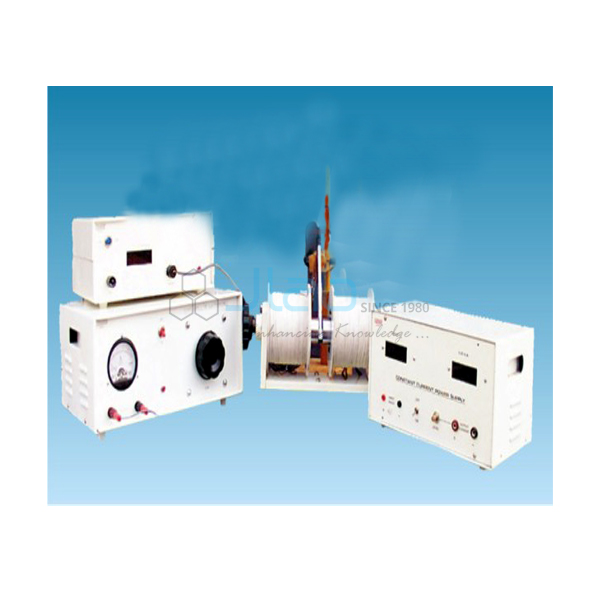
Susceptibility of FeCl3 Solution (code EL-SI-1090) is a complete apparatus for measuring the magnetic susceptibility of an iron salt solution such as ferric chloride (FeCl3) in a strong magnetic field, by the capillary-rise (Quincke’s) method, in college physics laboratories. It consists of a 7.5 kG electromagnet with its 0–100 V, 4 A variable power supply, a digital gauss meter reading 0–20 kG with a Hall probe, and a graduated capillary tube with stand. It is made by Jain Laboratory Instruments Pvt Ltd (JLab) at its works in Ambala, India.
Specifications
| Parameter | Detail |
|---|---|
| Experiment | Susceptibility of an iron (FeCl3) solution in a strong magnetic field |
| Electromagnet | 7.5 kG (0.75 T) strength |
| Electromagnet power supply | Variable, 0–100 V, 4 A |
| Gauss meter | Digital, 0–20 kG (0–2 T), with Hall probe |
| Sample tube | Graduated capillary tube with stand |
| Quality check | Each apparatus is visually inspected before dispatch |
| Pack quantity | Each (sold individually) |
| Minimum order quantity | 10 units |
| Dispatch time | Usually 7–10 working days |
| Product code | EL-SI-1090 |
| Manufacturer | Jain Laboratory Instruments Pvt Ltd (JLab) — OEM |
| Country of origin | India (made in Ambala, Haryana) |
What Is the Susceptibility Apparatus Used For?
A paramagnetic liquid, such as a solution of an iron salt, is pulled into the strongest part of a magnetic field. In this experiment the solution stands in the graduated capillary tube with its meniscus placed at the centre of the field between the electromagnet’s pole pieces. When the magnet is switched on, the liquid in the capillary rises; the rise is read on the graduations, and the field at the meniscus is measured with the digital gauss meter and its Hall probe. The volume susceptibility is then calculated from the rise, the density of the solution and the field. Repeating the reading at several magnet currents and plotting the rise against the square of the field gives a straight line, which is a useful check on the results. It is a standard magnetism practical in B.Sc. and M.Sc. physics courses.
Raise and lower the magnet current gradually with the variable supply rather than switching it off at full current, keep the capillary clean and free of air bubbles, and keep watches, phones and magnetic cards away from the pole pieces while the magnet is on.
What to Specify When Ordering
- Quantity — the minimum order is 10 units; tell us how many stations the lab will run.
- Test solution — the listing describes the apparatus; state in your enquiry if you also need the ferric chloride solution, or prepare it from your own laboratory stock.
- Other magnet experiments — the Hall effect experiment uses a similar electromagnet, power supply and gauss meter and can be quoted alongside.
Frequently Asked Questions
What is included in this apparatus?
A 7.5 kG electromagnet, its variable power supply (0–100 V, 4 A), a digital gauss meter reading 0–20 kG with Hall probe, and a graduated capillary tube with stand.
How strong is the electromagnet?
It is rated at 7.5 kilogauss, which is 0.75 tesla, and the field is set with the 0–100 V, 4 A variable supply.
How is the susceptibility worked out?
From the rise of the solution in the capillary when the field is applied, the density of the solution and the field at the meniscus measured with the gauss meter. Taking readings at several fields and plotting rise against field squared improves the result.
Is the ferric chloride solution supplied?
The listing covers the apparatus. If you want the solution as well, say so in your enquiry; shelf life depends on the chemical, its grade and storage conditions, so ask us for the expiry date of the batch you are quoted.
Who manufactures this apparatus?
Jain Laboratory Instruments Pvt Ltd (JLab) builds it at its works in Ambala, Haryana, India, and quotes for it directly.
OEM Manufacturer
JLab is the trading name of Jain Laboratory Instruments Pvt Ltd, a scientific instrument manufacturer in India, incorporated in 2017 and based on Hargolal Road, Ambala, Haryana. The electromagnet set-up is built in JLab’s own works rather than bought from a trader, so universities, colleges, dealers and importers buy it factory-direct; each apparatus is visually inspected before dispatch, and repeat orders and spares are handled by the manufacturer. JLab exports worldwide and can ship to every region — Congo in Central Africa, the Philippines in Southeast Asia, Ecuador in South America, Papua New Guinea in Oceania and Bhutan in South Asia are some examples. For tenders, see the JLab lab tenders page.
Related Magnetism and Solid-State Experiments
- Hall Effect Experiment — an electromagnet with a 0–100 V, 4 A supply, a mounted germanium crystal with constant current supply, and a digital gauss meter with Hall probe.
- Digital Flux Meter, Gauss Meter — a direct-reading digital gauss meter complete with Hall probe, for measuring magnet fields.
- Resistivity of Semiconductors by Four Probe Method — four probe set-up with germanium crystal and oven for resistivity and band gap.
See the full Scientific Instrument range or the Indian Instruments section.
Request a Quote
Quotes come direct from the manufacturer. Use the Add To Cart enquiry button on this page, or send the number of sets (minimum 10 units), whether you need the test solution, and your delivery location through the contact page.
Last updated: 8 October 2026