

Schering Bridge Manufacturer,Supplier and Exporter in India
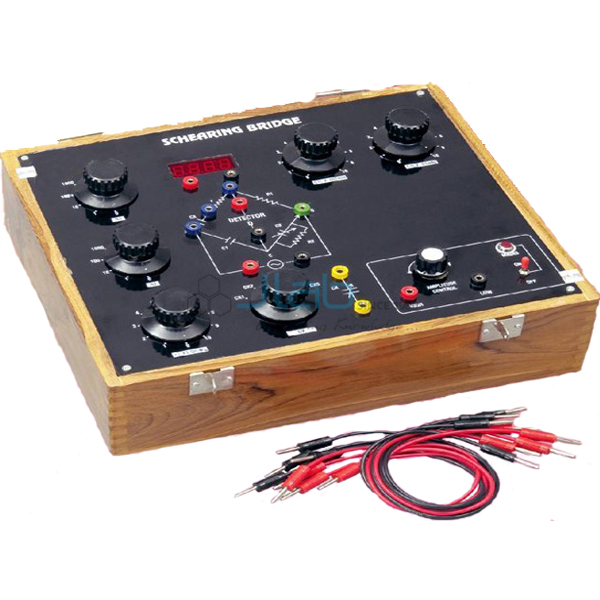
Product Code : EL-SI-8080
Jlab Export is a leading Schering Bridge Manufacturer,and suppliers in India
Schering Bridge (code EL-SI-8080) is an AC bridge used to measure unknown capacitance in college physics and electrical measurement labs. Everything is built into a teak wood case: a 1 kHz sine-wave source, a null detector with digital display, ratio, resistance and capacitance dials, and five unknown capacitors chosen with a rotary switch. It is made by Jain Laboratory Instruments Pvt Ltd (JLab) at its works in Ambala, India.
Specifications
| Parameter | Detail |
|---|---|
| Measures | Unknown capacitance (Schering bridge method) |
| Case | Teak wood, with all parts built in |
| AC source | Built-in sine-wave signal of 1 kHz; two sockets for the AC output |
| Source controls | Amplitude, switch and indicating lamp on the Bakelite board (listed as “The Amplitude of AC switch indicating lamp is provided on the bakelite board”) |
| Detector | Built-in null detector with digital display, for detecting small AC signals at the output |
| Connections | 4 mm sockets; circuit layout spread out on the board for convenient working and clear understanding |
| Unknown capacitors | Five unknown values on the board, selected by a rotary switch |
| R1, R2 | Ratio dial with steps of 1, 10, 100 and 1000 ohm |
| R | Decade dial, x1 ohm |
| C1 | Two decade dials, x0.001 mfd and x0.01 mfd (microfarad) |
| C2 | Internally fixed, 0.001 mfd (1 nF) |
| Quality check | Each bridge is visually inspected before dispatch |
| Pack quantity | Each (sold individually) |
| Minimum order quantity | 10 units |
| Dispatch time | Usually 7–10 working days |
| Product code | EL-SI-8080 |
| Manufacturer | Jain Laboratory Instruments Pvt Ltd (JLab) — OEM |
| Country of origin | India (made in Ambala, Haryana) |
How Does It Compare with Other JLab Capacitance Bridges?
| Model | Source and detector | Unknowns and controls |
|---|---|---|
| This Schering bridge (EL-SI-8080) | Built-in 1 kHz sine-wave source; null detector with digital display | Five unknowns on a rotary switch; R1 R2 ratio dial, R decade dial, two C1 decade dials, fixed C2; teak wood case |
| Wien Series Resistance Bridge | Built-in 1 kHz sine-wave source; null detector with digital display | Five unknown values; decade dials for R1 to R4 (Wien method) |
| Schering Bridge Trainer | 1 kHz sine-wave oscillator with 0–15 Vpp output; audio amplifier and speaker as null detector | Three unknown capacitors on a band switch; band switch for six resistance values; potentiometer for balancing |
Choose this model when students should balance a Schering bridge on decade dials and read the null on a digital display. The Wien series resistance bridge teaches the Wien method of capacitance measurement with the same kind of built-in source and detector, while the trainer is balanced with a potentiometer and its null is found by ear through a speaker.
What Is the Schering Bridge Used For?
The Schering bridge is the classic AC bridge for measuring the capacitance of a capacitor together with its loss, expressed as the dissipation factor or tan δ. A standard capacitor and a resistive arm sit in the arms facing the unknown, and a capacitor placed across one of the resistive arms balances the small in-phase (loss) part of the current. At balance the unknown capacitance equals the standard capacitance multiplied by a ratio of two resistive arms, and the setting of the balancing capacitor gives the loss. High-voltage versions of the bridge are used in industry to test the insulation of cables, bushings and transformers; in teaching labs it is a standard practical in B.Sc. physics and electrical measurement courses at colleges, universities and polytechnics.
To take a reading, select one of the five unknowns with the rotary switch, switch on the source and set its amplitude, then choose a ratio on the R1 R2 dial. Adjust the R and C1 dials in turn while watching the digital null detector until the reading falls to its minimum; go round the dials a few times, because the capacitance and loss balances affect each other. Record the settings, work out the capacitance from the balance equation in your practical manual, and repeat for the other unknowns. Keep the case dry and away from heat, and push leads straight into the 4 mm sockets rather than levering them out sideways.
What to Specify When Ordering
- Quantity — the minimum order is 10 bridges; state how many lab benches you are equipping.
- Power supply — the listing does not state the supply voltage, so tell us the mains voltage and plug type used in your laboratory.
- Unknown values and dial ranges — if your practical manual or tender names particular values, attach that sheet so JLab can confirm it against this model.
- Companion items — add capacitance boxes, an oscilloscope or another bridge from the list below to the same enquiry.
Frequently Asked Questions
What does this Schering bridge measure?
Unknown capacitance. Five unknown capacitors are built into the board and chosen with a rotary switch, and because the Schering method also balances the loss of a capacitor, students can discuss its dissipation factor alongside the capacitance value.
Does it need an external oscillator or detector?
No, according to the listing. A 1 kHz sine-wave source with two output sockets and a null detector with digital display are built into the teak wood case. An oscilloscope can be added if you also want to view the waveform.
What are the dial ranges?
The R1 R2 ratio dial has steps of 1, 10, 100 and 1000 ohm, R is a decade dial of x1 ohm, C1 has two decade dials of x0.001 and x0.01 mfd, and C2 is fixed internally at 0.001 mfd. The number of steps on each dial is not listed; ask JLab if you need it.
How does it differ from the Schering Bridge Trainer?
Both measure unknown capacitance by the Schering method. This model works with decade dials, five unknowns and a digital null detector in a teak wood case; the trainer has three unknowns on a band switch, a balancing potentiometer and an audio amplifier with speaker as its null detector.
What are the values of the five unknown capacitors?
The listing does not state them. Ask JLab for the values fitted to the bridge you are quoted for, especially if a practical manual or tender expects particular readings.
What does JLab need for an export quotation?
The quantity, destination country and port or city, your preferred delivery terms (for example FOB or CIF), any packing or labelling instructions, your mains voltage and the tender reference if you are buying against a tender.
Who manufactures the Schering bridge?
Jain Laboratory Instruments Pvt Ltd (JLab) makes it at its works in Ambala, Haryana, India, and quotes for it directly as the manufacturer.
OEM Manufacturer
JLab is the trading name of Jain Laboratory Instruments Pvt Ltd, a scientific instruments manufacturer in India, incorporated in 2017 and based on Hargolal Road, Ambala, Haryana. The Schering bridge is made in JLab’s own works instead of being bought in from a trader, so colleges, universities, dealers and importers deal directly with the maker, every bridge is visually inspected before it is packed, and repeat orders are handled by the manufacturer. The company holds MSME Udyam registration UDYAM-HR-01-0003849 as a manufacturing enterprise and Importer-Exporter Code 3317504552. JLab exports worldwide and ships to buyers in every region — Sri Lanka in South Asia, Lesotho in Southern Africa, Algeria in North Africa, Brazil in South America and Kazakhstan in Central Asia, to name a few. Tender buyers can refer to the JLab lab tenders page.
Related Bridges and Capacitance Accessories
- Wien Series Resistance Bridge — the Wien-method capacitance bridge, with five unknowns, a built-in source and a digital null detector.
- Schering Bridge Trainer — a trainer-style Schering bridge with a speaker null detector and three unknown capacitors.
- DE Sauty Bridge — for comparing the capacitance of two capacitors, with decade resistance and capacitance arms.
- Four Dial Condenser Box — a four-dial capacitance box for setting known capacitances.
- Fixed Condenser Boxes — fixed capacitors with two 4 mm socket terminals.
- Oscilloscope — to view the source waveform and the bridge output.
See more AC and DC bridges in the Scientific Instrument range and the Indian Instruments section.
Request a Quote
Quotes come straight from the manufacturer. Use the Add To Cart enquiry button on this page, or send the quantity (minimum 10 units), your mains voltage, any capacitance boxes or oscilloscope you want with it and the delivery city and country through the contact page.
Last updated: 8 October 2026


