Oscilloscope Manufacturer,Supplier and Exporter in India
Product Code : EL-SI-1027
Jlab Export is a leading Oscilloscope Manufacturer,and suppliers in India
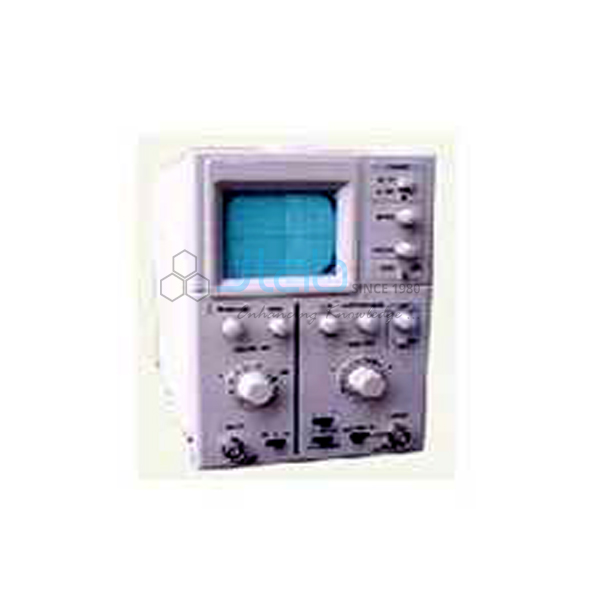
Oscilloscope (code EL-SI-1027) is a single-beam, fully solid-state oscilloscope with a DC to 10 MHz vertical bandwidth and an 8 x 8 cm square display, used to view and measure electrical waveforms in college physics and electronics laboratories. Stabilised internal supplies and an accurately triggered time base keep the trace clear and steady on screen. It is made by Jain Laboratory Instruments Pvt Ltd (JLab) at its works in Ambala, India.
Specifications
| Parameter | Detail |
|---|---|
| Type | Single beam; fully solid state |
| Vertical bandwidth | DC to 10 MHz (3 dB) |
| Vertical input coupling | AC or DC, selectable |
| Vertical attenuator | Calibrated input attenuator, up to 50 V/cm |
| Input impedance | 1 MΩ |
| Square-wave calibration signal | 2 V peak-to-peak |
| Triggering | Internal from the vertical amplifier, or external |
| Sweep time factor | 0.1 µs/div to 0.1 s/div, ±5% |
| Horizontal amplifier bandwidth | DC to 1 MHz |
| Display | 8 x 8 cm square screen |
| Internal supplies | All supplies stabilised |
| Power requirement | 25 W; 220/230 V, 50 Hz mains |
| Dimensions | 8 x 5½ x 11 inches |
| Quality check | Each oscilloscope is visually inspected before dispatch |
| Pack quantity | Each (sold individually) |
| Minimum order quantity | 10 units |
| Dispatch time | Usually 7–10 working days |
| Product code | EL-SI-1027 |
| Manufacturer | Jain Laboratory Instruments Pvt Ltd (JLab) — OEM |
| Country of origin | India (made in Ambala, Haryana) |
How Does It Compare with the JLab Dual Trace Oscilloscope?
| Model | Channels | Bandwidth | Display | Sweep range |
|---|---|---|---|---|
| This oscilloscope (EL-SI-1027) | Single beam | DC to 10 MHz (3 dB) | 8 x 8 cm square | 0.1 µs/div to 0.1 s/div |
| Dual Trace Oscilloscope | Dual channel | 20 MHz | 80 x 100 mm cathode ray tube | 0.2 s to 0.1 µs per division; x5 magnifier extends it to 20 ns per division |
Choose this single-beam model for practicals that look at one signal at a time, such as checking an oscillator output or a rectifier waveform. The dual trace model suits experiments that compare two signals on one screen, such as the input and output of an amplifier, and offers the higher listed bandwidth.
What Is the Oscilloscope Used For?
An oscilloscope plots voltage against time, so students can see the shape of a signal and read its amplitude from the calibrated vertical scale and its period, and hence frequency, from the time base. In B.Sc. physics and electronics practicals this oscilloscope is used to display the sine, square and triangular outputs of an audio oscillator, the ripple on a rectifier and filter circuit, the output of transistor and operational amplifier circuits, and the response of RC and LCR circuits. DC coupling shows the full signal including any steady level; AC coupling blocks the DC part, which makes a small ripple on a DC supply easier to see.
Before measuring, connect the 2 V peak-to-peak square-wave calibration signal to the input and check that the trace height matches the attenuator setting. Choose internal triggering for a signal taken from the vertical amplifier, or apply an external trigger when the display must lock to another source. Set the attenuator to its least sensitive range before connecting an unknown signal, then step down until the trace fills the screen. The 1 MΩ input impedance keeps loading on most teaching circuits low.
What to Specify When Ordering
- Quantity — the minimum order is 10 oscilloscopes; state how many benches the lab needs to equip.
- Single beam or dual trace — this model shows one signal; choose the dual trace oscilloscope if your experiments compare two signals.
- Signal sources and experiment boards — oscillators and circuit apparatus are separate catalogue items; list any you want quoted with the oscilloscopes.
- Mains supply — the instrument is listed for 220/230 V, 50 Hz; confirm that this matches your laboratory supply.
Frequently Asked Questions
What is the bandwidth of this oscilloscope?
The vertical amplifier is rated DC to 10 MHz at the 3 dB point, and the horizontal amplifier DC to 1 MHz.
What screen size does it have?
An 8 x 8 cm square display, with an accurately triggered time base for a clear, stable trace.
What time base range is available?
The sweep time factor runs from 0.1 µs per division to 0.1 s per division, with a listed accuracy of ±5%.
What are the input impedance and coupling options?
The input impedance is 1 MΩ, and the vertical input can be switched between AC and DC coupling.
Does it have a built-in calibration signal?
Yes. A 2 V peak-to-peak square wave is provided for checking the vertical calibration before measurements.
Can it show two signals at the same time?
No, it is a single-beam instrument. For side-by-side comparison of two signals, see the dual trace oscilloscope linked on this page.
Who manufactures this oscilloscope?
JLab — Jain Laboratory Instruments Pvt Ltd — builds it at its works in Ambala, Haryana, India, and supplies it factory-direct.
OEM Manufacturer
JLab is the trading name of Jain Laboratory Instruments Pvt Ltd, an electronic lab instruments and scientific equipment manufacturer in India, incorporated in 2017 with its base on Hargolal Road, Ambala, Haryana. The oscilloscope is built in JLab’s own works instead of being bought from a trader, which lets colleges, universities, dealers and importers order straight from the maker; every instrument is visually inspected before dispatch, and repeat orders and after-sales questions are handled by the manufacturer itself. JLab exports worldwide and ships to all regions — for instance Bangladesh in South Asia, Namibia in Southern Africa, Kazakhstan in Central Asia, Sweden in Northern Europe and Brunei in Southeast Asia. Tender buyers can refer to the JLab lab tenders page.
Instruments and Apparatus Used with the Oscilloscope
- A.F. Oscillator Bridge Experiments — a 1 Hz to 250 kHz oscillator with sine, square and triangular outputs to display on the screen.
- Bridge Oscillator — a Wien bridge oscillator giving a fixed 1 kHz sine wave.
- Dual Trace Oscilloscope — the dual-channel model compared above.
- LCR Resonance Apparatus Series and Parallel — for plotting frequency against current in series and parallel LCR circuits.
- UJT Characteristics Apparatus — for plotting the V-I characteristics of a UJT and measuring its interbase resistance.
See the full Scientific Instrument range or the Indian Instruments section.
Request a Quote
Quotes come direct from the manufacturer. Use the Add To Cart enquiry button on this page, or send the number of oscilloscopes (minimum 10 units), whether you also need the dual trace model or any signal sources, and your delivery location through the contact page.
Last updated: 8 October 2026