

Potentiometer Dial Pattern Manufacturer,Supplier and Exporter in India
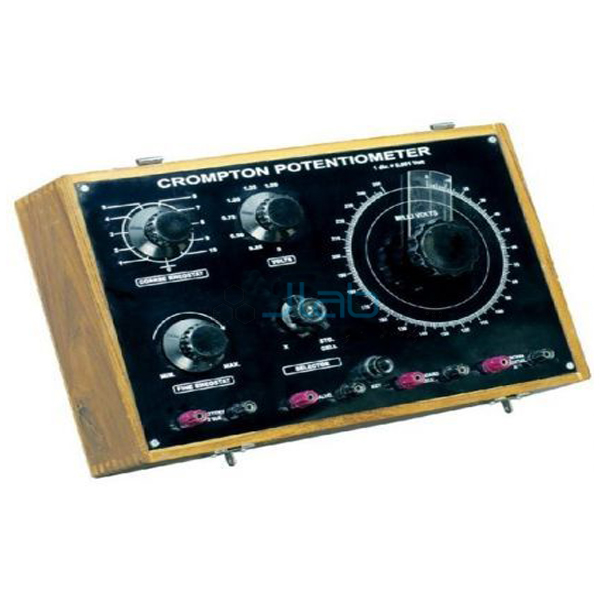
Product Code : EL-SI-8121
Jlab Export is a leading Potentiometer Dial Pattern Manufacturer,and suppliers in India
Potentiometer Dial Pattern (code EL-SI-8121) is a compact dial-type potentiometer for teaching students the method and techniques of emf measurement in school and college physics labs. It combines 10, 14 or 22 coils on a rotary dial with a linear 50 cm slide wire divided into 500 equal parts, read with a thick knife-edge jockey. It is made by Jain Laboratory Instruments Pvt Ltd (JLab) at its works in Ambala, India.
Specifications
| Parameter | Detail |
|---|---|
| Construction | Dial pattern: coils arranged on a rotary dial plus a linear slide wire |
| Dial coils | 10, 14 or 22 coils (state the version in your enquiry) |
| Slide wire | Linear, 50 cm long, subdivided into 500 equal parts (1 mm per division) |
| Jockey | Thick knife-edge jockey for making contact on the slide wire |
| Panel terminals | For the battery, the galvanometer and the test circuits |
| Quality check | Each potentiometer is visually inspected before dispatch |
| Pack quantity | Each (sold individually) |
| Minimum order quantity | 10 units |
| Dispatch time | Usually 7–10 working days |
| Product code | EL-SI-8121 |
| Manufacturer | Jain Laboratory Instruments Pvt Ltd (JLab) — OEM |
| Country of origin | India (made in Ambala, Haryana) |
How Does It Compare with Other JLab Potentiometers?
| Model | Measuring elements | Contact and controls | Panel terminals and other listed details |
|---|---|---|---|
| This dial-pattern potentiometer (EL-SI-8121) | 10, 14 or 22 dial coils plus a 50 cm slide wire in 500 parts | Thick knife-edge jockey on the slide wire | Battery, galvanometer and test-circuit terminals |
| Crompton Potentiometer | Voltage dials and slide wire; each slide-wire division equals 1/2 mV (500 microvolts) | Coarse and fine rheostats; current of the order of 125 mA | Terminals for a 2 V battery, galvanometer and standard cell; built-in self-standardisation circuit |
| Potentiometer with Pencil Jockey | Four constantan wires of 24 SWG, one metre long (ten-wire model also listed) | Pencil jockey with lead | Lock-type brass terminals on the wire blocks |
Choose the dial pattern when you want a compact teaching potentiometer that shows the coil-plus-slide-wire principle on one panel. The Crompton potentiometer is the direct-reading instrument with its own rheostats and standardisation circuit, and the multi-wire board suits the classic metre-wire practical.
What Is the Dial Pattern Potentiometer Used For?
A dial-pattern potentiometer splits a long measuring wire into two parts: coils switched in steps by the rotary dial give the coarse value, and the short slide wire supplies the fine fraction between two dial steps. The result behaves like a long potentiometer wire but fits on a compact panel. With a steady current from the battery, the student sets the dial to the step just below balance, then moves the knife-edge jockey along the slide wire until the galvanometer reads zero, and adds the two readings. Each of the 500 divisions is 1 mm of wire, so for a given wire the voltage per division is set by the current passed through it.
It is used for the standard emf practicals of class 12 and first-year college physics: comparing the emfs of two cells, finding the internal resistance of a cell, calibrating a voltmeter or ammeter, and measuring small emfs such as that of a thermocouple. Keep the slide wire clean, place the knife-edge jockey gently rather than dragging it, and open the battery key between readings so the current stays steady.
What to Specify When Ordering
- Dial version — 10, 14 or 22 coils.
- Quantity — the minimum order is 10 units.
- Circuit items — galvanometer, power supply or cell, rheostat, keys and a standard cell are separate items and can be quoted together.
Frequently Asked Questions
How many coils does the dial have?
The listing offers 10, 14 or 22 coils on the rotary dial, each version with the same 50 cm slide wire. State the version you need when you enquire.
How finely can the slide wire be read?
It is 50 cm long and divided into 500 equal parts, so each division is 1 mm of wire. The voltage that one division represents depends on the current you set.
What kind of jockey is used?
A thick knife-edge jockey that makes contact on the slide wire, giving a clear point of contact for reading the scale.
What else is needed to run an experiment?
A battery or regulated supply, a galvanometer, keys, a rheostat and a known emf or standard cell. Terminals for the battery, galvanometer and test circuits are on the panel; the items themselves are separate.
How is it different from the Crompton potentiometer?
The dial pattern is a compact teaching instrument with dial coils, a slide wire and a knife-edge jockey. The Crompton potentiometer is listed with coarse and fine rheostats, 1/2 mV per slide-wire division and a built-in self-standardisation circuit.
Who manufactures this potentiometer?
Jain Laboratory Instruments Pvt Ltd (JLab) builds it at its works in Ambala, Haryana, India, and quotes for it directly.
OEM Manufacturer
JLab is the trading name of Jain Laboratory Instruments Pvt Ltd, a manufacturer of physics lab instruments in India, incorporated in 2017 and based on Hargolal Road, Ambala, Haryana. The dial-pattern potentiometer is wired and assembled in JLab’s own works instead of being bought from a trader, so schools, colleges, dealers and importers deal with the maker directly; each unit is visually inspected before it is packed, and repeat orders are handled by the same team. JLab exports worldwide and ships to buyers in every region — for instance New Zealand in Oceania, Lesotho in Southern Africa, Uganda in East Africa, Tajikistan in Central Asia and Iceland in Northern Europe. Tender information is on the JLab lab tenders page.
Related Potentiometer Equipment
- Crompton Potentiometer — direct-reading model with coarse and fine rheostats and self-standardisation.
- Potentiometer with Pencil Jockey — the four-wire constantan board for metre-wire practicals.
- Stabilized Power Supply — a variable regulated supply designed for JLab potentiometer experiments.
- Standard Cell — a stable voltage reference for standardising potentiometers.
- Moving Coil Galvanometer — a centre-zero galvanometer on a stand for the null reading.
- Rheostats (Continuous Constantan Type) — for adjusting the current through the potentiometer.
More items are in the Scientific Instrument range and the Indian Instruments section.
Request a Quote
JLab quotes as the manufacturer. Use the Add To Cart enquiry button on this page, or send the dial version (10, 14 or 22 coils), the quantity (minimum 10 units), any supply, galvanometer or standard cell you need and the delivery location through the contact page.
Last updated: 8 October 2026


