A.F. Oscillator Bridge Experiments Manufacturer,Supplier and Exporter in India

Product Code : EL-SI-1026
Jlab Export is a leading A.F. Oscillator Bridge Experiments Manufacturer,and suppliers in India
A.F. Oscillator Bridge Experiments (code EL-SI-1026) is a solid-state audio-frequency (A.F.) oscillator that serves as the AC signal source for bridge experiments in college physics and electrical laboratories. It covers 1 Hz to 250 kHz in 6 steps, gives sine, square and triangular waveforms, and its output is set from 0 to 10 V with coarse and fine controls. It is made by Jain Laboratory Instruments Pvt Ltd (JLab) at its works in Ambala, India.
Specifications
| Parameter | Detail |
|---|---|
| Frequency range | 1 Hz to 250 kHz, in 6 steps |
| Waveforms | Sine, square and triangular |
| Output voltage | Variable from 0 to 10 V, with coarse and fine output controls |
| Accuracy | ±3% or 2 Hz (as listed) |
| Output impedance | 50 ohms |
| Construction | Solid state; complete IC version |
| Power supply | 220 V, 50 Hz mains |
| Quality check | Each oscillator is visually inspected before dispatch |
| Pack quantity | Each (sold individually) |
| Minimum order quantity | 10 units |
| Dispatch time | Usually 7–10 working days |
| Product code | EL-SI-1026 |
| Manufacturer | Jain Laboratory Instruments Pvt Ltd (JLab) — OEM |
| Country of origin | India (made in Ambala, Haryana) |
How Does It Compare with the JLab Bridge Oscillator?
| Model | Frequency | Waveform | Output |
|---|---|---|---|
| This oscillator (EL-SI-1026) | 1 Hz to 250 kHz in 6 steps | Sine, square and triangular | 0 to 10 V, coarse and fine controls |
| Bridge Oscillator | Fixed 1 kHz | Sine (Wien bridge oscillator using an operational amplifier) | 0–10 V RMS, continuously variable |
Choose this model when the experiment needs a frequency other than 1 kHz, a frequency sweep, or square and triangular waves as well as sine. The Bridge Oscillator suits labs that run four-arm bridges at a single fixed 1 kHz and only need a sine output.
What Is the A.F. Oscillator Used For?
An AC bridge balances an unknown capacitance or inductance against known arms, and it needs an alternating supply at a known frequency. This oscillator provides that supply for undergraduate physics and electrical engineering practicals such as Anderson’s bridge for self-inductance, De Sauty’s bridge for comparing capacitances, Hay and Maxwell bridges for inductance, and the Wien bridge, whose balance condition depends on frequency. A null detector or headphones across the detector arm show the balance point. Because the unit also gives square and triangular waves over a wide range, it doubles as a general signal generator for electronics lab work, for example when displaying waveforms on an oscilloscope or testing a filter at different frequencies.
Turn the output to zero before connecting the bridge, select the frequency step, and then raise the amplitude with the coarse control and trim it with the fine control. The 50 ohm output impedance should be taken into account when the oscillator drives a low-impedance load. The unit runs on 220 V, 50 Hz mains.
What to Specify When Ordering
- Quantity — the minimum order is 10 oscillators; many labs plan one for each bridge bench.
- Bridges and detector — the bridge boards and the null detector are separate catalogue items; add them to the same enquiry.
- Mains supply — the unit is listed for 220 V, 50 Hz; confirm that this matches the supply in your laboratory.
Frequently Asked Questions
What frequency range does this oscillator cover?
1 Hz to 250 kHz, selected in 6 steps. The listed accuracy is ±3% or 2 Hz.
Which waveforms are available?
Sine, square and triangular. Bridge measurements normally use the sine output; the other two are useful for waveform and circuit experiments.
How is the output level adjusted?
With coarse and fine controls, anywhere from 0 to 10 V. The output impedance is 50 ohms.
How does it differ from the JLab Bridge Oscillator?
The Bridge Oscillator gives a fixed 1 kHz sine wave, while this unit covers 1 Hz to 250 kHz with three waveforms. Pick the fixed-frequency unit only if every bridge you run works at 1 kHz.
Are the bridges and null detector included?
No. This listing covers the oscillator; the bridges and null detector are separate items, linked below.
Who manufactures this oscillator?
Jain Laboratory Instruments Pvt Ltd (JLab) makes it at its Ambala works in Haryana, India, and quotes for it directly.
OEM Manufacturer
JLab is the trading name of Jain Laboratory Instruments Pvt Ltd, a maker of physics and electronics laboratory instruments in India, incorporated in 2017 and based on Hargolal Road, Ambala, Haryana. This oscillator is produced in JLab’s own works rather than sourced from a trader, so colleges, universities, dealers and importers buy direct from the factory, each unit is visually inspected before dispatch, and repeat orders and service questions go straight to the manufacturer. JLab exports worldwide, with shipments possible to every region — Nepal in South Asia, Italy in Southern Europe, Chad in Central Africa, Laos in Southeast Asia and Morocco in North Africa, for example. For institutional purchasing, see the JLab lab tenders page.
Bridges and Detectors for Use with This Oscillator
- Null Detector — a solid-state amplifier with meter indication, designed for AC bridges in place of headphones.
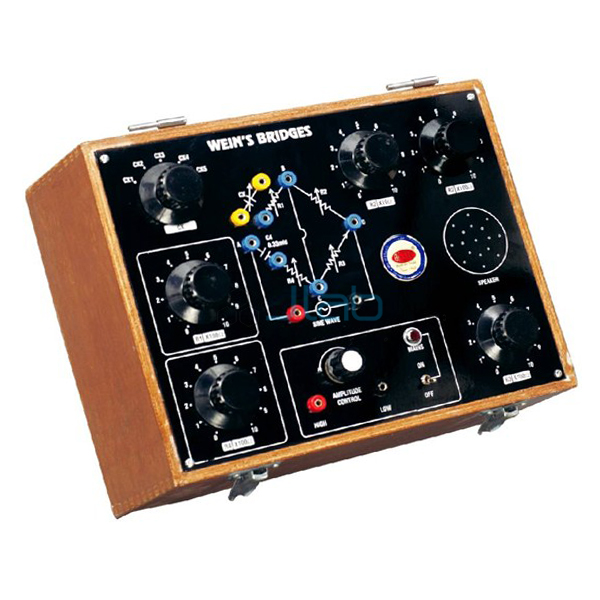
- Wien Series Resistance Bridge — a Wien bridge for measuring an unknown capacitance.
- Hay Bridge — for measuring an unknown inductance.
- Self Inductance Bridge — a bridge with a double key that can also be used as a Wheatstone bridge.
- Bridge Oscillator — the fixed 1 kHz sine source compared above.
Browse the Scientific Instrument range or the wider Indian Instruments section.
Request a Quote
Quotes come direct from the manufacturer. Use the Add To Cart enquiry button on this page, or send the number of oscillators (minimum 10 units), any bridges or detectors you want quoted with them, and your delivery location through the contact page.
Last updated: 8 October 2026