Groove Type Rheostat Tube Manufacturer,Supplier and Exporter in India
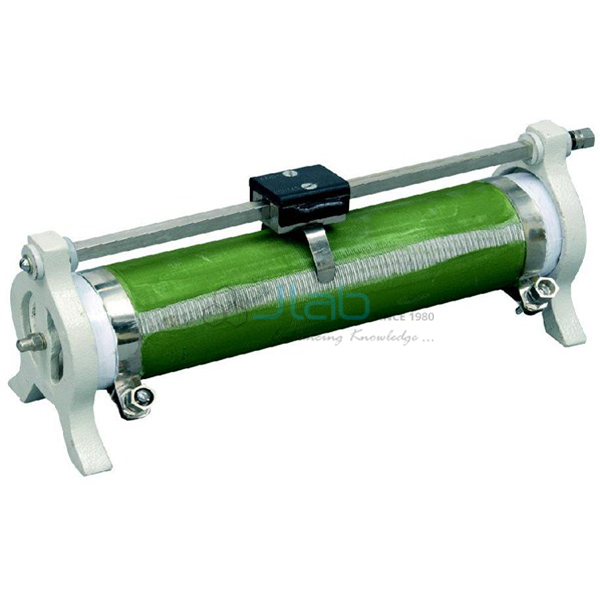
Product Code : EL-SI-8143
Jlab Export is a leading Groove Type Rheostat Tube Manufacturer,and suppliers in India
Groove Type Rheostat Tube (code EL-SI-8143) is a sliding rheostat for smooth current control in physics and electrical lab circuits. Bare Eureka resistance wire is wound on a thick-wall porcelain or cement pipe whose deeply grooved surface forms air ducts for convection cooling, and a brass slider with two copper brushes runs the full length of the winding. It is made by Jain Laboratory Instruments Pvt Ltd (JLab) at its works in Ambala, India.
Specifications
| Parameter | Detail |
|---|---|
| Former | Thick-wall porcelain or cement pipe with a deeply grooved outer surface |
| Cooling | Grooves provide air ducts for convection cooling |
| Resistance wire | Bare Eureka wire (listed as imported), with high stability and strength |
| Slider | Special brass slider that moves the full length of the rheostat quickly and easily |
| Contact | Two copper brushes with a large contact area, for smooth current control and very little wear |
| Quality check | Each rheostat is visually inspected before dispatch |
| Pack quantity | Each (sold individually) |
| Minimum order quantity | 10 units |
| Dispatch time | Usually 7–10 working days |
| Product code | EL-SI-8143 |
| Manufacturer | Jain Laboratory Instruments Pvt Ltd (JLab) — OEM |
| Country of origin | India (made in Ambala, Haryana) |
How Does It Compare with Other JLab Rheostats?
| Model | Resistance wire | Former | Contact |
|---|---|---|---|
| This rheostat (EL-SI-8143) | Bare Eureka wire | Thick-wall porcelain or cement pipe, deeply grooved for convection cooling | Brass slider over the full length; two copper brushes |
| Higher Range Rheostat | Kanthal wire in place of Eureka | Same thick-wall grooved porcelain or cement pipe | Slider over the full length; two copper brushes |
| Rheostat Single Tube | Heavily oxidised resistance wire set in ceramic cement | Vitreous enamelled steel tube on die-cast end stands | Socket terminals for rheostat or potentiometer connection |
The groove-type tube and the Higher Range Rheostat share the same grooved former and brush contact; the difference listed is the wire. Eureka, a copper–nickel alloy of the constantan type, changes resistance very little as it warms, while Kanthal, an iron–chromium–aluminium alloy, has a considerably higher resistivity for higher-resistance windings.
What Is the Groove Type Rheostat Used For?
Like other sliding rheostats, it is used as a variable resistance to set and adjust current — in Ohm’s law and meter-bridge practicals, potentiometer driver circuits, battery charging and lamp or motor experiments in electrical labs — or, with both ends across the supply, as a voltage divider. Because the wire is bare, the brushes touch it directly along the whole length, and the large contact area of the two copper brushes gives smooth adjustment with very little wear. The deep grooves increase the surface exposed to air, so heat from the winding is carried away by convection when the rheostat is passing a steady current.
Select a resistance and current rating that suits the circuit, keep the current within the rating, leave air space around the tube, and let it cool before handling after long use. Keep the slider rod and brushes clean so the contact stays smooth.
What to Specify When Ordering
- Resistance and current — the ohms and amps your circuit needs, as the listing does not fix them.
- Wire — this Eureka-wound model, or the Kanthal-wound Higher Range Rheostat for higher resistance.
- Quantity — the minimum order is 10 units.
Frequently Asked Questions
What is the rheostat wound on, and why is the tube grooved?
Bare Eureka wire is wound on a thick-wall porcelain or cement pipe. Its deeply grooved outer surface forms air ducts that cool the winding by convection.
How does the slider make contact?
A special brass slider carries two copper brushes with a large contact area. It moves the full length of the rheostat and gives smooth current control with very little wear.
How does it differ from the Higher Range Rheostat?
The two listings describe the same grooved former, full-length slider and copper brushes. This model uses bare Eureka wire; the Higher Range Rheostat uses Kanthal wire instead.
What resistance and current ratings are available?
They are not stated in the listing. Send the values your circuit needs and JLab will confirm a suitable winding.
Who manufactures it?
JLab (Jain Laboratory Instruments Pvt Ltd) makes the groove-type rheostat at its works in Ambala, Haryana, India.
OEM Manufacturer
JLab is the trading name of Jain Laboratory Instruments Pvt Ltd, a physics and electrical lab equipment manufacturer in India, incorporated in 2017 and based on Hargolal Road, Ambala, Haryana. The groove-type rheostat is wound and fitted in JLab’s own works rather than bought in, so schools, colleges, dealers and importers order from the manufacturer; each rheostat is visually inspected before dispatch, and repeat orders are handled directly. JLab exports worldwide and ships to buyers in every region — Gabon in Central Africa, Myanmar in Southeast Asia, Burkina Faso in West Africa, Bhutan in South Asia and Turkmenistan in Central Asia are examples. Tender information is on the JLab lab tenders page.
Other JLab Rheostats
- Higher Range Rheostat — the Kanthal-wound version on the same grooved former.
- Rheostat Single Tube — oxidised wire on a vitreous enamelled steel tube with die-cast end stands.
- Rheostats (Continuous Constantan Type) — continuous sliding-contact rheostats with constantan wire.
- Rheostat — a single-tube sliding rheostat rated 11 ohm and 3 A.
- Rheostat Bank Single Phase — a ventilated bank of porcelain-tube rheostats.
More instruments are in the Scientific Instrument range and the Indian Instruments section.
Request a Quote
JLab quotes as the manufacturer. Use the Add To Cart enquiry button on this page, or send the resistance and current you need, the quantity (minimum 10 units) and the delivery location through the contact page.
Last updated: 8 October 2026