Potentiometer Wire Manufacturer,Supplier and Exporter in India
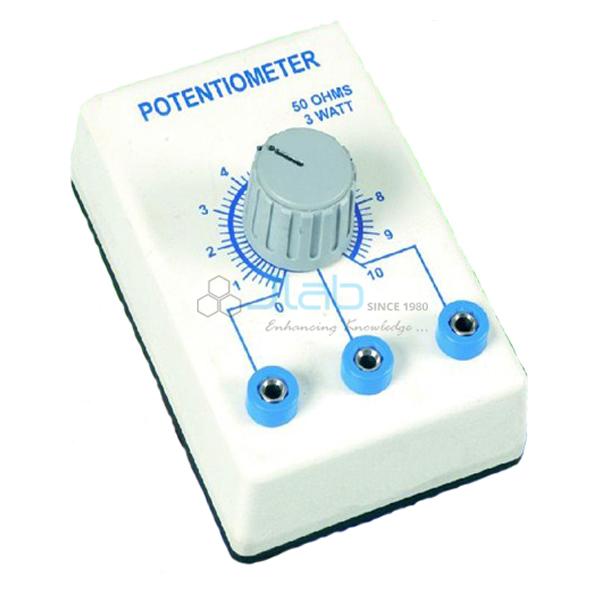
Product Code : EL-SI-8146
Jlab Export is a leading Potentiometer Wire Manufacturer,and suppliers in India
Potentiometer Wire (code EL-SI-8146) is a 3 W wire-wound rotary potentiometer in a moulded plastic case, used as a variable resistor or potential divider in school and college electricity and electronics practicals. A knob on top varies the resistance, three 4 mm sockets give the potential-dividing connections, and a calibration is printed on the cover plate beside the knob. It is made by Jain Laboratory Instruments Pvt Ltd (JLab) at its works in Ambala, India.
Specifications
| Parameter | Detail |
|---|---|
| Element | Wire-wound potentiometer, 3 W |
| Housing | Moulded plastic casing |
| Control | Knob on top for varying the resistance |
| Connections | Three 4 mm sockets on top for a potential-dividing arrangement |
| Scale | Calibration clearly printed on the cover plate beside the knob |
| Quality check | Each unit is visually inspected before dispatch |
| Pack quantity | Each (sold individually) |
| Minimum order quantity | 10 units |
| Dispatch time | Usually 7–10 working days |
| Product code | EL-SI-8146 |
| Manufacturer | Jain Laboratory Instruments Pvt Ltd (JLab) — OEM |
| Country of origin | India (made in Ambala, Haryana) |
What Is This Potentiometer Used For?
The three sockets connect to the two ends of the wire-wound track and to the wiper moved by the knob. With both ends across a supply, the wiper socket gives a voltage that can be turned smoothly from zero to the full supply — a simple way to vary the voltage across a lamp, LED, diode or sensor in a practical. Using one end socket and the wiper instead gives a variable resistor for setting a small current. The printed calibration lets students return to a setting and record it. Keep the power within the 3 W rating: this is a low-power control, so use a tube rheostat for heavier currents. Note that this is a rotary component, not the metre-long slide-wire potentiometer used for emf practicals.
Frequently Asked Questions
Is this a slide-wire potentiometer for emf experiments?
No. It is a 3 W wire-wound rotary potentiometer in a moulded case. For emf comparison and internal-resistance practicals, use a slide-wire potentiometer such as the single-wire model linked below.
What are the three sockets for?
They are 4 mm sockets for a potential-dividing arrangement: the two ends of the track and the wiper. Two of them can also be used for a simple variable resistor.
What resistance value is it?
The listing does not state the resistance. Tell JLab the value your circuit needs when you enquire.
Who manufactures it?
JLab (Jain Laboratory Instruments Pvt Ltd) assembles it at its works in Ambala, Haryana, India.
OEM Manufacturer
JLab is the trading name of Jain Laboratory Instruments Pvt Ltd, a physics lab instruments manufacturer in India, incorporated in 2017 and based on Hargolal Road, Ambala, Haryana. This potentiometer unit is assembled in JLab’s own works, so schools, colleges, dealers and importers order from the maker, and each piece is visually inspected before dispatch. JLab exports worldwide and ships to buyers in every region — Barbados in Central America and the Caribbean, Brazil in South America, South Korea in East Asia, Congo in Central Africa and Turkey in the Middle East, for instance. Tender details are on the JLab lab tenders page.
Related Circuit Items
- Rheostat Single Tube — a tube rheostat for heavier currents, also wired as a potential divider.
- Rheostats (Nichrome Type) — sliding rheostats used as variable resistors or potentiometers.
- Decade Resistance Box — switched resistance steps on a Bakelite panel in a wooden case.
- Stabilized Power Supply — a variable regulated supply to feed the divider.
- Potentiometer Single wire — the slide-wire potentiometer for emf practicals.
See the Scientific Instrument range and the Indian Instruments section.
Request a Quote
JLab quotes as the manufacturer. Use the Add To Cart enquiry button, or send the resistance value you need, the quantity (minimum 10 units) and your delivery location through the contact page.
Last updated: 8 October 2026