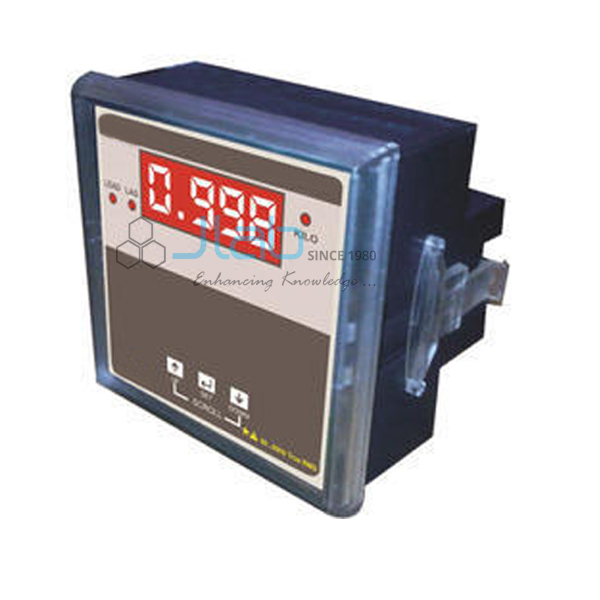
Lamp Load Single Phase Manufacturer,Supplier and Exporter in India

Product Code : EL-SI-8155
Jlab Export is a leading Lamp Load Single Phase Manufacturer,and suppliers in India
Lamp Load Single Phase (code EL-SI-8155) is a trolley-type lamp load used to put a known, stepped load on single-phase transformers, alternators and power supplies in electrical machines and power labs. It is listed with a loading capacity of 4 kW or 6 kW, added in steps of 200 W, and is supplied without lamps. It is made by Jain Laboratory Instruments Pvt Ltd (JLab) at its works in Ambala, India.
Specifications
| Parameter | Detail |
|---|---|
| Type | Lamp load, single phase, trolley type |
| Loading capacity | 4 kW or 6 kW (two versions) |
| Load steps | 200 W each |
| Lamps | Not included — supplied without lamps |
| Quality check | Each lamp load is visually inspected before dispatch |
| Pack quantity | Each (sold individually) |
| Minimum order quantity | 10 units |
| Dispatch time | Usually 7–10 working days |
| Product code | EL-SI-8155 |
| Manufacturer | Jain Laboratory Instruments Pvt Ltd (JLab) — OEM |
| Country of origin | India (made in Ambala, Haryana) |
What Is the Lamp Load Used For?
A lamp load is a simple resistive load: lamps are switched in one step at a time, so the current drawn rises in known increments and the lit lamps show how much load is connected. Electrical machines labs at engineering colleges, polytechnics and ITIs use it for load tests on single-phase transformers and alternators (voltage regulation, efficiency) and for loading inverters and power supplies. Filament lamps work at close to unity power factor, which also makes it a handy load for checking wattmeters and energy meters.
The trolley wheels to any bench. Fit lamps that suit your supply voltage, switch off before changing a lamp, keep the trolley clear of paper and curtains as the lamps run hot, and add steps one at a time, since a cold filament draws a brief surge of current.
What to Specify When Ordering
- Loading capacity — the 4 kW or the 6 kW version.
- Supply voltage — not given in the listing; state the single-phase supply at your benches.
- Lamps — not included; ask if you want them quoted separately.
Frequently Asked Questions
What loading capacities are available?
Two: 4 kW and 6 kW. Both are trolley-type units on which the load is added in steps of 200 W.
Are the lamps included?
No. It is supplied without lamps, so they are bought separately; mention them in your enquiry if you want them quoted.
Why use a lamp load rather than a rheostat bank?
Both are resistive loads. The lamp load switches in fixed steps and shows the load visibly, which helps students follow a test; a rheostat bank uses wire-wound resistors and gives no light.
Who manufactures this lamp load?
JLab builds it at its works in Ambala, Haryana, India.
OEM Manufacturer
JLab is the trading name of Jain Laboratory Instruments Pvt Ltd, an Indian maker of electrical and scientific instruments, incorporated in 2017 and based on Hargolal Road, Ambala, Haryana. The lamp load is built in its own works, not bought from a trader, so colleges, institutes, dealers and importers buy from the maker. JLab exports worldwide and ships to buyers in every region — Japan in East Asia, the Dominican Republic in Central America and the Caribbean, Tunisia in North Africa, Slovakia in Eastern Europe and South Africa in Southern Africa, for example. Tender buyers can find details on the JLab lab tenders page.
Related Electrical Lab Equipment
- Rheostat Bank Single Phase — a resistive load bank with rheostats wound on porcelain tubes.
- Variac Single & Three Phase — a variable autotransformer for adjusting the test voltage.
- Power Factor Meter — an electro-dynamic panel meter for reading the power factor of AC circuits.
See the Scientific Instrument range or the wider Indian Instruments section.
Request a Quote
Quotes come direct from JLab. Use the Add To Cart button, or send the capacity (4 kW or 6 kW), supply voltage, quantity (minimum 10 units), destination and any tender reference through the contact page.
Last updated: 8 October 2026