

Daniell Cell Manufacturer,Supplier and Exporter in India
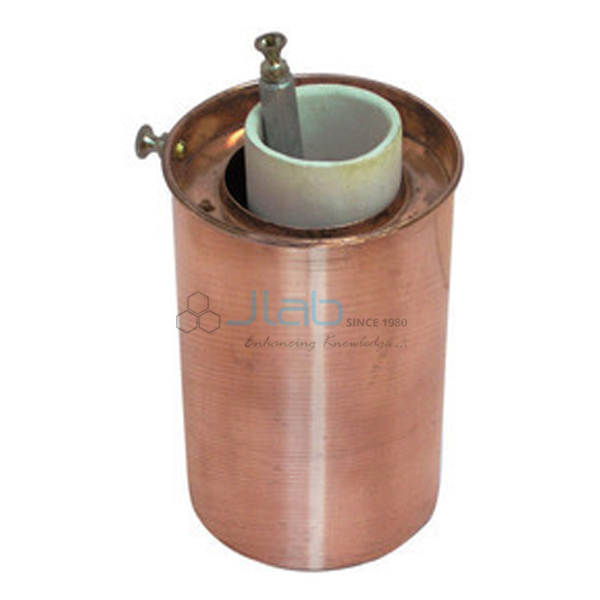
Product Code : EL-SLE-4746
Jlab Export is a leading Daniell Cell Manufacturer,and suppliers in India
Daniell Cell (code EL-SLE-4746) is a complete Daniell cell — a zinc rod in a porous pot set inside a copper container — used to demonstrate how a chemical reaction produces an electric current in school and college chemistry and physics labs. The porous pot is supplied empty, ready for your own solutions. It is made by Jain Laboratory Instruments Pvt Ltd (JLab) at its works in Ambala, India.
Specifications
| Parameter | Detail |
|---|---|
| Type | Daniell cell (sometimes spelt “Daniel cell”), complete |
| Negative electrode | Zinc rod |
| Inner vessel | Porous pot, supplied empty |
| Outer vessel | Copper container |
| Solutions | Not part of this listing |
| Quality check | Each cell is visually inspected before dispatch |
| Pack quantity | Each (sold individually) |
| Minimum order quantity | 10 units |
| Dispatch time | Usually 7–10 working days |
| Product code | EL-SLE-4746 |
| Manufacturer | Jain Laboratory Instruments Pvt Ltd (JLab) — OEM |
| Country of origin | India (made in Ambala, Haryana) |
How Does It Compare with Other JLab Daniell Cells?
| Item | Listed parts and details |
|---|---|
| This Daniell cell (EL-SLE-4746) | Zinc rod, empty porous pot, copper container |
| Daniel Cell (copper vessel) | Heavy-gauge copper outer vessel with an internal perforated shelf for copper sulphate crystals; porous pot; amalgamated zinc rod with supporting cap; 4 mm socket terminals on the zinc rod and copper vessel |
| Daniel Cell Kit | Copper vessel with perforated shelf and terminal, porous pot, zinc rod with support and terminal |
Choose this listing for a straightforward zinc–porous pot–copper cell for teaching. The copper-vessel model and the kit list a perforated shelf for copper sulphate crystals and terminals, which suit labs that run the cell for longer or connect it with 4 mm leads.
What Is the Daniell Cell Used For?
The Daniell cell is the classic example of a galvanic (voltaic) cell. The copper container holds copper sulphate solution and acts as the positive electrode, where copper ions gain electrons and deposit as copper; the porous pot holds dilute sulphuric acid or zinc sulphate solution around the zinc rod, the negative electrode, where zinc atoms lose electrons and dissolve as zinc ions. The porous wall keeps the two solutions from mixing quickly while letting ions pass, doing the job of a salt bridge. With standard solutions its emf is about 1.1 V; a classroom cell gives a value that depends on the concentrations used.
It is the cell students meet in the class 12 chemistry chapter on electrochemistry, and it is used in physics practicals on cells and emf in schools and colleges, as part of a set of chemistry lab equipment for electrochemistry. After use, pour out the solutions, rinse the copper container, porous pot and zinc rod with water, and let the porous pot dry before storage. Copper sulphate is harmful if swallowed and irritates the eyes, so wear eye protection and gloves when filling the cell.
What to Specify When Ordering
- Model — this complete cell, the copper-vessel version with crystal shelf, or the kit.
- Spares — extra porous pots, which are also listed separately.
- Quantity — the minimum order is 10 cells.
- Measuring equipment — voltmeters and leads to read the cell’s voltage can go on the same enquiry.
Frequently Asked Questions
What parts does this Daniell cell include?
A zinc rod, a porous pot and a copper container. The porous pot is supplied empty; the solutions are not part of this listing.
What voltage does a Daniell cell give?
With standard solutions the emf is about 1.1 V. The voltage you measure in class depends on the concentrations of the solutions and the condition of the electrodes.
Which solutions are used in it?
Copper sulphate solution in the copper container and dilute sulphuric acid or zinc sulphate solution in the porous pot, around the zinc rod. Prepare them according to your practical instructions.
Is it spelt Daniel or Daniell?
Daniell — the cell is named after the chemist John Frederic Daniell. “Daniel cell” is a common misspelling, and both names refer to the same cell.
Are replacement porous pots available?
Yes, a porous pot for the Daniell cell is listed separately and linked below.
What does an export quotation need?
The quantity, destination country and port or city, delivery terms (for example FOB or CIF), any packing or labelling instructions, and a tender reference if the purchase is against a tender.
Who manufactures this Daniell cell?
Jain Laboratory Instruments Pvt Ltd, trading as JLab, at its works in Ambala, Haryana, India.
OEM Manufacturer
JLab is the trading name of Jain Laboratory Instruments Pvt Ltd, an Indian manufacturer of chemistry and physics teaching apparatus, incorporated in 2017 and based on Hargolal Road, Ambala, Haryana. The Daniell cell is made in JLab’s own works and not bought in from a trader, so schools, colleges, dealers and importers order it straight from the manufacturer; each cell is visually inspected before dispatch, and repeat orders are handled by the same works. JLab exports worldwide and ships to buyers in every region — for example Benin in West Africa, Moldova in Eastern Europe, Jamaica in Central America and the Caribbean, Angola in Central Africa and the Philippines in Southeast Asia. Tender details are on the JLab lab tenders page.
Related Cells and Accessories
- Daniel Cell Porous Pot — a spare porous pot for the Daniell cell.
- Leclanche Cell — another classic primary cell, with a zinc rod and a charged porous pot.
- Simple Cell Pots — moulded polypropylene pots for building simple cells.
- Voltmeters Dual Range — stand-mounted voltmeters for measuring the cell’s potential difference.
More school apparatus is in the School Lab Equipment range.
Request a Quote
Quotes come direct from the manufacturer. Use the Add To Cart enquiry button on this page, or send the quantity (minimum 10 units), any spare porous pots or voltmeters you need, and your delivery location through the contact page.
Last updated: 4 October 2026


