Tapping Key Manufacturer,Supplier and Exporter in India
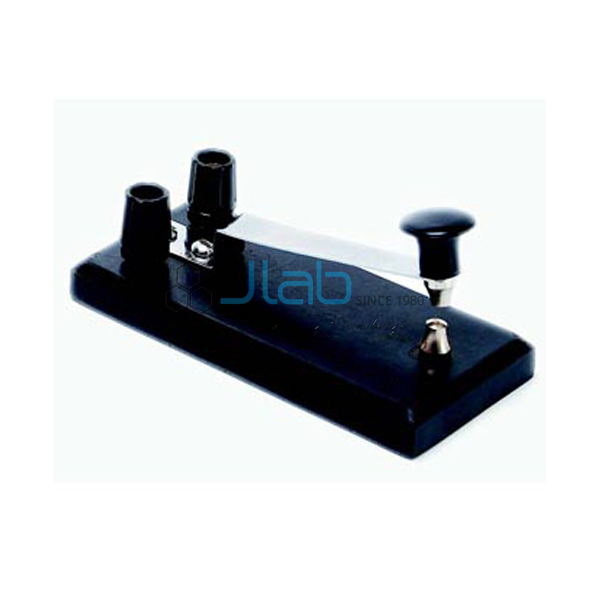
Product Code : EL-SLE-4832
Jlab Export is a leading Tapping Key Manufacturer,and suppliers in India
Tapping Key (code EL-SLE-4832) is a momentary-contact switch used in physics experiments to make or break an electric circuit only for as long as it is pressed. A light, flexible nickel-plated brass strip carries the contacts; pressing the insulated knob makes or breaks the circuit, and releasing it automatically does the opposite. It is mounted with its terminals on a highly insulating Bakelite plate, and is made by Jain Laboratory Instruments Pvt Ltd (JLab) at its works in Ambala, India.
Specifications
| Parameter | Detail |
|---|---|
| Type | Tapping key (momentary contact) |
| Action | Pressing makes or breaks the circuit; on release the opposite happens automatically |
| Contact strip | Light, flexible brass strip, nickel plated, with contacts |
| Knob | Insulated |
| Terminals | Provided |
| Base | Bakelite plate of high insulation |
| Quality check | Each key is visually inspected before dispatch |
| Pack quantity | Each (sold individually) |
| Minimum order quantity | 10 units |
| Dispatch time | Usually 7–10 working days |
| Product code | EL-SLE-4832 |
| Manufacturer | Jain Laboratory Instruments Pvt Ltd (JLab) — OEM |
| Country of origin | India (made in Ambala, Haryana) |
How Does It Compare with Other JLab Circuit Keys?
| Key | How it switches | Construction (as listed) |
|---|---|---|
| This tapping key (EL-SLE-4832) | Momentary: makes or breaks while pressed, returns on release | Nickel-plated brass strip, insulated knob, terminals, Bakelite plate |
| Contact Key Tapping Key Telegraph Key | Tapping key; listed for Morse code experiments and as a simple on/off switch | Bakelite base, all metal parts nickel-plated brass |
| Plug Key | Stays closed while the brass plug is in place | Brass blocks and terminals on a Bakelite base; one-way to four-way; 9 mm or 10.5 mm thick |
| Reversing Key | Commutator that reverses the current direction | Four gun-metal segments on a Bakelite base, multi-brush sweeping contacts moved by a handle, brass terminals |
Choose the tapping key when current should flow only for the moment a reading is taken; a plug key suits circuits that stay on for a whole run, and a reversing key is the choice when the current direction must be switched.
What Is the Tapping Key Used For?
Because the circuit is closed only while the knob is held down, a tapping key lets students pass current just long enough to take a reading. In metre bridge and potentiometer practicals in class 12 physics this protects the galvanometer from a steady deflection and keeps the resistance wire from warming up and changing its value. It is also used to charge and discharge capacitors, to switch an electromagnet or electric bell for a moment, and to send dots and dashes in Morse-code demonstrations. Wired through its make contact it works as a press-to-make switch, and through its break contact as press-to-break, which suits the circuits with keys met in class 10 science.
Press the knob firmly but briefly, keep the contacts clean and dry, and check that the terminal screws are tight before each practical. The key is intended for low-voltage laboratory circuits and should not be connected to mains supply.
What to Specify When Ordering
- Key type — this tapping key, a plug key (one-way to four-way) or a reversing key, depending on the practical.
- Quantity — the minimum order is 10 keys; one per circuit board or student pair is a practical plan.
- Circuit accessories — galvanometers, metre bridges and connecting leads can go in the same enquiry.
Frequently Asked Questions
What is a tapping key used for?
It closes or opens a circuit only while it is pressed. Students use it in galvanometer, bridge and potentiometer circuits, in capacitor experiments and for Morse-code signalling.
How does this tapping key work?
A light, flexible nickel-plated brass strip carries contacts. Pressing the insulated knob makes or breaks the circuit, and when it is released the strip springs back and the opposite effect is produced automatically.
How is it different from a plug key?
A plug key stays closed as long as its plug is inserted, so current flows continuously. A tapping key passes current only while held down, which is useful when the current should flow just for the moment of a reading.
Is it the same as the Contact Key Tapping Key Telegraph Key?
Both are tapping keys with nickel-plated brass parts on a Bakelite base, and that listing is described for Morse code experiments and as an on/off switch. The listings give no further differences, so ask JLab if your choice depends on another detail.
Why is the key mounted on Bakelite?
Bakelite is a good electrical insulator, so the plate keeps the terminals and contacts isolated from each other and from the bench.
What should an export enquiry include?
The quantity, destination country and port or city, delivery terms such as FOB or CIF, packing or labelling requirements, and any tender reference.
Who manufactures the tapping key?
Jain Laboratory Instruments Pvt Ltd (JLab) makes it at its works in Ambala, Haryana, India, and quotes for it directly.
OEM Manufacturer
JLab is the trading name of Jain Laboratory Instruments Pvt Ltd, an Indian manufacturer of physics and electricity apparatus for teaching laboratories, incorporated in 2017 and based on Hargolal Road, Ambala, Haryana. Tapping keys are assembled in JLab’s own works rather than bought in from a trader, so schools, colleges, dealers and importers buy from the manufacturer, each key is inspected visually before dispatch, and repeat orders are handled by the same team. JLab is registered under GSTIN 06AADCJ9848D1ZE and holds Legal Entity Identifier 549300DTGS77DGYD6N03. JLab exports worldwide and ships to buyers in every region — for example Lesotho in Southern Africa, Uzbekistan in Central Asia, the Czech Republic in Eastern Europe, Canada in North America and Chile in South America. Tender details are on the JLab lab tenders page.
Keys and Instruments for Electricity Practicals
- Plug Key — one-way to four-way plug keys on Bakelite bases.
- Reversing Key — a commutator for reversing the current.
- Galvanometer — the null detector often switched with a tapping key.
- Meter Bridge and Pencil Jockey — a metre bridge for resistance practicals.
Browse more in the School Lab Equipment range.
Request a Quote
Quotes come from JLab as the manufacturer. Use Add To Cart on this page, or send the quantity (minimum 10 units), any other keys or meters you need and your delivery location through the contact page.
Last updated: 4 October 2026