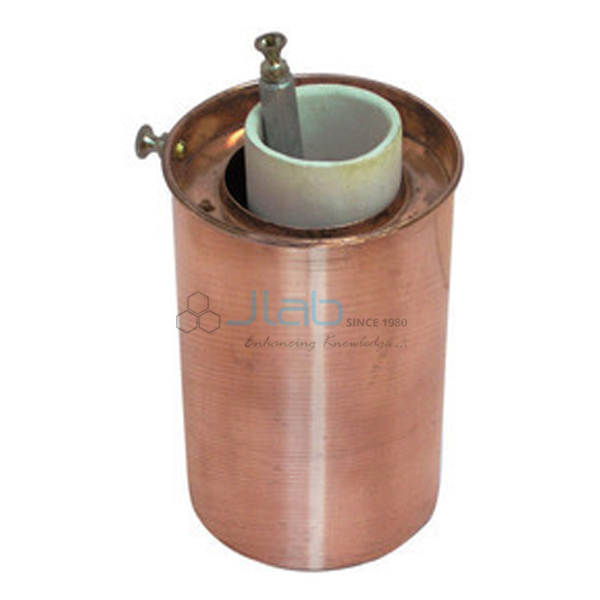
Concave Mirror (Vacuum Type) Manufacturer,Supplier and Exporter in India

Product Code : EL-SLE-4761
Jlab Export is a leading Concave Mirror (Vacuum Type) Manufacturer,and suppliers in India
Concave Mirror (Vacuum Type) (code EL-SLE-4761) is a 50 mm diameter concave mirror with optically true surfaces, used for experiments on collecting, imaging and focusing light in school and college physics labs. Its back carries a silver coating sealed with a layer of epoxy paint, it is listed for superior longer life, and it comes in focal lengths F/L 5, 10, 15, 20, 25 and 30. It is made by Jain Laboratory Instruments Pvt Ltd (JLab) at its works in Ambala, India.
Specifications
| Parameter | Detail |
|---|---|
| Mirror type | Concave (converging) spherical mirror, vacuum type |
| Diameter | 50 mm |
| Focal lengths | F/L 5, F/L 10, F/L 15, F/L 20, F/L 25 and F/L 30 — unit not stated in the listing; confirm when ordering |
| Surface | Processed, optically true surfaces |
| Back finish | Silver coating protected by an epoxy paint layer |
| Life | Listed for superior longer life |
| Applications | Collection of light, imaging and focusing |
| Quality check | Each mirror is visually inspected before dispatch |
| Pack quantity | Each (sold individually) |
| Minimum order quantity | 10 units |
| Dispatch time | Usually 7–10 working days |
| Product code | EL-SLE-4761 |
| Manufacturer | Jain Laboratory Instruments Pvt Ltd (JLab) — OEM |
| Country of origin | India (made in Ambala, Haryana) |
How Does It Compare with the Standard JLab Concave Mirror?
| Model | Diameter | Focal lengths | Back finish | Life |
|---|---|---|---|---|
| This vacuum-type mirror (EL-SLE-4761) | 50 mm | F/L 5 to F/L 30 | Silver coating with epoxy paint layer | Listed for superior longer life |
| Concave Mirror | 50 mm | F/L 5 to F/L 30 | Silver coating with epoxy paint layer | Not stated |
The two listings share size, focal lengths and back finish; the vacuum type is the one described for longer life, which suits class sets that see daily use over several years. Ask JLab if you need any other difference confirmed for a tender.
What Is a Concave Mirror Used For?
A concave mirror curves inwards and reflects parallel light to a real focus in front of it. Placed beyond the focus, an object gives a real, inverted image that can be caught on a screen; placed inside the focus, it gives an enlarged, upright virtual image — the idea behind shaving and dental mirrors, while torch reflectors and solar cookers use the mirror to collect and direct light. In the class 10 practical, students find the focal length by focusing the image of a distant object on a screen; in class 12 they repeat it by the u–v method on an optical bench and study how image size and position change with object distance. College optics labs use the same mirrors for curvature and aberration work.
Keep the mirror in its holder or a padded box when not in use, clean the reflecting face with lens tissue only, and never focus sunlight on anything flammable during demonstrations.
What to Specify When Ordering
- Focal length — F/L 5, 10, 15, 20, 25 or 30 and the unit; list how many of each.
- Quantity — the minimum order is 10 units.
- Version — vacuum type (this listing) or the standard concave mirror.
- Mounting — a mirror holder and optical bench if your lab does not already have them.
Frequently Asked Questions
What size is the mirror and which focal lengths are offered?
The mirror is 50 mm in diameter and is listed in focal lengths F/L 5, 10, 15, 20, 25 and 30. The listing does not give the unit for the focal length, so confirm it in your enquiry.
How is the back of the mirror protected?
A silver coating at the back is covered with a layer of epoxy paint, which the listing describes as making the mirror sturdy for lab use.
How does the vacuum type differ from the standard concave mirror?
Both are 50 mm mirrors in the same focal lengths with a silver and epoxy back. The vacuum type is listed for superior longer life; the standard listing does not make that point.
How do students find the focal length of a concave mirror?
Point the mirror at a distant window or tree, move a screen until the image is sharp and measure the mirror-to-screen distance; for better accuracy use the u–v method on an optical bench.
Will it fit a standard wooden lens holder?
JLab’s wooden lens holder is listed for lenses and mirrors up to 76 mm in diameter, so it can hold this 50 mm mirror upright on the bench. The holder is a separate item.
Who manufactures this concave mirror?
Jain Laboratory Instruments Pvt Ltd, trading as JLab, makes it at its works in Ambala, Haryana, India, and quotes for it directly as the manufacturer.
OEM Manufacturer
JLab is the trading name of Jain Laboratory Instruments Pvt Ltd, a manufacturer of school and college physics and optics apparatus in India, incorporated in 2017 and located on Hargolal Road, Ambala, Haryana. These mirrors are made at JLab’s own works rather than resold from a trader, which means schools, colleges, dealers and importers buy factory-direct, each mirror is visually inspected before dispatch, and repeat orders stay with the manufacturer. JLab exports worldwide and ships to buyers in every region — for example Rwanda in East Africa, Afghanistan in South Asia, Niger in West Africa, Bahrain in the Middle East and Turkmenistan in Central Asia. Tender information is on the JLab lab tenders page.
Mirrors, Lenses and Mounts
- Concave Mirror — the standard 50 mm concave mirror in the same focal lengths.
- Convex Mirror (Vacuum Type) — the diverging counterpart, for comparing images.
- Convex Lens — for lens experiments on the same bench.
- Wooden Lens Holder — a wooden V-slot holder for lenses and mirrors.
- Optical Bench Wooden — keeps the mirror, object and screen in line.
More optics lab equipment is in the School Lab Equipment range.
Request a Quote
Quotes come direct from the manufacturer. Use the Add To Cart enquiry button on this page, or send the focal lengths and unit, the quantity of each (minimum 10 units), any holders or benches, and your delivery city or port through the contact page.
Last updated: 4 October 2026