Newtons Color Disc Manufacturer,Supplier and Exporter in India
Product Code : EL-SLE-4666
Jlab Export is a leading Newtons Color Disc Manufacturer,and suppliers in India
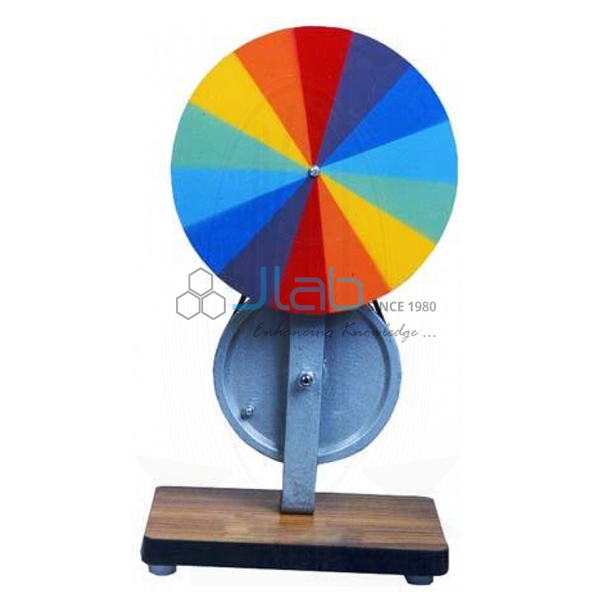
Newtons Color Disc (code EL-SLE-4666) is a 15 cm colour disc mounted on a wooden base with a wheel and handle, used to demonstrate that white light is made up of seven colours. Turning the handle spins the disc fast enough for the colours to blend, so the disc appears white to the class — a simple, memorable optics demonstration for school physics and general science. It is made by Jain Laboratory Instruments Pvt Ltd (JLab) at its works in Ambala, India.
Specifications
| Parameter | Detail |
|---|---|
| Disc diameter | 15 cm |
| Colours | Seven colours of white light |
| Mounting | Wooden base |
| Drive | Wheel and handle, turned by hand |
| Demonstrates | White light is composed of seven colours — the spinning disc appears white |
| Quality check | Each colour disc is visually inspected before dispatch |
| Pack quantity | Each (sold individually) |
| Minimum order quantity | 10 units |
| Dispatch time | Usually 7–10 working days |
| Product code | EL-SLE-4666 |
| Manufacturer | Jain Laboratory Instruments Pvt Ltd (JLab) — OEM |
| Country of origin | India (made in Ambala, Haryana) |
How Does It Compare with Other JLab Colour Discs?
| Model | Disc size | Mounting and drive |
|---|---|---|
| This colour disc (EL-SLE-4666) | 15 cm | Wooden base; wheel and handle |
| Newton’s Color Disc | 20 cm | Stand with turning wheel and handle |
| Newton’s Color Disc Wheel On Stand | 9 inch (230 mm) wheel | Pillar mounting with a turning wheel; seven colours in wedges in four quadrants |
| Electric Motor Model With Newton Colour Disc | Not stated | Motor-driven; plastic base |
Choose this 15 cm hand-turned disc for compact bench demonstrations and student group work. The larger 20 cm and 230 mm discs are easier for a whole class to see from the back of the room, and the motor-driven model gives a steady speed without cranking.
What Is Newton’s Colour Disc Used For?
Isaac Newton showed with a prism that white light splits into a spectrum of colours — violet, indigo, blue, green, yellow, orange and red. The colour disc demonstrates the reverse. When it spins quickly, the eye cannot follow the separate sectors; each colour’s image persists briefly on the retina and the colours combine, so the disc looks white or greyish-white. Teachers use it alongside a prism in lessons on the dispersion of white light, such as the class 10 chapter on the human eye and the colourful world, and in middle-school science and science-fair displays on light and vision.
Turn the handle smoothly and speed up gradually; the disc looks whitest at a steady high speed in good light. Keep fingers and loose clothing clear of the spinning disc, keep its painted face clean and dry, and store it so the colour surface is not scratched. Because paints are not pure spectral colours, the result is usually off-white rather than brilliant white — a useful talking point with students.
What to Specify When Ordering
- Disc size — this 15 cm model, or one of the larger or motor-driven discs listed above.
- Quantity — the minimum order is 10 units; one per class or per student group is typical.
- Prisms — add glass prisms so students can split white light as well as recombine it.
- Packing — mention any labelling or packing needs for distribution to several schools.
Frequently Asked Questions
What does Newton’s colour disc demonstrate?
That white light is made up of seven colours. When the disc spins quickly, the colours blend in the eye and the disc appears white.
Why does the disc look greyish-white rather than pure white?
The painted colours are not perfectly pure spectral colours, so their combination is slightly dull. The effect still shows clearly that the colours together produce white.
What size is the disc, and how is it turned?
The disc is 15 cm in diameter, mounted on a wooden base and turned by hand with a wheel and handle.
Is there a larger or motorised version?
Yes. JLab also lists a 20 cm disc on a stand, a disc wheel with a 9 inch (230 mm) wheel, and an electric motor model with a Newton colour disc.
What is needed for an export quotation?
The quantity, the destination country and port or city, delivery terms such as FOB or CIF, any packing or labelling instructions and a tender reference if relevant.
Who manufactures this colour disc?
Jain Laboratory Instruments Pvt Ltd (JLab) makes it at its works in Ambala, Haryana, India, and quotes for it directly as the manufacturer.
OEM Manufacturer
JLab is the trading name of Jain Laboratory Instruments Pvt Ltd, an Indian manufacturer of physics demonstration apparatus and school laboratory equipment, incorporated in 2017 and based on Hargolal Road, Ambala, Haryana. The colour disc is made at JLab’s own works rather than bought from a trader, so schools, colleges, dealers and importers buy it factory-direct, each unit is visually inspected before dispatch, and repeat orders are handled by the manufacturer. JLab exports worldwide and ships to buyers in every region — for example Honduras in Central America and the Caribbean, Ukraine in Eastern Europe, Sri Lanka in South Asia, Norway in Northern Europe and South Africa in Southern Africa. Tender details are on the JLab lab tenders page.
Light and Colour Apparatus
- Prism Glass — clear glass prisms in right-angle and equilateral forms for splitting white light into a spectrum.
- Hollow Prism — an equilateral hollow glass prism for refraction experiments with liquids.
- Ray Box (Metal) — produces coloured light effects with filters.
- Electric Motor Model With Newton Colour Disc — a motor-driven version of the colour disc.
More apparatus is listed under School Lab Equipment.
Request a Quote
Quotes come direct from the manufacturer. Use the Add To Cart enquiry button on this page, or send the quantity (minimum 10 units), the disc model you prefer, any prisms you want with it and your delivery location through the contact page.
Last updated: 4 October 2026