Prism Glass Manufacturer,Supplier and Exporter in India
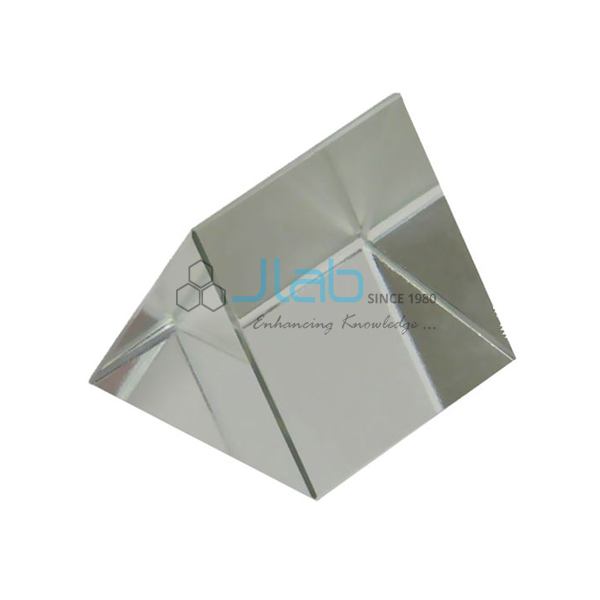
Product Code : EL-SLE-4565
Jlab Export is a leading Prism Glass Manufacturer,and suppliers in India
Prism Glass (code EL-SLE-4565) is a clear glass prism for teaching the fundamentals of refraction in school and college physics labs, offered in right-angle (90 x 45 x 45 degrees) and equilateral (60 x 60 x 60 degrees) forms, in 38 mm and 50 mm sizes. Each prism is packed in its own white labelled carton. It is made by Jain Laboratory Instruments Pvt Ltd (JLab) at its works in Ambala, India.
Specifications
| Parameter | Detail |
|---|---|
| Material | Clear glass |
| Shapes | Right angle (90 x 45 x 45 degrees); equilateral (60 x 60 x 60 degrees) |
| Sizes | 38 mm and 50 mm (as listed) |
| Use | Teaching the fundamentals of refraction |
| Packing | Each prism in an individual white labelled carton |
| Quality check | Each prism is visually inspected before dispatch |
| Pack quantity | Each (sold individually) |
| Minimum order quantity | 10 units |
| Dispatch time | Usually 7–10 working days |
| Product code | EL-SLE-4565 |
| Manufacturer | Jain Laboratory Instruments Pvt Ltd (JLab) — OEM |
| Country of origin | India (made in Ambala, Haryana) |
How Does It Compare with Other JLab Prisms?
| Model | Shape | Size | Listed details |
|---|---|---|---|
| This prism (EL-SLE-4565) | Right angle or equilateral | 38 mm or 50 mm | Clear glass; individual white labelled carton |
| Prism Glass Equilateral 50 x 50 mm JLab | Equilateral | About 50 mm face x 50 mm height | Polished faces; sold individually |
| Prism Glass Right Angle 50 mm JLab | Right angle | About 50 mm face | Polished faces; sold individually |
| Hollow Prism | Equilateral, hollow | 50 x 50 x 50 mm sides, 35 mm depth | Extra-dense hollow glass, optically worked |
Choose this listing when you want both prism shapes, or the smaller 38 mm size, from one product line with each prism boxed and labelled. The two 50 mm listings cover a single shape each, and the hollow prism is the one to pick when students fill the prism with water or other liquids to compare their refraction with glass.
What Is the Glass Prism Used For?
The equilateral prism is used for the class 10 practical on tracing the path of rays of light through a glass prism: students fix pins along an incident ray, sight the emergent ray through the second face, and measure how far the light has been deviated. Shone with white light, the same prism splits it into a spectrum, because violet light is bent most and red light least — the dispersion students meet in the class 10 chapter on the human eye and the colourful world. In class 12 and college labs it is used to find the angle of minimum deviation from a graph of angle of incidence against angle of deviation, and from that the refractive index of the glass: the sine of half the sum of the prism angle and the minimum deviation, divided by the sine of half the prism angle.
The right-angle prism shows total internal reflection. Light entering one short face strikes the long face at 45 degrees, which is more than the critical angle of glass, so it is reflected completely and turned through 90 degrees — the principle of the prism periscope and, with two reflections, of the prisms that send light back in binoculars. Store each prism in its labelled carton, hold it by the triangular ends to keep the faces free of fingerprints, and clean the faces with a soft cloth.
What to Specify When Ordering
- Shape and size — right angle or equilateral, 38 mm or 50 mm, with the quantity of each; ask JLab to confirm the combinations available.
- Quantity — the minimum order is 10 prisms; for the class 10 practical, schools often plan one equilateral prism per pair of students.
- Related optics — add optical pins, rectangular glass blocks or a hollow prism to the same enquiry.
Frequently Asked Questions
Which shapes and sizes are available?
Right-angle prisms (90 x 45 x 45 degrees) and equilateral prisms (60 x 60 x 60 degrees), in 38 mm and 50 mm sizes. The listing does not say whether the size is the face width or the length, so ask JLab to confirm it with the shape and size combinations you need.
Which school experiment uses a glass prism?
The class 10 practical of tracing the path of rays of light through a glass prism and measuring the angle of deviation, along with demonstrations of the dispersion of white light.
Why does a prism split white light into colours?
Glass bends different colours by slightly different amounts. Violet is refracted most and red least, so the colours mixed in white light fan out into a spectrum as they pass through the prism.
What is a right-angle prism used for?
To show total internal reflection. Light meets the long face at 45 degrees, beyond the critical angle of glass, so the face acts as a perfect mirror and turns the light through 90 degrees, as in a prism periscope.
How is the refractive index found with an equilateral prism?
Measure the angle of minimum deviation. The refractive index is the sine of half of the prism angle plus minimum deviation, divided by the sine of half the prism angle.
How are the prisms packed?
Each prism is packed in its own white labelled carton, which protects the faces and identifies the item on the shelf.
What information does an export quotation need?
Shapes, sizes and quantities, the destination country and port or city, delivery terms such as FOB or CIF, any packing or labelling instructions, and a tender reference if applicable.
Who manufactures the Prism Glass?
JLab (Jain Laboratory Instruments Pvt Ltd) makes it at its works in Ambala, Haryana, India.
OEM Manufacturer
JLab is the trading name of Jain Laboratory Instruments Pvt Ltd, an Indian manufacturer of optics lab equipment and school physics apparatus, incorporated in 2017 and based on Hargolal Road, Ambala, Haryana. These prisms are made at JLab’s own works rather than bought in from a trader, so schools, colleges, dealers and importers buy factory-direct, each prism is visually inspected before it goes into its carton, and repeat orders are handled by the manufacturer. JLab exports worldwide and serves buyers in every region — Austria in Western Europe, Mauritius in East Africa, Nepal in South Asia, Kazakhstan in Central Asia and the USA in North America, for instance. For tender purchases, visit the JLab lab tenders page.
Related Optics Apparatus
- Glass Block (Rectangular) — a bubble-free rectangular block for the ray-tracing practical on refraction through a slab.
- Optical Pins — chrome-plated pins for marking the incident and emergent rays.
- Hollow Prism — an optically worked hollow glass prism for liquids.
Find more optics and physics apparatus in the School Lab Equipment range.
Request a Quote
Quotes come direct from the manufacturer. Use the Add To Cart enquiry button on this page, or send the shapes, sizes and quantities you need (minimum 10 units) and your delivery location through the contact page.
Last updated: 4 October 2026