Hollow Prism Manufacturer,Supplier and Exporter in India
Product Code : EL-SLE-5815
Jlab Export is a leading Hollow Prism Manufacturer,and suppliers in India
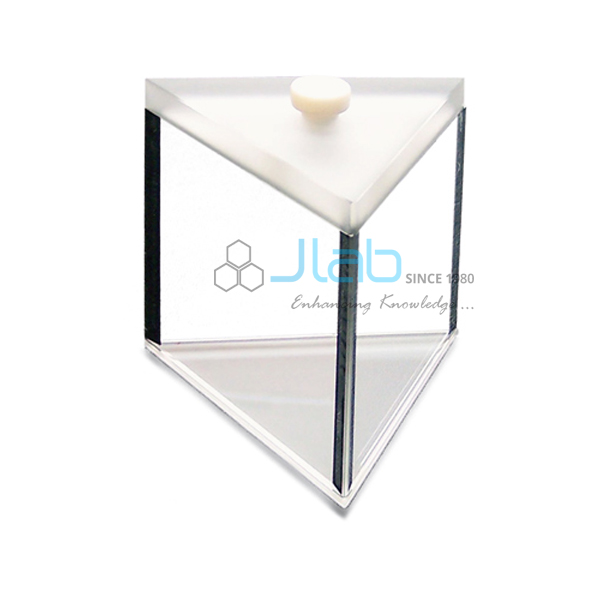
Hollow Prism (code EL-SLE-5815) is an equilateral hollow prism of optically worked glass, with 50 mm sides and a depth of 35 mm, used to study the refraction of light through liquids. Filled with water or another clear liquid, it lets students measure how strongly the liquid bends light and so find its refractive index. It is made by Jain Laboratory Instruments Pvt Ltd (JLab) at its works in Ambala, India.
Specifications
| Parameter | Detail |
|---|---|
| Type | Hollow prism, equilateral (each angle 60 degrees) |
| Material | Glass, optically worked (listed as extra dense) |
| Side length | 50 × 50 × 50 mm |
| Depth | 35 mm |
| Quality check | Each prism is visually inspected before dispatch |
| Pack quantity | Each (sold individually) |
| Minimum order quantity | 10 units |
| Dispatch time | Usually 7–10 working days |
| Product code | EL-SLE-5815 |
| Manufacturer | Jain Laboratory Instruments Pvt Ltd (JLab) — OEM |
| Country of origin | India (made in Ambala, Haryana) |
How Does It Compare with Other JLab Prisms?
| Prism | Construction | Listed details |
|---|---|---|
| This Hollow Prism (EL-SLE-5815) | Hollow, optically worked glass | Equilateral, 50 mm sides, 35 mm depth |
| Hollow Prism (physics lab range) | Hollow, glass | Size 50 mm; listed for finding the refractive index of a liquid |
| Prism Glass | Solid clear glass | Right-angle and equilateral forms, two sizes |
Choose a hollow prism when the experiment is about liquids; choose the solid Prism Glass for refraction and dispersion through glass itself. The two hollow prisms are both glass and listed at 50 mm; this listing also states the 35 mm depth and the optically worked finish.
What Is the Hollow Prism Used For?
The glass walls of a hollow prism are thin and parallel-sided, so they shift a ray only slightly and add almost no deviation of their own; the bending students see comes from the liquid inside. Filled with water, glycerine or another transparent liquid, the prism is set on paper with a ray box, or on the table of a prism spectrometer, and the angle of minimum deviation is measured. Together with the prism angle of 60 degrees, this gives the refractive index of the liquid, and repeating it with different liquids shows how the index changes from one to another. It is used in senior-secondary ray optics and in college spectrometer practicals.
Fill it carefully to just below the rim on a level surface, wipe off any drips so they do not form extra refracting surfaces, and empty, rinse and dry it after each class. Handle it by the edges, never heat it, and ask JLab before using solvents, as the listing does not state how the glass plates are joined.
What to Specify When Ordering
- Size — this listing is the 50 mm equilateral prism with 35 mm depth; mention it if your spectrometer table or practical file calls for another size.
- Liquids — tell JLab which liquids you plan to use, so it can confirm they suit the prism.
- Quantity — the minimum order is 10 units; schools usually plan one prism per spectrometer or per student pair.
- Instruments — a spectrometer, ray box or solid glass prisms can be added to the same enquiry.
Frequently Asked Questions
What is a hollow prism used for?
It holds a liquid in the shape of a prism so that the refraction of light through the liquid can be studied and its refractive index measured, usually from the angle of minimum deviation.
What size is this hollow prism?
It is equilateral with 50 mm sides, and its depth is 35 mm. Each angle of an equilateral prism is 60 degrees.
Does the glass affect the result?
Very little. The walls are thin parallel plates, which shift the ray slightly sideways but hardly change its direction, so the deviation measured comes almost entirely from the liquid.
Does it have a lid?
The listing does not say whether a lid or stopper is supplied. Ask JLab when you enquire if you need one to limit evaporation.
How does it differ from the solid Prism Glass?
The Prism Glass is solid glass and is used to study refraction and dispersion through glass. The hollow prism is filled with a liquid, so the liquid’s refraction is measured instead.
Who manufactures this hollow prism?
Jain Laboratory Instruments Pvt Ltd (JLab) makes it at its works in Ambala, Haryana, India, and quotes for it as the manufacturer.
OEM Manufacturer
JLab is the trading name of Jain Laboratory Instruments Pvt Ltd, a maker of optics, glassware and physics lab equipment in India, incorporated in 2017 and based on Hargolal Road, Ambala, Haryana. The hollow prism is produced at JLab’s own works rather than bought through a trader, so schools, colleges, dealers and importers buy direct from the manufacturer, each prism is checked by eye before it is packed, and repeat orders come from the same source. JLab exports worldwide and ships to buyers in every region — for example Zimbabwe in East Africa, Hong Kong in East Asia, Gambia in West Africa, Chile in South America and Sweden in Northern Europe. For tenders, see the JLab lab tenders page.
Instruments and Prisms for Refraction Work
- Spectrometer — measures the angle of minimum deviation in prism experiments.
- Prism Glass — solid glass prisms for refraction and dispersion through glass.
- Ray Box Kit — a ray box with slits for tracing rays through the filled prism on paper.
- Optical Glasses — Perspex blocks, including a 60-degree triangular block, for comparing a solid prism.
Browse other optics apparatus in the School Lab Equipment range.
Request a Quote
Quotes come direct from the manufacturer. Use the Add To Cart enquiry button on this page, or send the quantity (minimum 10 units), the liquids you plan to use, any spectrometers or ray boxes, and your delivery city or port through the contact page.
Last updated: 4 October 2026