Stop Clock Manufacturer,Supplier and Exporter in India
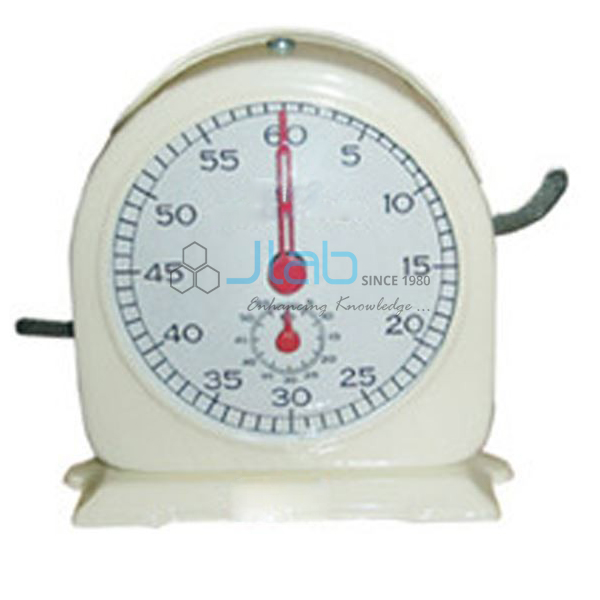
Product Code : EL-SLE-5560
Jlab Export is a leading Stop Clock Manufacturer,and suppliers in India
Stop Clock (code EL-SLE-5560) is a laboratory stop clock with start, stop and reset actions and a dial graduated in seconds and figured every 5 seconds, used for timing experiments in school physics, chemistry and biology practicals. The clock is listed at 100 mm in diameter. It is made by Jain Laboratory Instruments Pvt Ltd (JLab) at its works in Ambala, India.
Specifications
| Parameter | Detail |
|---|---|
| Controls | Start, stop and reset actions |
| Dial | Graduated in seconds, figured every 5 seconds |
| Size | 100 mm diameter (as listed) |
| Quality check | Each stop clock is visually inspected before dispatch |
| Pack quantity | Each (sold individually) |
| Minimum order quantity | 10 units |
| Dispatch time | Usually 7–10 working days |
| Product code | EL-SLE-5560 |
| Manufacturer | Jain Laboratory Instruments Pvt Ltd (JLab) — OEM |
| Country of origin | India (made in Ambala, Haryana) |
How Does It Compare with Other JLab Timers?
| Model | Display | Other listed details |
|---|---|---|
| This stop clock (EL-SLE-5560) | Dial graduated in seconds, figured every 5 seconds; 100 mm diameter | Start, stop and reset actions |
| Stop Clock Mechanical | Two sweep hands, one for seconds and one recording minutes | Large metal body; start-stop lever on the left, zero-reset lever on the right |
| Stop Clock (Smith type) | Second hand with a subsidiary dial recording 0 to 60 minutes | Metal case; fly-back action |
| Digital Timer | Digital, touch panel | Microprocessor controlled; for timing short intervals |
Choose this stop clock for everyday bench timing where a clear seconds dial is all you need. The mechanical and Smith-type clocks are listed with a minutes register for longer runs, and the digital timer is the one for intervals too short to time by hand.
What Is a Stop Clock Used For?
A stop clock times how long something takes. In physics, students time a set number of swings of a simple pendulum and divide to find the period, or time a trolley or ball over a measured distance to work out its speed — the motion and time work of class 7 and the simple pendulum experiment of class 11. In chemistry it times reaction rates, for example how long a cross under a flask of sodium thiosulphate and acid takes to disappear, and readings taken at regular intervals give the cooling curves plotted in class 11 physics practicals. Biology classes use it to time readings in transpiration and respiration experiments.
Because the clock is started and stopped by hand, each reading includes the observer’s reaction time, which is a fraction of a second. A dial that reads to the nearest second is therefore well matched to intervals of tens of seconds or more; for short events, time many repeats together and divide. Keep the clock away from water and heat sources on the bench, and reset it before each run.
What to Specify When Ordering
- Quantity — one stop clock per group is usual for practical classes; the minimum order is 10 units.
- Drive and minute register — the listing does not say whether the clock is clockwork or battery driven, or whether it records minutes; state your preference.
- Pendulum and timing accessories — add pendulum bobs or a digital timer to the same enquiry if you are equipping a physics lab.
Frequently Asked Questions
How is the dial marked?
In seconds, with figures every 5 seconds, so readings are taken to the nearest second. The listing gives the size as 100 mm in diameter.
What controls does the stop clock have?
Start, stop and reset actions, so a run can be started, stopped for a reading and returned to zero for the next trial.
Is it clockwork or battery operated?
The listing does not say. If you need one or the other, state it in your enquiry and ask JLab to confirm before ordering.
How accurate is hand timing with a stop clock?
The limit is usually the person, not the clock: starting and stopping by hand adds a reaction delay of a fraction of a second. Timing longer intervals, or many pendulum swings at once, keeps that error small compared with the reading.
How does it differ from JLab’s digital timer?
This is a dial stop clock for bench timing read to the nearest second. The digital timer is microprocessor controlled with a touch panel and is listed for timing short intervals.
What information is needed for an export quotation?
The quantity, the destination country and port or city, the delivery terms you want (for example FOB or CIF), any packing or labelling requirements, and the tender reference if one applies.
Who manufactures this stop clock?
Jain Laboratory Instruments Pvt Ltd, trading as JLab, makes it at its works in Ambala, Haryana, and quotes for it directly.
OEM Manufacturer
JLab is the trading name of Jain Laboratory Instruments Pvt Ltd, a manufacturer of physics lab equipment for schools in India alongside its chemistry and biology ranges, incorporated in 2017 and based on Hargolal Road, Ambala, Haryana. The stop clock is made at JLab’s own works, not bought in from a trader, so schools, colleges, dealers and importers buy it factory-direct, each clock is visually inspected before dispatch, and repeat orders are handled by the manufacturer. The company holds MSME Udyam registration UDYAM-HR-01-0003849 (manufacturing enterprise) and the Importer-Exporter Code 3317504552. JLab exports worldwide and ships to buyers in every region — for example France in Western Europe, Iraq in the Middle East, Bhutan in South Asia, Indonesia in Southeast Asia and Papua New Guinea in Oceania. Tender details are on the JLab lab tenders page.
Timers and Pendulum Apparatus
- Stop Clock Mechanical — a large metal-bodied stop clock with seconds and minutes hands.
- Stop Clock (Smith type) — a metal-cased stop clock with fly-back action and a minutes dial.
- Digital Timer — a microprocessor-controlled touch-panel timer for short intervals.
- Pendulum Bobs (18mm) — brass or chrome-plated iron bobs with a hook for simple pendulum experiments.
See more items in the School Lab Equipment range.
Request a Quote
Quotes come direct from the manufacturer. Use the Add To Cart enquiry button on this page, or send the number of stop clocks (minimum 10 units), any preference for clockwork or battery drive and your delivery location through the contact page.
Last updated: 4 October 2026