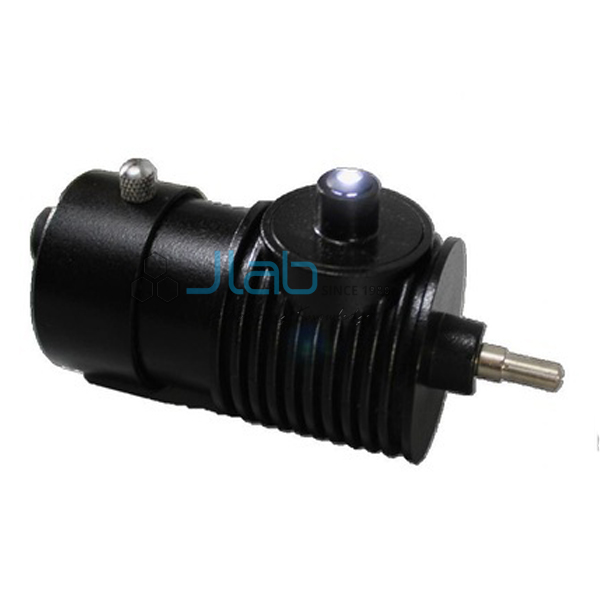
Newtons Ring Apparatus Manufacturer,Supplier and Exporter in India

Product Code : EL-SLE-4667
Jlab Export is a leading Newtons Ring Apparatus Manufacturer,and suppliers in India
Newtons Ring Apparatus (code EL-SLE-4667) is an optics apparatus for measuring the wavelength of light. Light falling on the thin film of air between a convex lens and a flat glass plate forms an interference pattern of concentric rings, and the lens and plate are held in a heavy frame with three adjustment screws. It is used in college and university physics laboratories. It is made by Jain Laboratory Instruments Pvt Ltd (JLab) at its works in Ambala, India.
Specifications
| Parameter | Detail |
|---|---|
| Purpose | Measuring the wavelength of light |
| Optics | Convex lens resting on a flat glass plate |
| Principle | Interference in the thin film of air between the lens and the plate |
| Frame | Heavy frame with three adjustment screws |
| Quality check | Each apparatus is visually inspected before dispatch |
| Pack quantity | Each (sold individually) |
| Minimum order quantity | 10 units |
| Dispatch time | Usually 7–10 working days |
| Product code | EL-SLE-4667 |
| Manufacturer | Jain Laboratory Instruments Pvt Ltd (JLab) — OEM |
| Country of origin | India (made in Ambala, Haryana) |
How Does It Compare with Other JLab Newton’s Ring Sets?
| Model | Optics | Frame and other listed details |
|---|---|---|
| This apparatus (EL-SLE-4667) | Convex lens on a flat glass plate | Heavy frame, three adjustment screws; for measuring wavelength |
| Newton’s Ring Apparatus | Pair of optically polished glass plates, one plane and one plano-convex, 40 mm diameter | Mounted together in a frame; pressure set by three nickel-plated brass screws |
| Newton’s Ring Model | Glass plate and convex lens | Heavy aluminium frame, 9 cm diameter with 5 cm aperture; three adjusting screws; fringes visible in sunlight, fluorescent or monochromatic light |
Choose this apparatus for the standard wavelength-measurement practical. The other two listings state their plate diameter, frame size and aperture, which helps if a tender or practical manual specifies them.
What Is the Newton’s Ring Apparatus Used For?
When the lens rests on the plate, the air gap between them is zero at the point of contact and grows steadily outwards. Light reflected from the curved lower surface of the lens and from the top of the plate interferes, giving concentric bright and dark rings — Newton’s rings — with a dark centre when viewed in reflected light. With monochromatic light, usually from a sodium vapour lamp, students measure the diameters of the rings with a travelling microscope; the wavelength then follows from the difference between the squares of two ring diameters, the number of rings between them and the radius of curvature of the lens. It is a standard experiment in B.Sc. physics and first-year engineering physics practicals on interference, and the same set-up can be used to find the refractive index of a liquid placed in the gap.
Clean the lens and plate with lens tissue before assembly, because dust between them distorts the rings. Turn the three screws only until the lens just makes even contact — over-tightening strains the glass and shifts the ring centre — and centre the pattern under the microscope cross-wire before taking readings.
What to Specify When Ordering
- Quantity — the minimum order is 10 units; departments usually plan one per practical bench.
- Lens data — ask JLab for the radius of curvature of the lens if your practical sheet needs it, or measure it with a spherometer.
- Light source and microscope — sodium vapour lamps and a travelling or Newton’s ring microscope are separate items and can be quoted together.
- Comparison models — name one of the other Newton’s ring listings if you need their stated sizes.
Frequently Asked Questions
What is the Newton’s ring apparatus used for?
Measuring the wavelength of light from the interference rings formed in the thin air film between a convex lens and a flat glass plate.
What light source should be used?
A monochromatic source, normally a sodium vapour lamp, gives sharp rings for measurement. White light shows coloured rings that are useful only for demonstration.
Is the sodium lamp or microscope included?
No. They are not part of this listing; JLab lists sodium vapour lamps, a travelling microscope and a Newton’s ring microscope separately.
What is the radius of curvature of the lens?
It is not stated in this listing. Ask JLab to quote it, or measure it in the lab with a spherometer before calculating the wavelength.
What do the three adjustment screws do?
They hold the lens against the plate and let you set gentle, even contact so that the ring system is centred and the glass is not strained.
What should an export enquiry include?
The quantity, the destination country and port or city, delivery terms such as FOB or CIF, any packing or labelling requirements, any accessories you need and the tender reference, if there is one.
Who manufactures this apparatus?
JLab, the trading name of Jain Laboratory Instruments Pvt Ltd, makes it at its works in Ambala, Haryana, India, and quotes for it directly.
OEM Manufacturer
JLab is the trading name of Jain Laboratory Instruments Pvt Ltd, a manufacturer of optics and physics laboratory apparatus in India, incorporated in 2017 and based on Hargolal Road, Ambala, Haryana. The apparatus is made at JLab’s own works rather than bought from a trader, so colleges, universities, dealers and importers buy it factory-direct, each unit is visually inspected before dispatch, and repeat orders and spares are handled by the manufacturer. JLab exports worldwide and ships to buyers in every region — for example Kazakhstan in Central Asia, Japan in East Asia, Namibia in Southern Africa, Bulgaria in Eastern Europe and Lebanon in the Middle East. Tender information is on the JLab lab tenders page.
Equipment for the Newton’s Rings Experiment
- Sodium Vapour Lamp — the usual monochromatic light source for the rings.
- Sodium Vapour Lamp with power supply — the lamp supplied with its power supply.
- Travelling Microscope — rack-and-pinion focusing on sliding carriages for measuring ring diameters.
- Newton Ring Microscope — a microscope unit with a rotatable cross-line eyepiece for viewing the rings.
- Spherometer Disc Type — three legs and a fine-pitch screw for finding the lens’s radius of curvature.
More apparatus is listed in the School Lab Equipment range.
Request a Quote
Quotes come direct from the manufacturer. Use the Add To Cart enquiry button on this page, or send the quantity (minimum 10 units), any lens data you need, the lamps or microscopes to quote with it and your delivery location through the contact page.
Last updated: 4 October 2026