Dropping Bottle Manufacturer,Supplier and Exporter in India
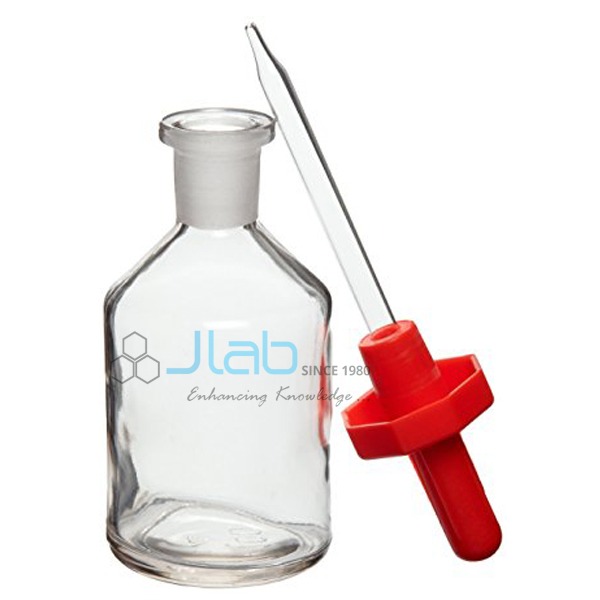
Product Code : EL-SLE-5596
Jlab Export is a leading Dropping Bottle Manufacturer,and suppliers in India
Dropping Bottle (code EL-SLE-5596) is a narrow-mouth glass bottle with a dropping pipette ground into the neck and fitted with a rubber teat, used to store indicators and reagents and dispense them a drop at a time in school, college and university chemistry and biology labs. It is listed in 30 ml, 50 ml and 125 ml capacities, packed 10 per size. It is made by Jain Laboratory Instruments Pvt Ltd (JLab) at its works in Ambala, India.
Specifications
| Parameter | Detail |
|---|---|
| Bottle | Glass, narrow mouth |
| Dropping pipette | Ground into the neck of the bottle, with a rubber teat |
| Capacities | 30 ml, 50 ml and 125 ml |
| Quality check | Each bottle is visually inspected before dispatch |
| Pack quantity | Pack of 10 for each capacity |
| Minimum order quantity | 10 units |
| Dispatch time | Usually 7–10 working days |
| Product code | EL-SLE-5596 |
| Manufacturer | Jain Laboratory Instruments Pvt Ltd (JLab) — OEM |
| Country of origin | India (made in Ambala, Haryana) |
How Does It Compare with Other JLab Dropping Bottles?
| Model | Material | How it dispenses | Other listed details |
|---|---|---|---|
| This dropping bottle (EL-SLE-5596) | Glass, narrow mouth | Ground-in dropping pipette with rubber teat | 30, 50 and 125 ml; packs of 10 per size |
| Dropping Bottle (soda glass) | Soda glass, clear | Not stated | 30 ml; listed as heat and chemical resistant |
| Dropping Bottles | Low-density polyethylene | Small uniform drops when the bottle is pressed lightly | Several capacities |
| Dropping Bottles Euro Design | Low-density polyethylene | Small uniform drops | Screw cap with lid; several capacities |
Choose this bottle when you want glass for reagents and a separate pipette that sits in the neck, so the dose is drawn up and released with the teat. The polyethylene squeeze bottles avoid breakage on younger students’ benches, and the soda-glass bottle is the single-size glass option listed.
What Is the Dropping Bottle Used For?
Dropping bottles keep the small volumes of liquid that practical work uses a few drops at a time: phenolphthalein or methyl orange indicator for titrations, test reagents for salt analysis and functional-group tests in class 11 and class 12 chemistry practicals, iodine solution for the starch test in biology, and stains for slide preparation. Because the pipette is ground to fit the neck, it also closes the bottle, which limits evaporation and keeps dust out between lessons. The 30 ml size suits individual student benches, the 50 ml a shared bench, and the 125 ml a side-shelf stock that refills the smaller bottles — standard chemistry lab glassware for schools and colleges alike.
Squeeze the teat gently to draw liquid up, hold the pipette above the tube or flask without touching it, and release one drop at a time. Always return each pipette to its own bottle so reagents do not cross-contaminate, label every bottle clearly, and wash the pipette before the bottle is refilled with a different reagent. Light-sensitive reagents such as silver nitrate are usually kept in amber bottles, so mention the glass colour you need when ordering.
What to Specify When Ordering
- Capacity — 30 ml, 50 ml or 125 ml, with the number of packs of 10 for each.
- Glass colour — ask JLab to confirm clear or amber glass if you store light-sensitive reagents.
- Quantity — the minimum order is 10 units; a reagent set for one bench often mixes sizes.
- Companion items — add spare dropping pipettes, litmus paper or spot plates to the same enquiry.
Frequently Asked Questions
Which capacities are available?
30 ml, 50 ml and 125 ml, each packed 10 to a pack.
How does the dropping pipette fit the bottle?
It is ground into the neck of the bottle and has a rubber teat, so the pipette also acts as the closure when it is put back after use.
Is the bottle glass or plastic?
Glass, with a narrow mouth. The listing does not state the glass type or colour, so confirm these if they matter; JLab also lists polyethylene dropping bottles if you prefer plastic.
What are dropping bottles used for in the lab?
Holding indicators, test reagents, stains and iodine solution, and dispensing them a drop at a time into test tubes, titration flasks, spot plates or onto slides.
What is needed for an export quotation?
The capacities and number of packs, destination country and port or city, delivery terms such as FOB or CIF, packing or labelling needs, and any tender reference.
Who manufactures these dropping bottles?
Jain Laboratory Instruments Pvt Ltd, trading as JLab, at its works in Ambala, Haryana, India; it quotes for them directly.
OEM Manufacturer
JLab is the trading name of Jain Laboratory Instruments Pvt Ltd, a laboratory glassware and school science equipment manufacturer in India, incorporated in 2017 and based on Hargolal Road, Ambala, Haryana. These dropping bottles are made at JLab’s own works instead of being bought from a trader, so schools, colleges, dealers and importers order factory-direct; bottles are inspected by eye before dispatch, and repeat orders are handled by the manufacturer. The company is registered as an MSME manufacturing enterprise (Udyam registration UDYAM-HR-01-0003849) and holds Importer-Exporter Code 3317504552. JLab exports worldwide and ships to buyers in every region — for example the USA in North America, Belgium in Western Europe, Albania in Southern Europe, Tonga in Oceania and Thailand in Southeast Asia. Tender details are on the JLab lab tenders page.
Related Reagent and Dropping Items
- Dropping Pipette Glass — a glass dropping pipette with a teat for adding liquids one drop at a time.
- Litmus Paper — red or blue litmus paper for testing whether a solution is acidic or alkaline.
- Spot Plates — porcelain plates with six cavities for drop-scale tests.
- Reagent Bottle Narrow Mouth — a polypropylene bottle with a sealed cap for larger reagent stocks.
See the full School Lab Equipment range.
Request a Quote
Quotes come direct from the manufacturer. Use the Add To Cart enquiry button on this page, or send the capacities and number of packs (minimum 10 units), the glass colour you need, any related items, and your delivery location through the contact page.
Last updated: 4 October 2026