Spot Plates Manufacturer,Supplier and Exporter in India
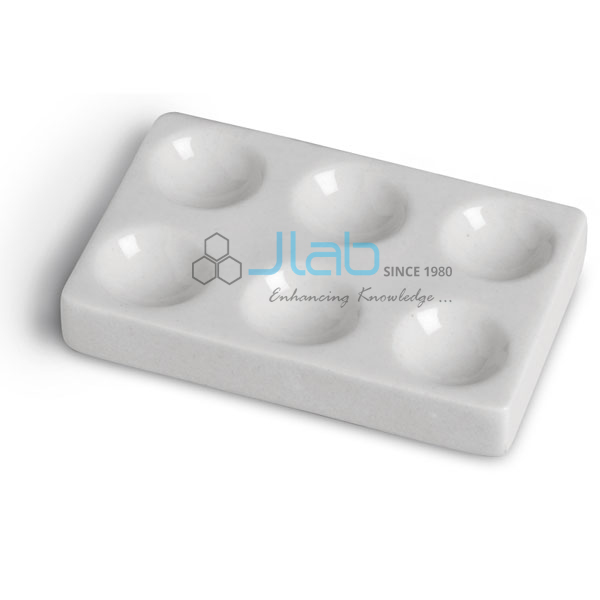
Product Code : EL-SLE-5541
Jlab Export is a leading Spot Plates Manufacturer,and suppliers in India
Spot Plates (code EL-SLE-5541) are porcelain plates with 6 cavities, used for drop-scale tests in school and college labs — a few drops of a sample and a reagent go into each well so that colour changes can be compared side by side. Six wells suit a small group or a short series of tests. They are made by Jain Laboratory Instruments Pvt Ltd (JLab) at its works in Ambala, India.
Specifications
| Parameter | Detail |
|---|---|
| Material | Porcelain |
| Number of cavities | 6 |
| Quality check | Each spot plate is visually inspected before dispatch |
| Pack quantity | Each (sold individually) |
| Minimum order quantity | 10 units |
| Dispatch time | Usually 7–10 working days |
| Product code | EL-SLE-5541 |
| Manufacturer | Jain Laboratory Instruments Pvt Ltd (JLab) — OEM |
| Country of origin | India (made in Ambala, Haryana) |
How Does It Compare with Other JLab Spotting Tiles?
| Model | Material | Cavities | Other listed details |
|---|---|---|---|
| These spot plates (EL-SLE-5541) | Porcelain | 6 | — |
| Cavity Reaction Spot Plate Porcelain | Porcelain | 12 | Glazed on top and sides; about 115 x 90 mm |
| Cavity Tiles (12 Holes) | Porcelain or plastic | 12 (a 6-hole version is also listed) | For lab and classroom experiments |
Choose the 6-cavity plate for pairs or small groups running a handful of tests; the 12-cavity tiles suit longer series, such as testing many samples against one indicator, and the plastic version avoids breakage.
What Are Spot Plates Used For?
A spot plate lets students run several small tests at once using only drops of each chemical, which saves reagents and makes results easy to compare. Typical uses are testing acids, bases and household substances with litmus or universal indicator in class 7 and class 10 science, the iodine test for starch in food tests from class 6, and following the digestion of starch by amylase by adding a drop of the mixture to iodine in a fresh well at intervals. In chemistry, spot tests help confirm ions in qualitative analysis.
Add reagents with a dropping pipette, keep a note of which well holds which sample, and rinse the plate in water straight after use so that coloured residues do not dry in the wells. Handle it like any ceramic labware, as porcelain chips if dropped.
What to Specify When Ordering
- Number of cavities — this 6-cavity plate or a 12-cavity tile.
- Quantity — the minimum order is 10 units; many schools plan one plate per student pair.
- Dropping pipettes and indicators — add them to the same enquiry.
Frequently Asked Questions
What is a spot plate used for?
It holds drops of chemicals in separate wells for quick colour tests, such as indicator tests on acids and bases or the iodine test for starch, using very little reagent.
How many cavities does this spot plate have?
Six. JLab also lists porcelain and plastic tiles with 12 cavities if you need more wells per plate.
What is it made of?
Porcelain. The listing does not give the plate size or the volume of each cavity, so ask JLab for them if your worksheet or tender needs dimensions.
Are dropping pipettes included?
No, the listing covers the spot plate only. Glass dropping pipettes with teats are a separate item, linked below.
What should an export enquiry include?
The quantity, destination country and port or city, delivery terms such as FOB or CIF, packing or labelling needs, and any tender reference.
Who manufactures these spot plates?
Jain Laboratory Instruments Pvt Ltd (JLab) makes them at its works in Ambala, India, and supplies them directly as the manufacturer.
OEM Manufacturer
JLab is the trading name of Jain Laboratory Instruments Pvt Ltd, an Indian maker of school laboratory equipment, incorporated in 2017 with its works on Hargolal Road, Ambala, Haryana. Spot plates are made at JLab’s own works and not sourced from a trader, so schools, colleges, dealers and importers buy them factory-direct, every plate is visually inspected before it is packed, and repeat orders come straight from the manufacturer. JLab exports worldwide and ships to buyers in every region — for example Ethiopia in East Africa, Ecuador in South America, Morocco in North Africa, Burkina Faso in West Africa and Japan in East Asia.
For Drop Tests and Indicators
- Dropping Pipette Glass — a glass dropping pipette with teat for adding single drops to each well.
- Litmus Paper — red or blue litmus for showing whether a substance is acidic or alkaline.
- Universal Indicator Sol — universal indicator solution, analytical reagent supplied with MSDS.
- Stirring Rod Glass — a glass rod with rounded ends for mixing and transferring drops.
See the full School Lab Equipment range.
Request a Quote
Quotes come direct from the manufacturer. Use the Add To Cart enquiry button on this page, or send the quantity (minimum 10 units), whether you also need 12-cavity tiles or pipettes, and your delivery location through the contact page.
Last updated: 4 October 2026