Galvanometer Manufacturer,Supplier and Exporter in India
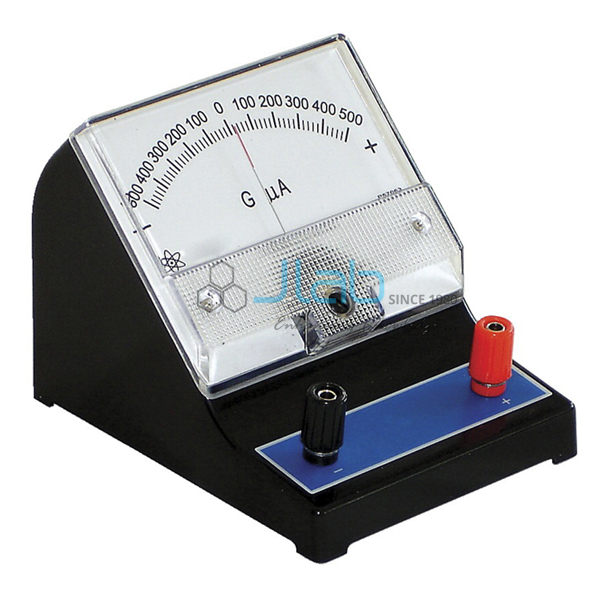
Product Code : EL-SLE-4650
Jlab Export is a leading Galvanometer Manufacturer,and suppliers in India
Galvanometer (code EL-SLE-4650) is a sensitive current detector in which a coil placed in a magnetic field turns when a current flows through it, so it picks up currents too small for an ordinary ammeter. Physics students use it as the null detector in bridge and potentiometer practicals and to show induced currents in electromagnetic induction. It is made by Jain Laboratory Instruments Pvt Ltd (JLab) at its works in Ambala, India.
Specifications
| Parameter | Detail |
|---|---|
| Function | Detects small electric currents |
| Sensitivity | High sensitivity to electric current |
| Movement | Electromechanical: a coil placed in a magnetic field turns in response to the current |
| Quality check | Each galvanometer is visually inspected before dispatch |
| Pack quantity | Each (sold individually) |
| Minimum order quantity | 10 units |
| Dispatch time | Usually 7–10 working days |
| Product code | EL-SLE-4650 |
| Manufacturer | Jain Laboratory Instruments Pvt Ltd (JLab) — OEM |
| Country of origin | India (made in Ambala, Haryana) |
How Does It Compare with Other JLab Galvanometers?
| Model | Listed details |
|---|---|
| This galvanometer (EL-SLE-4650) | Coil in a magnetic field; high sensitivity; detects small currents |
| Galvanometer, DC | For small D.C. currents; reading shown by a moving needle |
| Galvanometer (±35 µA) | Range ±35 µA; binding-post connections; compact |
| Moving Coil Galvanometer | Centre-zero 30-0-30 scale; D.C., with stand; diode protection against overload up to 12 V D.C. |
Choose this galvanometer as a general detector for bridge, potentiometer and induction work. If your practical sheet names a range or needs a centre-zero scale and overload protection, the models above state those details.
What Is a Galvanometer Used For?
A galvanometer works on the moving-coil principle: a current through a coil sitting in a magnetic field produces a turning force, and the coil turns against a restoring spring by an amount that depends on the current. Because a very small current gives a visible deflection, the instrument is used to detect currents rather than to measure large ones. In the class 12 meter bridge and potentiometer practicals it is the null detector — the balance point is where it shows no deflection. In electromagnetic induction experiments (class 10 and class 12) it shows the brief current induced when a magnet moves into or out of a coil, swinging one way and then the other. It is also the starting point of the class 12 practical on converting a galvanometer into an ammeter, with a low-resistance shunt, or into a voltmeter, with a high series resistance.
A galvanometer is easily overloaded. Connect it through a key, keep a high resistance in series while searching for a balance point, and tap the jockey briefly rather than holding it down. Never connect it directly across a cell.
What to Specify When Ordering
- Range and scale — the deflection range you need and whether you want a centre-zero scale.
- Circuit type — D.C. or A.C. use.
- Quantity — the minimum order is 10 galvanometers; bridge and potentiometer benches need one each.
- Bench items — meter bridge, resistance box and plug key for complete practical sets.
Frequently Asked Questions
What does a galvanometer do?
It detects small electric currents. A coil in a magnetic field turns when current flows, so even a small current gives a visible deflection, and no deflection means no current.
What is its range?
The range and scale are not stated in this listing. Tell JLab the range you need, or choose a model above that lists one, such as the ±35 µA galvanometer or the centre-zero moving coil galvanometer.
Why is a galvanometer used in a meter bridge?
Because the bridge is balanced when no current flows through the middle branch. A sensitive detector shows that zero point far more precisely than an ammeter could.
Can it be converted into an ammeter or a voltmeter?
Yes, that is a standard class 12 practical: a low-resistance shunt in parallel makes it an ammeter, and a high resistance in series makes it a voltmeter. The resistance values depend on the galvanometer’s own resistance and full-scale current, which you find first.
How do I protect it from damage?
Start with a high resistance in series, close the circuit with a key only while reading, and tap the jockey rather than pressing it continuously. Never connect it straight across a battery.
Who manufactures this galvanometer?
Jain Laboratory Instruments Pvt Ltd (JLab) makes it at its works in Ambala, Haryana, India, and quotes for it directly as the manufacturer.
OEM Manufacturer
JLab is the trading name of Jain Laboratory Instruments Pvt Ltd, an electrical and physics lab instrument manufacturer in India, incorporated in 2017 and based on Hargolal Road, Ambala, Haryana. The galvanometers are made at JLab’s own works rather than bought from a trader, so schools, colleges, dealers and importers buy them factory-direct; each instrument is checked by eye before packing, and repeat orders are handled by the manufacturer. JLab exports worldwide and ships to buyers in every region — for example Lesotho in Southern Africa, Cameroon in Central Africa, Singapore in Southeast Asia, Greece in Southern Europe and Luxembourg in Western Europe. Tender information is on the JLab lab tenders page.
Practicals That Use a Galvanometer
- Meter Bridge and Pencil Jockey — a four-gap metre bridge in which the galvanometer finds the balance point.
- Resistance Box Plug Type (Superior Type) — known resistances for bridge work and series protection.
- Magnets U-Shaped Alnico — strong magnets for producing induced currents.
- Tangent Galvanometer — a coil-and-compass instrument for measuring current by deflection.
More apparatus is in the School Lab Equipment range.
Request a Quote
Quotes come direct from the manufacturer. Use the Add To Cart enquiry button on this page, or send the quantity (minimum 10 units), the range and scale you need, and your delivery location through the contact page.
Last updated: 4 October 2026