Draining Rack Manufacturer,Supplier and Exporter in India
Product Code : EL-SLE-5665
Jlab Export is a leading Draining Rack Manufacturer,and suppliers in India
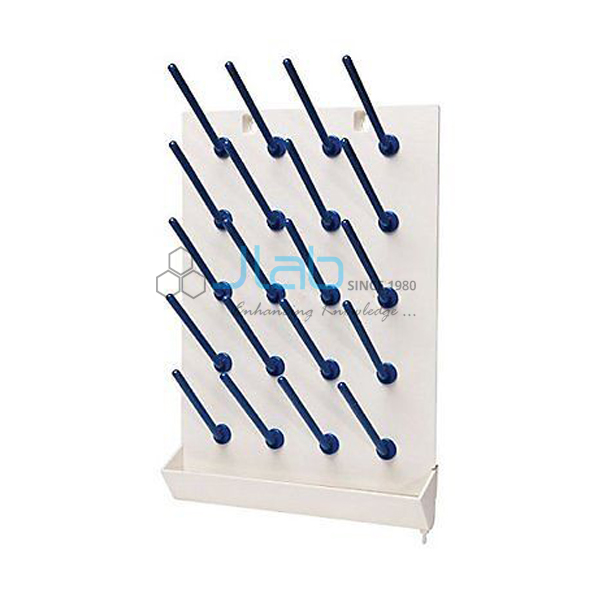
Draining Rack (code EL-SLE-5665) is a plastic rack in acrylonitrile butadiene / polycarbonate for draining test tubes, bottles and flasks after washing in school, college and research labs. Its back plate has 20 holes for pegs fixed with screw nuts, and a tray along the bottom catches the drained water and leads it through a drain tube into a container. It is made by Jain Laboratory Instruments Pvt Ltd (JLab) at its works in Ambala, India.
Specifications
| Parameter | Detail |
|---|---|
| Material | Acrylonitrile butadiene / polycarbonate |
| Back plate | 20 holes; pegs are tightened into them with screw nuts |
| Drip tray | Fitted at the bottom of the rack; collects the water drained from the glassware |
| Drain tube | Carries the collected water from the tray into a container |
| Durability | Does not rot, stain or rust |
| Quality check | Each draining rack is visually inspected before dispatch |
| Pack quantity | Each (sold individually) |
| Minimum order quantity | 10 units |
| Dispatch time | Usually 7–10 working days |
| Product code | EL-SLE-5665 |
| Manufacturer | Jain Laboratory Instruments Pvt Ltd (JLab) — OEM |
| Country of origin | India (made in Ambala, Haryana) |
How Does It Compare with Other JLab Draining Racks?
| Rack | Material | Details given in its listing |
|---|---|---|
| This rack (EL-SLE-5665) | Acrylonitrile butadiene / polycarbonate | 20-hole back plate with screw-nut pegs; drip tray with drain tube; does not rot, stain or rust |
| Draining Rack | Not stated | Same peg, tray and drain-tube design described |
| Draining Rack Hardwood | Hardwood | 50 hardwood pegs on a hardwood base; for storing, drying or dispensing test tubes and small graduates |
| Drying/Draining Rack | Acrylic drain pan | Self-standing or wall-mounted; holds up to 55 pieces on rubber-tipped pins; removable drain pan |
| Glassware Drying Rack | Northern hardwood | Wall-mounted; wooden pegs in two lengths; two hanging rings |
Choose this rack when you want a plastic rack whose drained water is piped away rather than left standing on the bench, and which will not rot or rust in a wet wash-up area. The hardwood racks suit labs that prefer wood and need more peg positions, and the Drying/Draining Rack suits larger loads.
What Is the Draining Rack Used For?
After glassware is washed and rinsed, it is placed upside down on the pegs so that water runs out of it instead of collecting inside. Hanging tubes, bottles and flasks this way lets them drain and air-dry, keeps clean items off the sink edge, and frees bench space in school chemistry and biology labs, college practical labs and research wash-up areas. The tray and drain tube keep the dripping water off the bench or floor below.
Put each item on a peg that fits its neck loosely enough for air to circulate, empty the collecting container regularly, and rinse the tray now and then so it stays clean. If a peg works loose, tighten its screw nut again. Glassware needed bone-dry for weighing or moisture-sensitive work is usually finished in a drying oven after draining.
What to Specify When Ordering
- Size and mounting — the listing does not give the rack’s dimensions, peg length or whether it is wall-mounted or free-standing; ask JLab if your sink area has limited space.
- Quantity — the minimum order is 10 racks; schools often plan one per wash-up sink.
- Cleaning brushes — add test tube and bottle brushes to the same enquiry if you are equipping a wash-up area.
Frequently Asked Questions
What material is the draining rack made of?
Acrylonitrile butadiene / polycarbonate plastic. The listing states that the rack does not rot, stain or rust, which suits wet wash-up areas where wooden or metal racks deteriorate.
How many pieces of glassware does it hold?
Up to 20 at a time, one on each peg. The back plate has 20 holes, and a peg is tightened into each hole with a screw nut.
Where does the drained water go?
Into the tray at the bottom of the rack. From the tray, a drain tube carries the water into a container you place below, so it does not run across the bench.
What are the dimensions of the rack?
The listing does not give them. Ask JLab for the overall size, the peg length and the mounting arrangement before ordering if space by the sink is limited.
Can I replace or re-tighten a loose peg?
Yes, the pegs are held by screw nuts, so a loose peg can be tightened again. Ask JLab when you enquire if you need spare pegs.
Who manufactures this draining rack?
Jain Laboratory Instruments Pvt Ltd, trading as JLab, makes it at its works in Ambala, Haryana, India, and quotes for it directly.
OEM Manufacturer
JLab is the trading name of Jain Laboratory Instruments Pvt Ltd, a manufacturer of school lab equipment and laboratory plasticware in India, incorporated in 2017 and based on Hargolal Road, Ambala, Haryana. The draining rack is made in JLab’s own works and not bought in from a trader, so schools, colleges, dealers and importers deal with the maker directly; each rack is checked by eye before it is packed, and repeat orders and spare parts come from the same works. JLab exports worldwide and ships to buyers in every region — for instance the UK in Western Europe, Vanuatu in Oceania, Cameroon in Central Africa, Egypt in North Africa and Sweden in Northern Europe. Tender buyers can see the JLab lab tenders page.
Glassware Washing and Drying
- Draining Rack — a rack listed with the same peg, tray and drain-tube design.
- Drying/Draining Rack — a self-standing or wall-mounted rack for larger loads.
- Draining Rack Hardwood — a hardwood alternative with more pegs for test tubes.
- Test Tube Brush — a cotton-head brush for scrubbing test tubes before draining.
- Bottle Brush — a bristle brush for bottles, beakers and flasks.
See more in the School Lab Equipment range.
Request a Quote
Quotes come direct from the manufacturer. Use the Add To Cart enquiry button on this page, or send the quantity (minimum 10 units), any brushes or spare pegs you need, and your delivery location through the contact page.
Last updated: 4 October 2026