Inertia Balance Manufacturer,Supplier and Exporter in India
Product Code : EL-SLE-5752
Jlab Export is a leading Inertia Balance Manufacturer,and suppliers in India
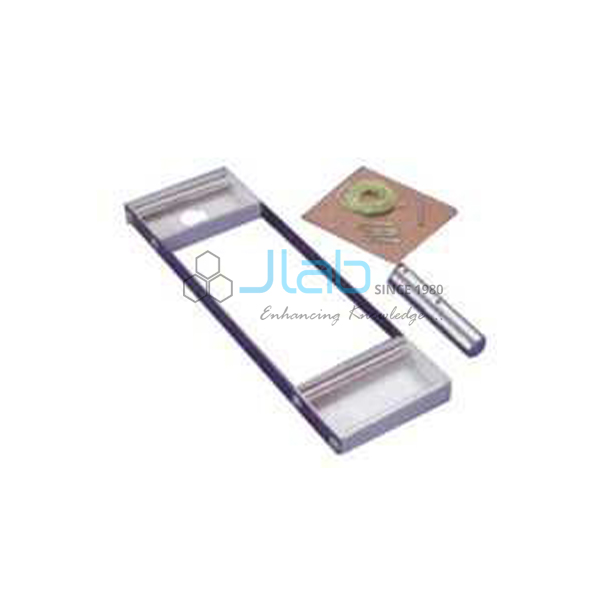
Inertia Balance (code EL-SLE-5752) is a physics teaching balance with three removable masses, used to explain the meaning of inertial mass in school and college mechanics lessons. Instead of weighing a load, it lets students compare masses by how they resist being set in motion, timing the balance as it swings sideways with different loads. It is made by Jain Laboratory Instruments Pvt Ltd (JLab) at its works in Ambala, India.
Specifications
| Parameter | Detail |
|---|---|
| Type | Inertia balance |
| Purpose | Explaining the meaning of inertial mass |
| Masses | Three removable masses |
| Quality check | Each balance is visually inspected before dispatch |
| Pack quantity | Each (sold individually) |
| Minimum order quantity | 10 units |
| Dispatch time | Usually 7–10 working days |
| Product code | EL-SLE-5752 |
| Manufacturer | Jain Laboratory Instruments Pvt Ltd (JLab) — OEM |
| Country of origin | India (made in Ambala, Haryana) |
How Does It Compare with Other JLab Inertia Apparatus?
| Model | What it shows | Listed details |
|---|---|---|
| This balance (EL-SLE-5752) | Meaning of inertial mass | Three removable masses |
| Inertia Balance JLab | Inertial mass measured quantitatively; motion independent of gravity | Frame with two aluminium trays joined by horizontal spring steel strips; oscillating tray holds cylindrical masses; anchor tray clamped with a C-clamp, which is not included |
| Inertia Apparatus JLab | Inertia of rest (Newton’s first law) | Steel ball on a card over a pillar; a spring-loaded striker flicks the card away and the ball stays |
Choose this balance for a compact inertial-mass demonstration with its own three masses; the other inertia balance gives a fully described tray-and-strip design for quantitative work, and the inertia apparatus is a quick demonstration of inertia of rest rather than a way to compare masses.
What Is the Inertia Balance Used For?
Mass has two faces: it gives an object weight in a gravitational field, and it makes the object resist changes in its motion. An inertia balance isolates the second. The load sits on a platform that is set swinging from side to side; because the motion is horizontal, gravity plays no part, and the more mass the platform carries, the longer each oscillation takes. Students time several oscillations with none, one, two and three of the removable masses, plot the square of the period against the added mass to get a calibration line, and then read off the mass of an unknown object from its period.
It supports the discussion of inertia and mass in the force and laws of motion chapter of class 9 science, and oscillation work in class 11 physics and college mechanics. Set the balance swinging with a small, sideways push, time ten or more oscillations for each load to reduce timing error, and do not load it with heavy objects that could bend the moving parts.
What to Specify When Ordering
- Quantity — the minimum order is 10 units.
- Details to confirm — the value of the three masses and how the balance is fixed to the bench, which this listing does not state.
- Companion apparatus — a spring balance for the weight-versus-mass comparison and a stopwatch for timing.
Frequently Asked Questions
What does an inertia balance measure?
Inertial mass: how strongly an object resists a change in motion. It compares masses through the period of a sideways oscillation, which does not depend on gravity, so it would give the same result on the Moon as on Earth.
What is supplied with this balance?
Three removable masses are listed with it. The value of each mass and the clamping arrangement are not given, so confirm them in your enquiry.
How is an unknown mass found with it?
Time the oscillations with the balance empty and with one, two and three of the supplied masses, plot the period squared against the added mass, then time the unknown object and read its mass from the graph.
How does it differ from the Inertia Balance JLab model?
Both show inertial mass. The other model is described in detail — two aluminium trays joined by spring steel strips, holes for cylindrical masses, and a C-clamp that must be bought separately — while this listing states the purpose and the three removable masses. Ask JLab if your choice depends on construction details.
What should an export enquiry include?
The quantity, the destination country and port or city, your preferred delivery terms (for example FOB or CIF), any packing or labelling requirements, and the tender reference if one applies.
Who manufactures this inertia balance?
Jain Laboratory Instruments Pvt Ltd, trading as JLab, makes it at its works in Ambala, Haryana, India, and quotes for it directly.
OEM Manufacturer
JLab is the trading name of Jain Laboratory Instruments Pvt Ltd, a manufacturer of mechanics and physics demonstration apparatus in India, incorporated in 2017 and based on Hargolal Road, Ambala, Haryana. The balance is produced in JLab’s own works, not bought from a trader, so schools, colleges, dealers and importers order it factory-direct; every unit is checked visually before dispatch, and spare masses or repeat orders come from the same manufacturer. JLab holds MSME Udyam registration UDYAM-HR-01-0003849 as a manufacturing enterprise and Importer-Exporter Code 3317504552. JLab exports worldwide and ships to buyers in every region — for example Slovenia in Southern Europe, Hong Kong in East Asia, Egypt in North Africa, Tonga in Oceania and Nepal in South Asia. For tenders, see the JLab lab tenders page.
Related Mass and Inertia Apparatus
- Spring Balance — a newton meter that measures weight, for contrasting weight with inertial mass.
- Variable Inertia Steel Bar — shows how the torque needed to accelerate a flywheel changes as its inertia is varied.
See the full School Lab Equipment range for more mechanics apparatus.
Request a Quote
Quotes come direct from the manufacturer. Use the Add To Cart enquiry button on this page, or send the quantity (minimum 10 units), any details you need confirmed and your delivery location through the contact page.
Last updated: 4 October 2026