Platinum Electrode Manufacturer,Supplier and Exporter in India
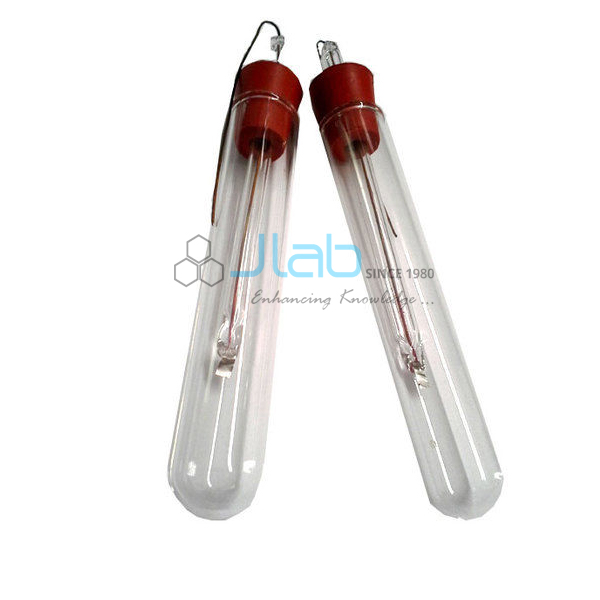
Product Code : EL-SLE-4681
Jlab Export is a leading Platinum Electrode Manufacturer,and suppliers in India
Platinum Electrode (code EL-SLE-4681) is a laboratory electrode made of platinum wire set into a glass rod, with a glass protection tube around it that is closed with a rubber stopper. Its main application is quantitative electrochemical analysis in college, university and research laboratories, where an unreactive platinum surface is needed. It is made by Jain Laboratory Instruments Pvt Ltd (JLab) at its works in Ambala, India.
Specifications
| Parameter | Detail |
|---|---|
| Electrode element | Platinum wire |
| Mounting | Wire inserted into a glass rod |
| Protection | Glass protection tube around the rod, closed with a rubber stopper |
| Main application | Quantitative electrochemical analysis in laboratories |
| Quality check | Each electrode is visually inspected before dispatch |
| Pack quantity | Each (sold individually) |
| Minimum order quantity | 10 units |
| Dispatch time | Usually 7–10 working days |
| Product code | EL-SLE-4681 |
| Manufacturer | Jain Laboratory Instruments Pvt Ltd (JLab) — OEM |
| Country of origin | India (made in Ambala, Haryana) |
How Does It Compare with Other JLab Platinum Electrodes?
| Item | Platinum form | Construction as listed |
|---|---|---|
| This Platinum Electrode (EL-SLE-4681) | Wire | Wire in a glass rod, inside a glass protection tube closed with a rubber stopper |
| Electrode Platinum (pair) | Rectangular foil, supplied as a pair | Foil fused into a protective glass tube; internal lead through the tube and rubber stopper to screw terminals |
| Platinum Wire | Wire | Wire fused into a glass rod, protected in a glass tube |
Choose this electrode for analytical work with a single platinum wire electrode. The foil pair exposes more metal to the solution and suits electrolysis of water, while the platinum wire listing is a similar glass-mounted wire.
What Is a Platinum Electrode Used For?
Platinum is chosen because it is very unreactive: it carries current into a solution without dissolving or taking part in the reaction itself. In quantitative electrochemical analysis it serves as the indicator electrode in potentiometric redox titrations and as an inert working or counter electrode in electrolysis experiments. College and university chemistry labs also use platinum electrodes to measure redox potentials and to study electrolysis products, where a copper or zinc electrode would react with the solution.
Rinse the electrode with distilled water after each use and let it dry in its protection tube. Do not bend or pull the exposed wire, keep it away from aqua regia, which dissolves platinum, and wipe off any deposit gently rather than scraping it.
What to Specify When Ordering
- Quantity — the minimum order is 10 units.
- Wire size and connection — if your method or tender gives a wire length, diameter or connector type, include it so JLab can confirm.
- Companion electrodes — carbon, copper, lead or zinc electrode rods and platinum foil pairs can be added to the same enquiry.
Frequently Asked Questions
What is this platinum electrode used for?
Mainly quantitative electrochemical analysis, such as potentiometric redox titrations and electrolysis, where an inert electrode that does not react with the solution is required.
How is the electrode built?
A platinum wire is inserted into a glass rod, and a glass protection tube surrounds it; the tube is closed with a rubber stopper.
Why platinum and not copper or carbon?
Platinum hardly reacts with acids, alkalis or most oxidising agents, so it does not dissolve or add products of its own to the solution. That keeps measurements tied to the reaction being studied.
What wire length and diameter does it have?
These are not stated in the listing. Ask JLab for the details, or give the size your method requires.
What should an export enquiry include?
The quantity, any wire or connector requirements, the destination country and port or city, your preferred delivery terms (for example FOB or CIF), packing or labelling needs, and the tender reference if there is one.
Who manufactures this platinum electrode?
JLab (Jain Laboratory Instruments Pvt Ltd) makes it at its works in Ambala, Haryana, India, and quotes for it directly as the manufacturer.
OEM Manufacturer
JLab is the trading name of Jain Laboratory Instruments Pvt Ltd, a manufacturer of electrochemistry and teaching lab apparatus in India, incorporated in 2017 and based on Hargolal Road, Ambala, Haryana. The platinum electrode is made at JLab’s own works rather than bought in from a trader, so colleges, research labs, dealers and importers deal with the factory directly, each electrode is visually inspected before dispatch, and repeat orders are handled by the manufacturer. JLab exports worldwide and can deliver to buyers in every region — for example Mexico in North America, Vanuatu in Oceania, Morocco in North Africa, Georgia in Eastern Europe and Kyrgyzstan in Central Asia. Tender buyers can refer to the JLab lab tenders page.
Related Electrochemistry Items
- Electrode Platinum (pair) — a pair of platinum foil electrodes in glass tubes with screw terminals.
- Platinum Wire — platinum wire fused into a glass rod and protected in a glass tube.
- Electrode Rods — carbon, copper, lead or zinc rods with terminals for electrolysis and simple cells.
- Hoffman Voltameter with All Accessories — an electrolysis apparatus for showing the composition of water.
Find more apparatus in the School Lab Equipment range.
Request a Quote
Quotes come direct from the manufacturer. Use the Add To Cart enquiry button on this page, or send the quantity (minimum 10 units), any wire or connector requirements, and your delivery location through the contact page.
Last updated: 4 October 2026