
Voltmeters Dual Range Manufacturer,Supplier and Exporter in India
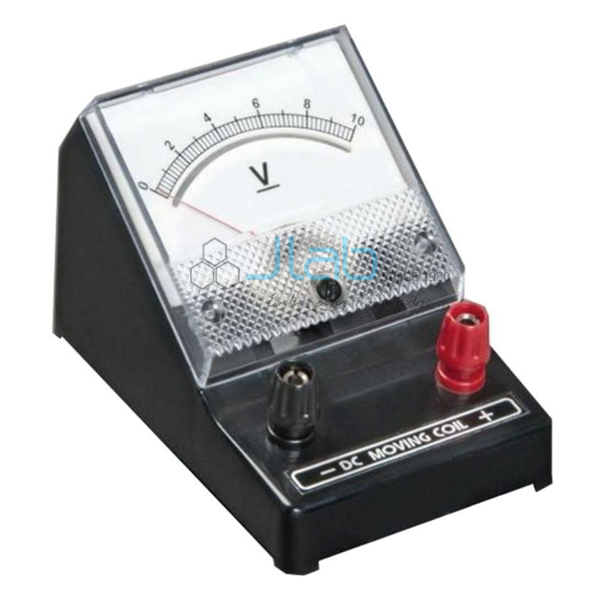
Product Code : EL-SLE-4649
Jlab Export is a leading Voltmeters Dual Range Manufacturer,and suppliers in India
Voltmeters Dual Range (code EL-SLE-4649) are voltmeters on a white stand for measuring the potential difference, or voltage, between two points in a circuit, listed in ranges of 0–1 V and 0–3 V and in the dual ranges 0–1/2.5 V and 0–3/15 V. They are used across school and college electrical experiments, from Ohm’s law to cell and diode practicals. They are made by Jain Laboratory Instruments Pvt Ltd (JLab) at its works in Ambala, India.
Specifications
| Parameter | Detail |
|---|---|
| Measures | Potential difference (voltage) between two points in a circuit |
| Ranges listed | 0–1 V, 0–3 V, 0–1/2.5 V and 0–3/15 V; a 2.5/5 range is also listed, with the unit given as amperes — confirm it before ordering |
| Stand | White stand |
| Quality check | Each meter is visually inspected before dispatch |
| Pack quantity | Each (sold individually) |
| Minimum order quantity | 10 units |
| Dispatch time | Usually 7–10 working days |
| Product code | EL-SLE-4649 |
| Manufacturer | Jain Laboratory Instruments Pvt Ltd (JLab) — OEM |
| Country of origin | India (made in Ambala, Haryana) |
How Does It Compare with JLab’s Current Meters?
| Model | Measures | Ranges listed | How it is connected |
|---|---|---|---|
| This voltmeter (EL-SLE-4649) | Potential difference | 0–1, 0–3 V; dual 0–1/2.5 and 0–3/15 V | In parallel, across the component |
| Ammeter | Current | 0–1, 0–2.5 or 0–5 A; dual 0–1/3 or 0–2.5/5 A | In series |
| Milliammeters (Dual Range) | Small currents | 0–1 mA up to 0–500 mA | In series |
| Digital Ammeter | Current, digital display | 0–1.999 A and 0–19.99 A | In series |
An Ohm’s law set needs one voltmeter and one current meter. Pair a 0–3/15 V voltmeter with the ammeter for resistor circuits run from cells or a low-voltage supply, and a 0–1/2.5 V voltmeter with a milliammeter for diode and LED work.
What Is a Voltmeter Used For?
A voltmeter measures the potential difference between the two points it touches, so it is always connected in parallel with the component — one lead on each side — and has a high resistance so that it draws very little current. In the class 10 Ohm’s law activity students read the voltage across a resistor at several settings of a rheostat and plot it against the current; the same meter measures the terminal voltage of a cell, the voltage shared between resistors in series, and, in class 12, the forward voltage of a p-n junction diode, which is below one volt for a silicon diode — where the 0–1 V range gives the finest reading.
On a dual-range meter, connect to the higher range first and move to the lower one only if the reading is small. The 0–15 V range covers low-voltage DC supplies up to 12 V; the 0–3 V range suits one or two cells. On a scale meter, work out the least count before reading, and in D.C. circuits connect the positive terminal to the higher-potential side.
What to Specify When Ordering
- Range — 0–1 V, 0–3 V, 0–1/2.5 V or 0–3/15 V, with the quantity of each.
- Circuit type — state whether the voltmeters are for D.C. or A.C. use.
- Quantity — the minimum order is 10 meters.
- Matching current meters, rheostats and a power supply for complete Ohm’s law sets.
Frequently Asked Questions
Which voltage ranges are available?
0–1 V and 0–3 V, and the dual ranges 0–1/2.5 V and 0–3/15 V. The listing also shows a 2.5/5 range with the unit given as amperes; ask JLab to confirm that option if you need it.
How is a voltmeter connected?
In parallel with the component, with one lead on each side of it. Connected in series it would block the current, because its resistance is very high.
Which range should I choose for Ohm’s law?
For circuits run from cells or a low-voltage supply, the 0–3/15 V dual-range meter covers both small and larger voltages. For diode forward-bias readings the 0–1 V or 0–1/2.5 V meter reads more finely.
Is it for A.C. or D.C.?
The listing does not say. State the circuit type in your enquiry and JLab will confirm the meter.
Who manufactures these voltmeters?
Jain Laboratory Instruments Pvt Ltd (JLab) makes them at its works in Ambala, Haryana, India, and quotes for them directly.
OEM Manufacturer
JLab is the trading name of Jain Laboratory Instruments Pvt Ltd, a teaching-laboratory instrument manufacturer in India, incorporated in 2017 and based on Hargolal Road, Ambala, Haryana. These voltmeters are built at JLab’s own works rather than bought in from a trader, so schools, colleges, dealers and importers buy them factory-direct; every meter gets a visual check before dispatch, and repeat orders are handled by the manufacturer. JLab exports worldwide and ships to buyers in every region — for example Lesotho in Southern Africa, Jamaica in Central America and the Caribbean, Uruguay in South America, the UAE in the Middle East and Fiji in Oceania.
Complete the Circuit
- Battery Eliminator (0-12 Volts) — a DC power pack used in place of batteries.
- Rheostats (Continuous Constantan Type) — for varying the voltage across the component.
- Plug Key — for closing the circuit only while reading.
- Diode Mounted — a diode valve on a transparent base for diode demonstrations.
Browse more apparatus in the School Lab Equipment range.
Request a Quote
Quotes come direct from the manufacturer. Use the Add To Cart enquiry button on this page, or send the ranges and quantity (minimum 10 units), the circuit type, and your delivery location through the contact page.
Last updated: 4 October 2026