Dissecting Kit Manufacturer,Supplier and Exporter in India
Product Code : EL-SLE-5624
Jlab Export is a leading Dissecting Kit Manufacturer,and suppliers in India
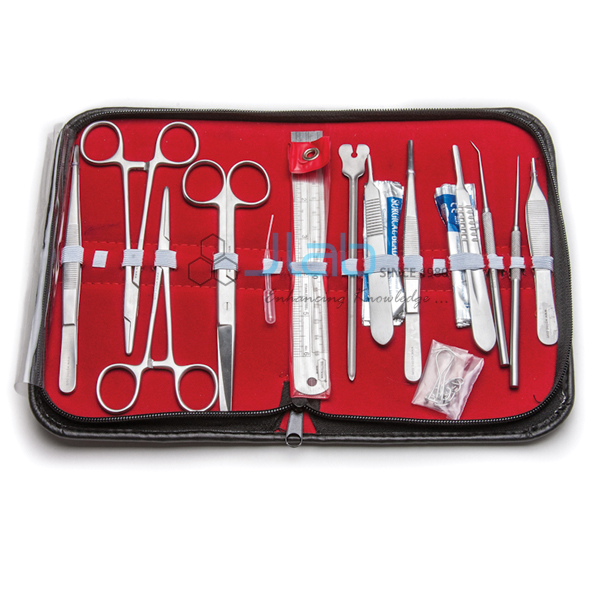
Dissecting Kit (code EL-SLE-5624) is a stainless steel dissection set in a folding pouch, used for plant and animal dissection and for cutting hand sections in school and college biology labs. It holds 13 listed items, one of each, from fine- and blunt-point scissors and forceps to two fixed-blade scalpels and a section lifter. It is made by Jain Laboratory Instruments Pvt Ltd (JLab) at its works in Ambala, India.
Specifications
| Parameter | Detail |
|---|---|
| Instrument material | Stainless steel, except the blow pipe (nickelled brass) and the razor (carbon steel), as listed |
| Case | Folding pouch (pouch material not stated in the listing) |
| Dissecting scissors | One straight with fine points, 100 mm; one straight with blunt points, 125 mm |
| Dissecting forceps | One straight with fine points, 100 mm; one straight with blunt points, 125 mm |
| Needles | One needle with lancet point; one pointed needle |
| Seeker | One |
| Section lifter | One |
| Scalpels | Two with fixed blades, listed as 38 mm and 50 mm |
| Blow pipe | One, nickelled brass |
| Hooks and chain | One set |
| Razor | One, carbon steel |
| Items listed | 13, one of each |
| Quality check | Each kit is visually inspected before dispatch |
| Pack quantity | Each (one kit with the listed contents) |
| Minimum order quantity | 10 units |
| Dispatch time | Usually 7–10 working days |
| Product code | EL-SLE-5624 |
| Manufacturer | Jain Laboratory Instruments Pvt Ltd (JLab) — OEM |
| Country of origin | India (made in Ambala, Haryana) |
How Does It Compare with Other JLab Dissection Kits?
| Kit | Items | Material | Case and listed contents |
|---|---|---|---|
| This kit (EL-SLE-5624) | 13 listed | Stainless steel; brass blow pipe, carbon steel razor | Folding pouch; scissors and forceps in fine and blunt points, two needles, seeker, section lifter, two fixed-blade scalpels, blow pipe, hooks and chain, razor |
| Dissection Kit With 14 Instruments | 14 | Surgical steel (as listed) | Contents and case not itemised in its listing |
| Dissecting (Set of 14 Instruments) | 14 | Stainless steel | Zipper leather case; scissors, forceps, needles, scalpel, B.P. handle with blade, razor, magnifying glass, chain and hook, blow pipe |
| Dissection Kit With 18 Instruments | 18 | Surgical steel (as listed) | Offered in regular and superior types |
Choose this kit when you want every instrument and its size spelled out before you order, with a pair of scissors and a pair of forceps in both fine and blunt points, two fixed-blade scalpels and a section lifter for slide work. The leather-cased 14-instrument set adds a magnifying glass and a B.P. handle with a replaceable blade, and the 18-instrument kit suits teachers who want a larger selection.
What Is the Dissecting Kit Used For?
This is the dissection box that biology students keep at the bench for practical work. In class 11 biology practicals it is used to take flowers apart to identify the sepals, petals, stamens and carpels, and to cut thin transverse sections of dicot and monocot stems and roots with the razor; the section lifter then moves each section onto a slide for staining and viewing under the microscope. In college botany and zoology labs the same tools are used on preserved specimens: fine-point scissors and forceps for delicate cuts, blunt-point scissors to open a body cavity with less risk of damaging the organs beneath, the seeker to separate tissues and trace nerves or vessels without cutting, the blow pipe to inflate hollow organs so they can be seen clearly, and the hooks and chain to hold back flaps of skin while students work.
Scalpels and the razor are sharp, so school use should be supervised and blades kept covered when not in use. After each practical, wash the instruments, dry them fully before returning them to the pouch, and give the carbon steel razor a light film of oil, because carbon steel rusts far more readily than stainless steel.
What to Specify When Ordering
- Kit choice — this 13-item kit in a folding pouch, or one of the 14- or 18-instrument sets compared above.
- Quantity — the minimum order is 10 kits; schools often plan one per student pair for class 11 and class 12 practical batches.
- Work surfaces — dissecting dishes, trays or boards are separate items and can go on the same enquiry.
- Spare instruments — list any extra needles or scalpels you want with the kits so they are quoted together.
Frequently Asked Questions
What instruments are in this dissecting kit?
Thirteen items, one of each: straight dissecting scissors with fine points (100 mm) and with blunt points (125 mm), straight dissecting forceps in the same two versions, a needle with a lancet point, a pointed needle, a seeker, a section lifter, fixed-blade scalpels of 38 mm and 50 mm, a nickelled brass blow pipe, a hooks and chain set and a carbon steel razor, all in a folding pouch.
Are all the instruments stainless steel?
Most of them. The kit is described as stainless steel, but the item list gives the blow pipe as nickelled brass and the razor as carbon steel. Dry the razor after washing and keep it lightly oiled to stop rust.
What are the blow pipe and the hooks and chain for?
The blow pipe is used to inflate hollow organs so their shape can be seen during a dissection, and the hooks on the chain hold back flaps of skin or tissue so both hands stay free for the instruments.
How does this kit differ from the 14- and 18-instrument kits?
This kit lists its 13 items with sizes and comes in a folding pouch. The Dissecting (Set of 14 Instruments) comes in a zipper leather case and adds a magnifying glass and a B.P. handle with blade, while the 14- and 18-instrument dissection kits are listed in surgical steel without an itemised contents list. Ask JLab to compare full contents if your syllabus needs a particular tool.
Can the scalpels take replacement blades?
No. Both scalpels in this kit are listed with fixed blades. If you prefer a handle with replaceable blades, the 14-instrument leather-cased set includes a B.P. handle with blade.
Is a dissecting dish, tray or board included?
No. This listing covers the instruments and the pouch only. Dissecting dishes, trays and boards are separate catalogue items, linked below, and can be added to the same enquiry.
What should an export enquiry include?
Give the number of kits, the destination country and port or city, the delivery terms you want (for example FOB or CIF), any packing or labelling needs, and the tender reference if you are buying against a tender.
Who makes this dissecting kit?
Jain Laboratory Instruments Pvt Ltd, trading as JLab, makes it at its works in Ambala, Haryana, India, and quotes for it directly.
OEM Manufacturer
JLab is the trading name of Jain Laboratory Instruments Pvt Ltd, a manufacturer of biology lab instruments and school science equipment in India, incorporated in 2017 and based on Hargolal Road, Ambala, Haryana. The dissecting kit is assembled at JLab’s own works rather than bought in from a trader, so schools, colleges, dealers and importers buy it factory-direct; each kit is checked by eye before it is packed, and repeat orders are handled by the manufacturer itself. The company holds GSTIN 06AADCJ9848D1ZE and Legal Entity Identifier 549300DTGS77DGYD6N03. JLab exports worldwide and ships to buyers in every region — for example DR Congo in Central Africa, Guyana in South America, South Korea in East Asia, Malta in Southern Europe and Mozambique in East Africa. Institutions buying through a tender can find details on the JLab lab tenders page.
Dissection Work Surfaces and Spare Instruments
- Dissecting Dishes — dishes with a white wax layer on the bottom for pinning specimens.
- Dissecting Trays — galvanised iron sheet trays, with or without a wax layer.
- Dissecting Board — a one-piece softwood board that takes pins pushed in by hand.
- Dissecting Needles — spare needles with hardwood handles.
- Scalpel Knife Stainless Steel — a separate stainless steel dissection knife.
See more in the School Lab Equipment range.
Request a Quote
Quotes come direct from the manufacturer. Use the Add To Cart enquiry button on this page, or send the number of kits (minimum 10 units), any spare instruments or dissecting trays you need, and your delivery location through the contact page.
Last updated: 4 October 2026