Dissecting Board Manufacturer,Supplier and Exporter in India
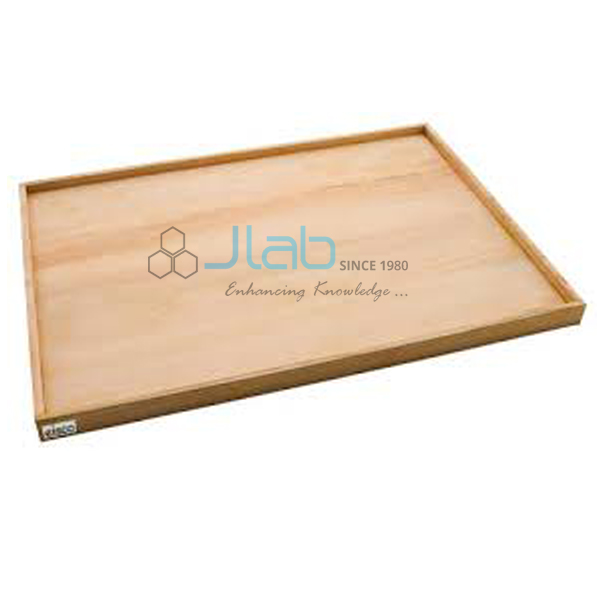
Product Code : EL-SLE-4742
Jlab Export is a leading Dissecting Board Manufacturer,and suppliers in India
Dissecting Board (code EL-SLE-4742) is a seamless, one-piece softwood board used as the work surface for dissecting specimens in school and college biology labs. The soft wood lets students push pins in by hand to hold a specimen open, and the board is custom made in two sizes, 8 x 10 in and 12 x 18 in. It is made by Jain Laboratory Instruments Pvt Ltd (JLab) at its works in Ambala, India.
Specifications
| Parameter | Detail |
|---|---|
| Material | Softwood, custom made |
| Construction | Seamless, one piece |
| Sizes | 8 x 10 in (about 20.3 x 25.4 cm) and 12 x 18 in (about 30.5 x 45.7 cm) |
| Pinning | Takes pins pushed in by hand |
| Use | Dissection of specimens |
| Quality check | Each board is visually inspected before dispatch |
| Pack quantity | Each (sold individually) |
| Minimum order quantity | 10 units |
| Dispatch time | Usually 7–10 working days |
| Product code | EL-SLE-4742 |
| Manufacturer | Jain Laboratory Instruments Pvt Ltd (JLab) — OEM |
| Country of origin | India (made in Ambala, Haryana) |
How Does It Compare with Other JLab Dissecting Surfaces?
| Item | Material | Listed details |
|---|---|---|
| This dissecting board (EL-SLE-4742) | Softwood, one piece | 8 x 10 in or 12 x 18 in; pins go in by hand |
| Dissecting Trays | Galvanised iron sheet | Tray with raised sides, with or without a wax layer |
| Dissecting Dishes | Dish with a white wax layer on the bottom | Wax base for pinning |
Choose the board for dry or lightly moist work — plant material, flowers and pinned specimens — where a flat, pin-friendly surface is all you need. For wet specimens a dissection tray or wax-bottomed dish is the better choice, because the raised sides hold the liquid.
What Is a Dissecting Board Used For?
A dissecting board gives each student or pair a firm, flat surface on which to lay out and open a specimen. Pins pushed through the specimen into the soft wood hold skin, petals or tissue back so the parts underneath can be seen, labelled and drawn. Schools use it in biology practicals for studying the parts of a flower, for pinning out preserved specimens and models of dissection, and for mounting insects; colleges use it in botany and zoology labs. The larger 12 x 18 in size gives room for bigger specimens and for instruments laid beside the work, while the 8 x 10 in board suits individual student work and smaller specimens.
Cover the board with paper or a plastic sheet for messy work, keep scalpels and scissors angled away from your hand, and count pins in and out so none are lost. After use, wipe the surface clean, disinfect it according to your lab’s procedure, and let it dry flat; do not leave the wood soaking in water.
What to Specify When Ordering
- Size — 8 x 10 in or 12 x 18 in, with the number of each.
- Quantity — the minimum order is 10 boards; a typical class set is one per student or pair.
- Instruments and pins — dissection kits, scissors, forceps and pins are separate items and can be added to the same enquiry.
Frequently Asked Questions
What is the dissecting board made of?
Softwood, made as a single seamless piece. The soft wood is what allows pins to be pushed in by hand.
What sizes are available?
Two: 8 x 10 in (about 20.3 x 25.4 cm) and 12 x 18 in (about 30.5 x 45.7 cm). State the size and quantity of each in your enquiry.
Do I need a hammer or pin pusher?
No. According to the listing, the board takes pins easily with the hands alone.
Are pins or dissecting instruments included?
No, the listing covers the board only. Pins, dissection kits, scissors and forceps are separate catalogue items, linked below.
Board, tray or wax dish — which should we buy?
A board suits dry work and pinning on a flat surface. For wet specimens choose a dissecting tray or a dish with a wax layer, which have raised sides.
What details should an export enquiry include?
Quantities per size, the destination country and port or city, preferred delivery terms such as FOB or CIF, packing or labelling instructions, and any tender reference.
Who makes the dissecting board?
Jain Laboratory Instruments Pvt Ltd (JLab) at its works in Ambala, Haryana, India.
OEM Manufacturer
JLab is the trading name of Jain Laboratory Instruments Pvt Ltd, an Indian manufacturer of biology lab equipment and other school science apparatus, incorporated in 2017 and based on Hargolal Road, Ambala, Haryana. The dissecting board is made in JLab’s own works rather than bought from a trader, so schools, colleges, dealers and importers order it direct from the maker; every board is visually checked before dispatch, and repeat orders in either size are handled by the manufacturer. JLab exports worldwide and ships to buyers in every region — for example South Africa in Southern Africa, Australia in Oceania, Paraguay in South America, Togo in West Africa and Libya in North Africa. Tender buyers can refer to the JLab lab tenders page.
Dissection Tools and Accessories
- Dissection Kit With 14 Instruments — a complete steel dissection set for a student or bench pair.
- Dissecting Scissors — stainless steel scissors for cutting specimens and plant material.
- Dissection Forceps Sharp — sharp-tipped steel forceps for holding small parts.
- Pin Entomological — chrome-plated pins for holding specimens on the board.
Browse the School Lab Equipment range for more biology apparatus.
Request a Quote
Quotes come direct from the manufacturer. Use the Add To Cart enquiry button on this page, or send the quantity (minimum 10 units) in each size, any instruments or pins you need, and your delivery location through the contact page.
Last updated: 4 October 2026