Combined Convection and Radiation Manufacturer,Supplier and Exporter in India
Product Code : EL-HTTLP-9207
Jlab Export is a leading Combined Convection and Radiation Manufacturer,and suppliers in India
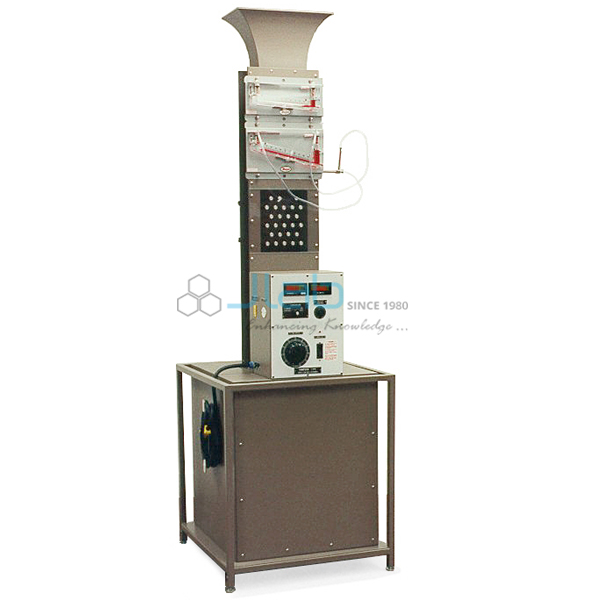
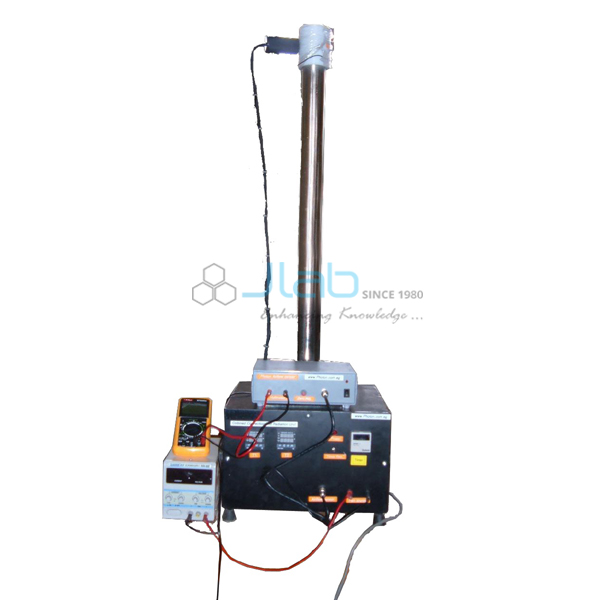
Combined Convection and Radiation (code EL-HTTLP-9207) is a bench-top accessory in which a horizontal heated cylinder, with a heater rated 100 W at 24 V DC, sits in a vertical duct with a fan at its base, to separate convective from radiative heat loss. Air flow is adjustable over 0–7 m/s electronically on the computer-controlled unit, or by hand on the manual one. JLab makes this convection and radiation accessory in Ambala, India.
Specifications
| Parameter | Detail |
|---|---|
| Test element | Horizontal heated cylinder in a vertical air duct |
| Heater rating | 100 W at 24 V DC |
| Air flow | Fan at the base of the duct; 0–7 m/s by variable-speed fan on the computer-controlled unit, manually adjusted otherwise |
| Temperature sensors | K-type thermocouples for upstream air and cylinder surface temperature |
| Air flow measurement | Vane-type anemometer in the outlet duct |
| Mounting | PVC baseplate; stands on the bench and connects to the Heat Transfer Service Unit without tools |
| Quality check | Each convection and radiation unit is visually inspected before dispatch |
| Pack quantity | Each (sold individually) |
| Minimum order quantity | 1 unit |
| Dispatch time | Usually 14–18 working days |
| Product code | EL-HTTLP-9207 |
| Manufacturer | Jain Laboratory Instruments Pvt Ltd (JLab) — OEM |
| Country of origin | India (made in Ambala, Haryana) |
Splitting the Loss into Convection and Radiation
At steady state the electrical power to the heater equals the total heat lost from the cylinder surface, the sum of a convective and a radiative part: Q = (h_c + h_r) × A × (Ts − Ta), where Ts is the surface temperature, Ta the air temperature and A the cylinder surface area. Treating the surroundings as being at the air temperature, the radiative coefficient comes from the Stefan–Boltzmann law, h_r = εσ(Ts⁴ − Ta⁴)/(Ts − Ta), with both temperatures in kelvin, σ the Stefan–Boltzmann constant and ε the emissivity of the cylinder surface. Once h_r is worked out from the two thermocouple readings, the rest of the loss gives the convective coefficient h_c.
From Natural to Forced Convection
With the fan stopped, air moves past the cylinder by natural convection alone and the radiative share of the loss is at its greatest. As the fan speed and air velocity rise, the convective coefficient grows, the surface runs cooler for the same heater power, and the radiative share falls. The vane-type anemometer in the outlet duct gives the air velocity for each run, so h_c can be plotted against velocity and compared with the free-convection value.
Other Convection and Radiation Experiments
- Heat Transfer In Natural Convection — heated brass tube in an open vertical duct with an acrylic window.
- Heat Transfer In Forced Convection — blower-fed test pipe with an orifice for air flow and a Nichrome heater.
- Stefan Boltzmann Apparatus — copper test disc in a hot-water-heated hemisphere for finding the constant.
- Emissivity Measurement Apparatus — test plate compared with an identical blackened plate to find emissivity.
The accessory is grouped in Heat Transfer Through Lagged Pipe under Heat Transfer Lab Equipment.
Request a Quote
Tell us whether you want the computer-controlled or the manual air-flow version, plus the quantity and the delivery address, using Add To Cart or the contact page.
Last updated: 30 October 2026