Parallel and Counter Flow Heat Exchanger Manufacturer,Supplier and Exporter in India
Product Code : EL-HTTLP-9221
Jlab Export is a leading Parallel and Counter Flow Heat Exchanger Manufacturer,and suppliers in India
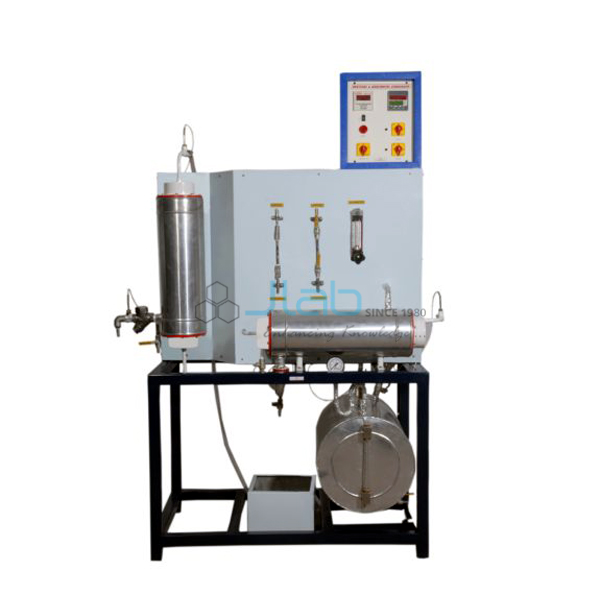
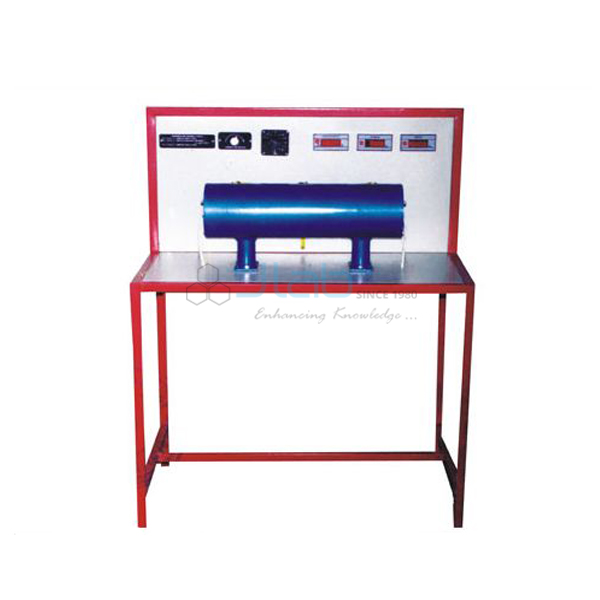
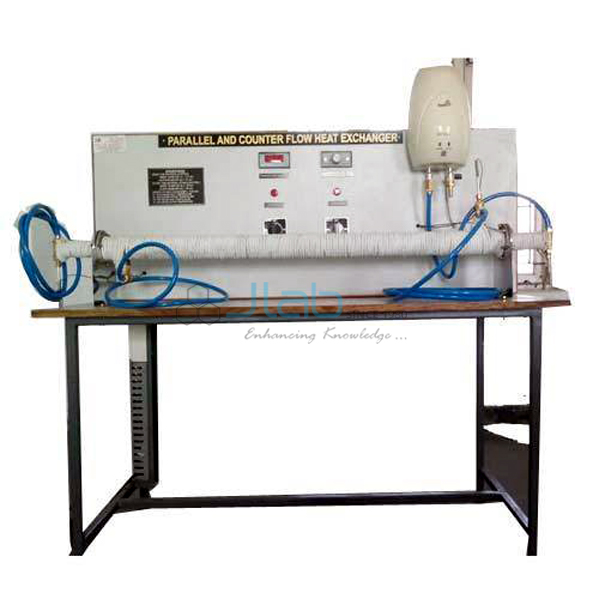
Parallel and Counter Flow Heat Exchanger (code EL-HTTLP-9221) is a concentric-tube heat exchanger in which hot water runs through the inner tube and cold water through the outer tube, with the cold-water direction switchable so the same unit works as a parallel-flow or a counter-flow exchanger. JLab builds this parallel and counter flow exchanger in Ambala, India.
Specifications
| Parameter | Detail |
|---|---|
| Type | Concentric tube heat exchanger |
| Hot water | Through the inner tube, one direction only |
| Cold water | Through the outer tube, parallel or counter to the hot water |
| Hot water circuit | Magnetic drive pump; recirculating tank with heaters and digital temperature controller |
| Flow measurement | Rotameters for hot and cold water |
| Electricity supply | Single phase, 220 V AC, 3 kW |
| Water supply | 10 litres/min (approx.) and drain |
| Floor area | 2 m x 0.6 m |
| Quality check | Each heat exchanger is visually inspected before dispatch |
| Pack quantity | Each (sold individually) |
| Minimum order quantity | 1 unit |
| Dispatch time | Usually 14–18 working days |
| Product code | EL-HTTLP-9221 |
| Manufacturer | Jain Laboratory Instruments Pvt Ltd (JLab) — OEM |
| Country of origin | India (made in Ambala, Haryana) |
Why Counter Flow Gives the Larger LMTD
The log mean temperature difference is LMTD = (ΔT1 − ΔT2)/ln(ΔT1/ΔT2), where ΔT1 and ΔT2 are the hot-to-cold temperature differences at the two ends. In parallel flow both streams enter at the same end, so the difference starts large and shrinks along the tube; in counter flow the cold water enters where the hot water leaves, and the difference stays more even.
For the same four inlet and outlet temperatures, counter flow gives the larger LMTD, so it needs less area for the same duty; with the same exchanger, inlet temperatures and flows, it transfers more heat. Only in counter flow can the cold water leave hotter than the hot water does.
Results Worked Out from Each Run
The rotameter flow rates and the inlet and outlet temperatures give the heat given up by the hot water and gained by the cold water, Q = mass flow × specific heat × temperature change; any gap between the two is heat lost to or gained from the room. Dividing Q by the heat transfer area and the LMTD gives the overall heat transfer coefficient U, and effectiveness compares Q with the maximum possible, C_min × (hot inlet − cold inlet), where C_min is the lower of the two heat capacity rates. With the tank temperature held by its digital controller, both arrangements can be run at the same flows and hot-water inlet temperature.
Other Concentric and Shell-and-Tube Exchangers
- Parallel Flow and Counter Flow Heat Exchanger — copper inner tube in a GI outer tube, heated by an instantaneous geyser.
- Concentric Tube Heat Exchanger — plain-tube water-to-water and finned-tube water-to-air versions.
- Shell and Tube Heat Exchanger — two-pass exchanger with copper tubes and baffles in an SS shell.
This exchanger appears in Heat Transfer Through Lagged Pipe, under Heat Transfer Lab Equipment.
Request a Quote
Ask for a quotation through Add To Cart or the contact page, giving the quantity, the delivery address and the electricity supply available at your laboratory.
Last updated: 30 October 2026