Vertical and Horizontal Condenser Manufacturer,Supplier and Exporter in India
Product Code : EL-HTTLP-9226
Jlab Export is a leading Vertical and Horizontal Condenser Manufacturer,and suppliers in India
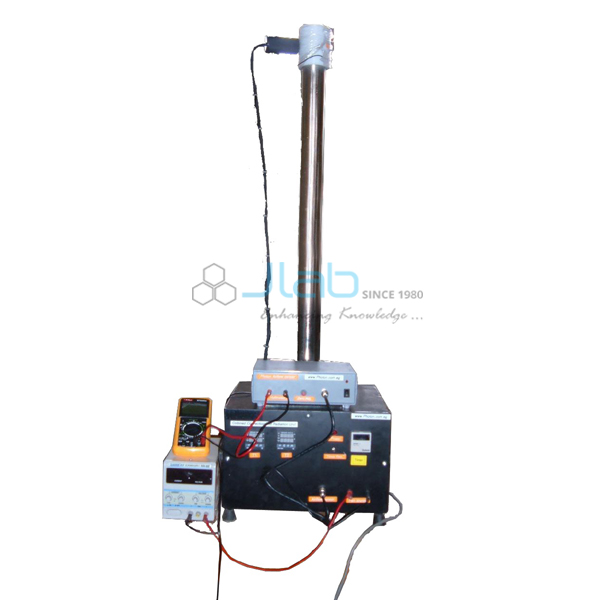
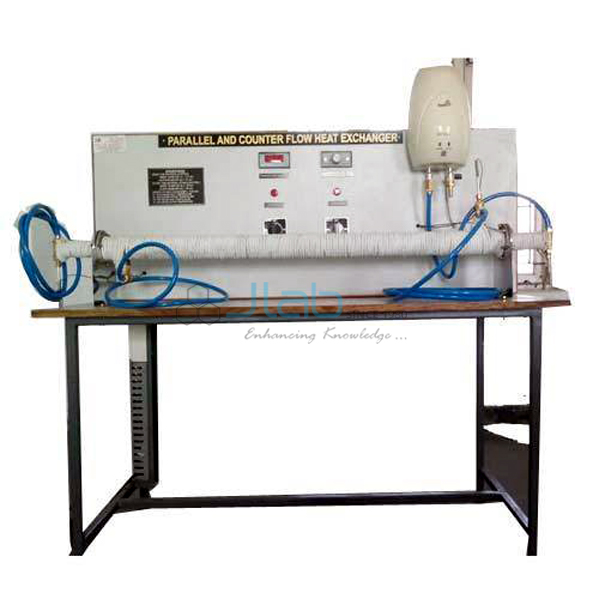
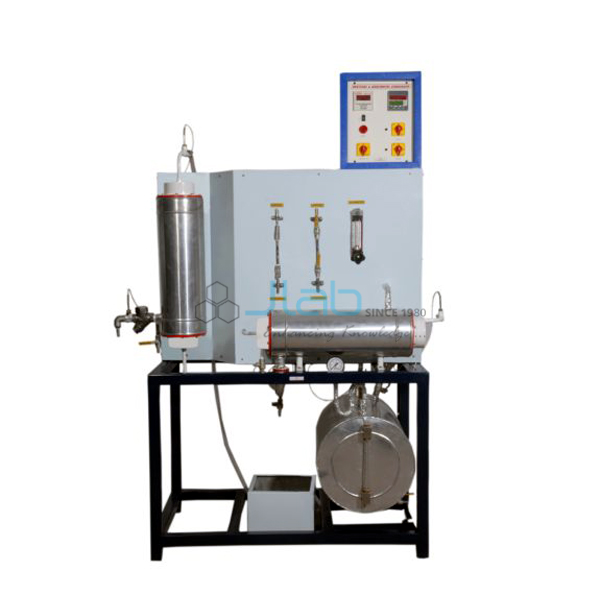
Vertical and Horizontal Condenser (code EL-HTTLP-9226) is a steam-to-water shell and tube condenser set-up with two condensers, one vertical and one horizontal, run one at a time so their heat transfer coefficients can be compared. Steam from a stainless steel steam generator flows through the shell while cooling water runs inside the tubes. These twin condensers are produced by JLab in Ambala, India.
Specifications
| Parameter | Detail |
|---|---|
| System | Steam to water, shell and tube |
| Condensers | 2 (vertical and horizontal), operated one at a time |
| Shell | Stainless steel, inner dia. 100 mm, length 500 mm (approx.) |
| Tubes | Stainless steel, OD 12.7 mm, length 500 mm |
| Insulation | Ceramic wool with aluminium foil cladding |
| Steam generator | Stainless steel; level indicator, pressure gauge, safety valve, drain; ceramic wool and aluminium foil insulation |
| Heater | Nichrome wire heater |
| Condensate measurement | Steam traps on the shell; measuring cylinder and stopwatch |
| Cooling water | Flow control valves; rotameter |
| Temperature measurement | Sensors at the inlet and outlet of both steam and water |
| Quality check | Each condenser set-up is visually inspected before dispatch |
| Pack quantity | Each (sold individually) |
| Minimum order quantity | 1 unit |
| Dispatch time | Usually 14–18 working days |
| Product code | EL-HTTLP-9226 |
| Manufacturer | Jain Laboratory Instruments Pvt Ltd (JLab) — OEM |
| Country of origin | India (made in Ambala, Haryana) |
Overall and Film Coefficients from One Run
Steam condenses on the outside of the tubes at its saturation temperature Ts while the cooling water inside warms from T_in to T_out. The rotameter flow and that rise give the heat removed, Q = mass flow × specific heat × (T_out − T_in), and the condensate collected in the measuring cylinder over a timed interval, multiplied by the latent heat, checks it from the steam side. With the shell at Ts, LMTD = (T_out − T_in)/ln[(Ts − T_in)/(Ts − T_out)] and U = Q/(A × LMTD) on the outer tube area; the steam-side film coefficient then follows from 1/h_o = 1/U − (tube wall resistance) − (water-side resistance referred to the outer area).
Why Tube Orientation Changes the Coefficient
In filmwise condensation the heat must cross the condensate film, so a thinner film means a higher coefficient. On a vertical tube the film runs down the full 500 mm and thickens as it goes; on a horizontal tube it drains only round the circumference of the 12.7 mm tube before dripping off. Nusselt’s film theory therefore predicts a higher coefficient for a horizontal tube when, as here, the length is many times the diameter, and the rig tests that prediction. Dropwise condensation, studied on a separate apparatus below, gives higher coefficients than filmwise in either orientation.
Related Condensation and Shell-and-Tube Rigs
- Dropwise and Filmwise Condensation Apparatus — both condensation types on tubes inside a glass cylinder, for coefficients and visualisation.
- Shell and Tube Heat Exchanger — two-pass water-to-water exchanger in an SS shell, with rotameters.
The condenser set-up is part of Heat Transfer Through Lagged Pipe within Heat Transfer Lab Equipment.
Request a Quote
Use Add To Cart or the contact page to send the number of condenser set-ups and the delivery address.
Last updated: 30 October 2026