

Early Years Mathematics Manufacturer, Suppliers and Exporter in India
Jlabexport is a leading Early Years Mathematics Manufacturer,and suppliers in India, United States, Indonesia, Brazil, Bangladesh, Mexico, Japan, Egypt, Philippines, Democratic Republic of the Congo, Vietnam, Iran, Turkey, Tanzania, United Kingdom, France, South Africa, Italy, Kenya, Colombia, Sudan, Uganda, South Korea, Argentina, Afghanistan, Yemen, Angola, Morocco, Poland, Uzbekistan, Mozambique, Malaysia, Ghana, Saudi Arabia, Peru, Madagascar, Côte d’Ivoire, Cameroon, Niger, Venezuela, Australia, Syria, Mali, Burkina Faso, Sri Lanka, Malawi, Zambia, Chad, Kazakhstan, Somalia, Chile, Senegal, Ecuador, Cambodia, Zimbabwe, Guinea, Benin, Rwanda, Burundi, Bolivia, South Sudan, Tunisia, Haiti, Belgium, Dominican Republic, Jordan, United Arab Emirates, Honduras, Tajikistan, Papua New Guinea, Portugal, Togo, Sierra Leone, Belarus, Laos, Turkmenistan, Libya, Kyrgyzstan, Nicaragua, Paraguay, Bulgaria, Serbia, Republic of the Congo, Lebanon, Liberia, Central African Republic, Palestine, Oman, Mauritania, New Zealand, Costa Rica, Kuwait, Panama, Croatia, Georgia, Eritrea, Mongolia, Uruguay, Qatar, Namibia, Bosnia and Herzegovina, Moldova, Armenia, Gambia, Jamaica, Lithuania, Albania, Gabon, Botswana, Lesotho, Guinea-Bissau, Slovenia, Equatorial Guinea, Latvia, North Macedonia, Bahrain, Trinidad and Tobago, Timor-Leste, Cyprus, Estonia, Eswatini, Mauritius, Djibouti, Fiji, Comoros, Solomon Islands, Guyana, Bhutan, Luxembourg, Suriname, Montenegro, Malta, Maldives, Cabo Verde, Brunei, Belize, Bahamas, Iceland, Vanuatu, Barbados, São Tomé and Príncipe, Samoa, Saint Lucia, Kiribati, Seychelles, Grenada, Saint Vincent and the Grenadines, Antigua and Barbuda.
Last updated: 20 November 2026
What Is Early Years Mathematics Material?
Early years mathematics material lets preschool children learn number and shape by handling real objects: sorting, counting, stacking and comparing them. Nursery and pre-primary teachers use it for hands-on maths before written sums. This range holds one item, the Different Types of Blocks, a set of 40 smooth solid wooden blocks: 20 cubes of 30 x 30 x 30 mm and 20 cylinders 30 mm in diameter and 30 mm high. Children sort the blocks by shape, count each group, build patterns and stack them to see which solid stays put and which one rolls. JLab (Jain Laboratory Instruments Pvt Ltd), Ambala, India, makes it.
Request a quotation | See the blocks at a glance | See the activities covered
Early Years Maths Blocks at a Glance
The table gives the facts stated on the product page of the Different Types of Blocks.
| Feature | Detail |
|---|---|
| Shapes | Cylindrical and cubical |
| Intended for | Preschool maths and classroom activities |
| Activities | Sorting, counting, pattern building, stacking and tracing round faces |
| Sold as | A set of 40 blocks in a storage box with an activity card, each set sold individually |
| Set contents | 40 smooth solid wooden blocks: 20 cubes and 20 cylinders |
| Cube size | 30 x 30 x 30 mm |
| Cylinder size | 30 mm diameter x 30 mm high |
| Finish | Rounded edges, smooth child-safe finish |
How to Choose Early Years Maths Material
- Two solids or more. The block set gives cylinders and cubes. For more solid shapes, Geometry lists 3D Solids, a 3D Solids Set, a Hollow Cylinder and a Hollow Sphere.
- Objects for counting. Counting has counters, unit cubes, stacking counters, colour tiles, a number mat and magnetic numbers.
- Sorting sets. Sorting has 2D Shape, Attribute Block, Pattern Block and Sorting Rings sets for sorting work beyond two solids.
- Cubes that link. Cubes has Interlocking Cubes, 1 CM Interlocking Cubes and Centimeter Cubes for building and counting in rows.
- Flat shapes and patterns. Pattern & Blocks has the Pattern Block and Pattern Block Plastic sets for the step from solids to flat shapes.
Activities Covered by Early Years Mathematics
| Activity | Material |
|---|---|
| Sorting blocks into cylinders and cubes | Different Types of Blocks |
| Counting the blocks in each group | Different Types of Blocks |
| Building repeating patterns such as cube, cylinder, cube | Different Types of Blocks |
| Stacking blocks to compare flat and curved faces | Different Types of Blocks |
| Rolling a cylinder on its curved side | Different Types of Blocks |
| Tracing round a face to draw a square or a circle | Different Types of Blocks |
Who Uses Early Years Mathematics Material?
Nursery, kindergarten and pre-primary teachers use the blocks for hands-on maths. Primary teachers use them in the first lessons on solid shapes.
Ordering, Minimum Quantity and Dispatch
| Point | Detail |
|---|---|
| Minimum order quantity | 15 units, as shown on the product page |
| Pack quantity | Each block set is sold individually |
| Dispatch time | Usually 4–6 working days |
| How to enquire | Use Add To Cart on the product page, or send the number of sets through the contact page |
| Tenders and OEM supply | Send the schedule through the tender enquiry page |
| Manufacturer | JLab (Jain Laboratory Instruments Pvt Ltd), Ambala, India |
Related Ranges in Maths Lab Equipment
Early Years Mathematics is one of 25 subcategories of the Maths Lab Equipment range.
| Range | How it relates |
|---|---|
| Counting | Counters, unit cubes, stacking counters, colour tiles, a number mat and magnetic numbers. |
| Sorting | 2D Shape, Attribute Block, Pattern Block and Sorting Rings sets. |
| Geometry | 3D solids and solid sets, a hollow cylinder and sphere, geometry boxes and volume relation sets. |
| Cubes | Interlocking Cubes, 1 CM Interlocking Cubes and Centimeter Cubes. |
| Place value | Frame, counting and decimal abacus models and a place value game. |
| Foundational Literacy and Early Learning | Play-based alphabet, phonics and word-building material for the same early classes. |
Frequently Asked Questions
How many sets does one class need?
That depends on how the class works. One set per child suits individual sorting and tracing, while one set per pair or small group suits pattern and counting games. The minimum order is 15 sets, and each set is sold individually, so the number can match the class.
Should a school order spare sets?
Yes, a few. Small loose blocks go missing in early-years rooms over a term. Keep each set in its storage box, count the 40 blocks back after each lesson, and hold one or two spare sets so that no group is short.
Why do children call a cube a square?
They name the face they can see. Let them trace round one face: the drawing is a square, while the block itself is a cube with six square faces. Use both words together, a cube has square faces, until the difference is clear.
Is a cylinder lying on its side still a cylinder?
Yes. Turning a solid or laying it down does not change its shape. Children often accept a shape name only in its usual position, so show the cylinder standing, lying and tilted, and the cube on different faces, and ask them to name it each time.
Request a Quote
Name the block sets and the number you need, for example 15 sets of Different Types of Blocks for one nursery class. Then send the request from the contact page.
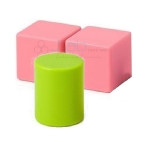
Different Types of Blocks
Product Code : EL-EYM-13429
A set of 40 smooth solid wooden blocks, 20 cubes of 30 mm and 20 cylinders 30 mm across and 30 mm high, in a storage box for preschool sorting, counting and shape work.
View Details