Resistance Loose Type (Pack of 100) Manufacturer,Supplier and Exporter in India
Product Code : EL-SLE-4697
Jlab Export is a leading Resistance Loose Type (Pack of 100) Manufacturer,and suppliers in India
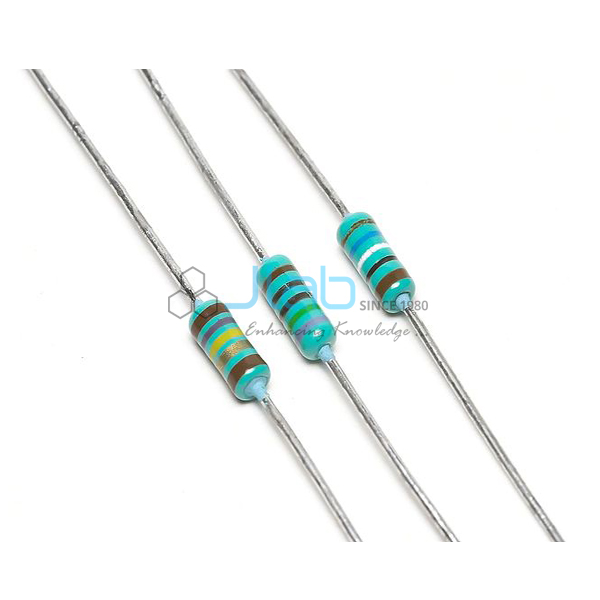
Resistance Loose Type (Pack of 100) (code EL-SLE-4697) is a pack of 100 loose resistors for building and testing circuits in school and college electricity practicals. A resistor is a passive two-terminal component that adds a set resistance to a circuit, reducing the current and lowering the voltage across other parts, so students can wire their own series, parallel and Ohm’s law circuits. It is made by Jain Laboratory Instruments Pvt Ltd (JLab) at its works in Ambala, India.
Specifications
| Parameter | Detail |
|---|---|
| Type | Loose resistors (individual components) |
| Component | Passive, two-terminal resistor |
| Function in a circuit | Reduces current flow and lowers voltage levels |
| Quality check | Each pack is visually inspected before dispatch |
| Pack quantity | Pack of 100 resistors |
| Minimum order quantity | 10 units |
| Dispatch time | Usually 7–10 working days |
| Product code | EL-SLE-4697 |
| Manufacturer | Jain Laboratory Instruments Pvt Ltd (JLab) — OEM |
| Country of origin | India (made in Ambala, Haryana) |
How Does It Compare with Other JLab Resistance Items?
| Item | Form | Listed values and connection |
|---|---|---|
| This pack (EL-SLE-4697) | 100 loose resistors | Values not stated; leads wired or clipped into the circuit |
| Resistance Board 10 Types JLab | Ten resistances on a box-type plastic base | Ten fixed values; connection by 4 mm sockets |
| Resistance Box Plug Type (Superior Type) | Plug-type resistance box | Listed in 100, 500 and 1000 ohm versions |
| Resistance Box Electronic Type | Electronic-type resistance box | Offered in 50, 100, 500 and 1000 ohm versions |
Choose loose resistors when students should build circuits from separate components and replace them one at a time as they wear out; choose a resistance board or box when you need known values that can be changed quickly on one bench unit.
What Are Loose Resistors Used For?
Loose resistors let students assemble real circuits instead of using a ready-made board. With a cell or power supply, an ammeter and a voltmeter they can verify Ohm’s law (V = IR), show that resistances in series add up while resistances in parallel give a total smaller than the smallest one (their reciprocals add), and build a potential divider that lowers the voltage across part of a circuit. These are core practicals in the electricity chapter of class 10 science and in current electricity in class 12 physics, and loose resistors are also basic stock for ITI and first-year electronics workshops.
Fixed resistors of this kind are usually marked with coloured bands that give their value, so students can read the colour code and then check the value with a multimeter. Do not pass more current through a resistor than its power rating allows, as it will overheat; switch off before changing connections, and sort the resistors by value in a compartment box so a class set stays usable.
What to Specify When Ordering
- Resistance values — list the values you need, or ask for a mixed assortment to suit your practicals.
- Power rating and tolerance — ask JLab to confirm them for the values you choose.
- Quantity — the minimum order is 10 units of this listing, each a pack of 100 resistors.
- Meters and leads — multimeters, connecting leads and resistance boxes can go on the same enquiry.
Frequently Asked Questions
What is in this pack?
The pack contains 100 loose resistors. The listing does not state their values, power rating or tolerance, so tell JLab which values you need when you ask for a quotation.
What does a resistor do in a circuit?
It resists the flow of charge: it reduces the current and lowers the voltage across other parts of the circuit. Resistors are used to set currents, divide voltages and protect components such as LEDs.
How do students find the value of a resistor?
Most fixed resistors carry coloured bands; each colour stands for a digit or a multiplier, and the last band gives the tolerance. A multimeter on its resistance range confirms the reading.
Should I buy loose resistors or a resistance box?
Loose resistors suit building circuits from components and for series and parallel combinations. A resistance box gives known, quickly changed values on one unit, which suits meter bridge and bridge-balancing practicals.
Who manufactures these resistor packs?
Jain Laboratory Instruments Pvt Ltd (JLab) supplies them from its works in Ambala, Haryana, India, and quotes for them directly as the manufacturer.
OEM Manufacturer
JLab is the trading name of Jain Laboratory Instruments Pvt Ltd, a manufacturer of electricity and school physics lab equipment in India, incorporated in 2017 and based on Hargolal Road, Ambala, Haryana. These resistor packs come from JLab’s own works rather than from a trader, so schools, colleges, dealers and importers buy them factory-direct, each pack is visually inspected before dispatch, and repeat orders are handled by the manufacturer. JLab exports worldwide and ships to buyers in every region — for example Botswana in Southern Africa, Indonesia in Southeast Asia, Japan in East Asia, Trinidad and Tobago in Central America and the Caribbean and Jordan in the Middle East. For tender purchases, see the JLab lab tenders page.
Related Resistance and Circuit Items
- Resistance Box Plug Type (Superior Type) — known resistances for meter bridge and other practicals.
- Resistance Board 10 Types JLab — ten resistances mounted on one base with 4 mm sockets.
- Resistances in Series and Parallel Apparatus — an instrument with two meters for series and parallel experiments.
- Digital Multimeter — measures resistance, voltage and current and checks continuity.
- Connecting Leads — plastic-covered leads with connectors for wiring circuits.
See more apparatus in the School Lab Equipment range.
Request a Quote
Quotes come direct from the manufacturer. Use the Add To Cart enquiry button on this page, or send the number of packs (minimum 10 units), the resistance values you need, and your delivery location through the contact page.
Last updated: 4 October 2026