Copper Wire Manufacturer,Supplier and Exporter in India
Product Code : EL-SLE-4752
Jlab Export is a leading Copper Wire Manufacturer,and suppliers in India
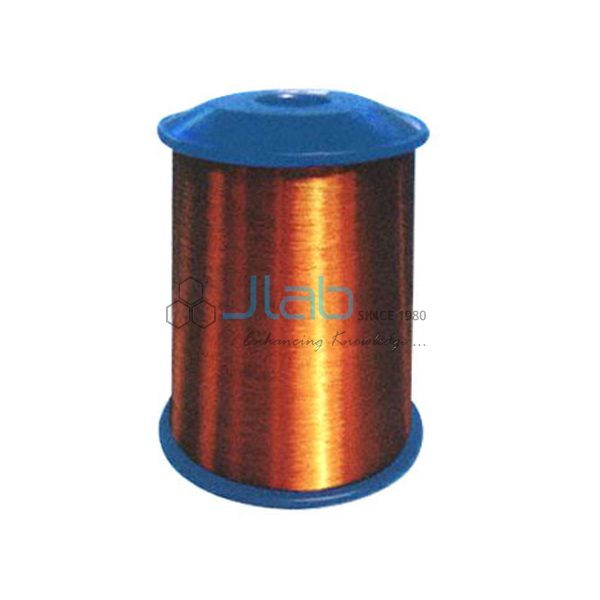
Copper Wire (code EL-SLE-4752) is enamelled copper winding wire, supplied in 75 g rolls, used to wind transformer coils, inductors, electromagnets and solenoids in school and college physics labs and for other electrical work. It is offered in five gauges from SWG 24 to SWG 32, and the enamel coating insulates each turn from the next. It is made by Jain Laboratory Instruments Pvt Ltd (JLab) at its works in Ambala, India.
Specifications
| Parameter | Detail |
|---|---|
| Material | Copper wire |
| Insulation | Enamel coating (enamelled copper wire) |
| Wire gauges | SWG 24, SWG 26, SWG 28, SWG 30 and SWG 32 |
| Roll weight | 75 g per roll |
| Listed applications | Construction of transformers, inductors and other electrical applications |
| Quality check | Each roll is visually inspected before dispatch |
| Pack quantity | One 75 g roll in the gauge you specify |
| Minimum order quantity | 10 units |
| Dispatch time | Usually 7–10 working days |
| Product code | EL-SLE-4752 |
| Manufacturer | Jain Laboratory Instruments Pvt Ltd (JLab) — OEM |
| Country of origin | India (made in Ambala, Haryana) |
How Does It Compare with JLab Constantan Wire?
| Wire | Material | Roll weight | Gauges | Listed use |
|---|---|---|---|---|
| This copper wire (EL-SLE-4752) | Enamelled copper | 75 g | SWG 24, 26, 28, 30 and 32 | Transformers, inductors and other electrical applications |
| Constantan Wire | Nickel–copper alloy with a low temperature coefficient | 75 g | SWG 24, 26, 28, 30 and 32 | Resistance coils |
Choose copper when the coil should carry current with as little resistance as possible — transformer windings, electromagnets and induction coils. Choose constantan when you want the wire itself to act as a resistance whose value changes little as it warms, as in home-made resistance coils and resistivity experiments.
What Is Enamelled Copper Wire Used For?
In school physics, enamelled copper wire is the material students wind into coils: an electromagnet made by winding the wire round an iron nail, a solenoid for plotting a magnetic field, coils for electromagnetic induction experiments, and simple electric motors in the class 10 topic on magnetic effects of current and the class 12 topic on electromagnetic induction. College labs and hobby workshops use the same wire for small transformer and inductor windings. Because the enamel is a thin insulating layer rather than thick plastic, turns can be packed side by side without short-circuiting. Scrape or sand the enamel off the last centimetre or so of each end before connecting it to a terminal or crocodile clip, and unwind the roll steadily to avoid kinks that weaken the wire.
What to Specify When Ordering
- Gauge — SWG 24, 26, 28, 30 or 32; a higher SWG number means a thinner wire, so state each gauge you need and how many rolls of each.
- Quantity — the minimum order is 10 units (rolls); many schools order a mix of gauges for coil-winding practicals.
- Related items — add constantan wire, a ready-wound solenoid or a demountable transformer to the same enquiry if your practicals use them.
Frequently Asked Questions
Which wire gauges are available?
SWG 24, SWG 26, SWG 28, SWG 30 and SWG 32. SWG is the Standard Wire Gauge: the higher the number, the thinner the wire, so SWG 24 is the thickest and SWG 32 the finest in this range.
How do I choose a gauge for a school coil?
A thicker gauge carries more current without heating and is easier for students to handle, while a thinner gauge lets you fit more turns into a small coil. Many teachers keep both ends of the range so different experiments can be set up.
How much wire is on one roll?
Each roll weighs 75 g. The listing does not give a length, which depends on the gauge — a thinner wire gives more metres for the same weight — so ask JLab if your practical needs a minimum length.
Do I need to remove the enamel before making a connection?
Yes. The enamel is an insulating coating, so scrape or sand it off the ends of the wire before fixing them to terminals, otherwise the circuit will not conduct.
How is it different from constantan wire?
Copper has a low resistance and is used for windings that should waste little energy. Constantan is a nickel–copper alloy with a low temperature coefficient, listed by JLab for resistance coils. Both are offered in the same five gauges and 75 g rolls.
Who manufactures this copper wire?
Jain Laboratory Instruments Pvt Ltd (JLab) makes it at its works in Ambala, Haryana, India, and quotes for it directly as the manufacturer.
OEM Manufacturer
JLab is the trading name of Jain Laboratory Instruments Pvt Ltd, a physics, chemistry and biology lab equipment manufacturer in India, incorporated in 2017 and located on Hargolal Road, Ambala, Haryana. This wire is made at JLab’s own works rather than bought from a trader, so schools, colleges, dealers and importers deal with the manufacturer directly; each roll is visually inspected before dispatch and repeat orders come from the same source. The company is registered under CIN U29309HR2017PTC069123 and holds MSME Udyam registration UDYAM-HR-01-0003849 as a manufacturing enterprise. JLab exports worldwide and can ship to buyers in every region — Saudi Arabia in the Middle East, El Salvador in Central America and the Caribbean, Namibia in Southern Africa, Serbia in Southern Europe and Mexico in North America are just a few examples. Tender buyers can see the JLab lab tenders page.
Coils, Transformers and Resistance Wire
- Constantan Wire — nickel–copper resistance wire in the same gauges and roll weight.
- Solenoid with Terminals on Stand — a ready-wound copper coil on a stand for magnetic field experiments.
- Demountable Transformer — a mains coil with interchangeable secondary coils for transformer practicals.
- Demonstration Transformer — used to explain the working of transformers in class.
Browse more physics lab equipment for schools in the School Lab Equipment range.
Request a Quote
Quotes come direct from the manufacturer. Use the Add To Cart enquiry button on this page, or send the gauges and number of rolls you need (minimum 10 units), any related items, and your delivery address or port through the contact page.
Last updated: 4 October 2026