

Skeletons For Medical Students Manufacturer, Suppliers and Exporter in India
Jlabexport is a leading Skeletons For Medical Students Manufacturer,and suppliers in India, United States, Indonesia, Brazil, Bangladesh, Mexico, Japan, Egypt, Philippines, Democratic Republic of the Congo, Vietnam, Iran, Turkey, Tanzania, United Kingdom, France, South Africa, Italy, Kenya, Colombia, Sudan, Uganda, South Korea, Argentina, Afghanistan, Yemen, Angola, Morocco, Poland, Uzbekistan, Mozambique, Malaysia, Ghana, Saudi Arabia, Peru, Madagascar, Côte d’Ivoire, Cameroon, Niger, Venezuela, Australia, Syria, Mali, Burkina Faso, Sri Lanka, Malawi, Zambia, Chad, Kazakhstan, Somalia, Chile, Senegal, Ecuador, Cambodia, Zimbabwe, Guinea, Benin, Rwanda, Burundi, Bolivia, South Sudan, Tunisia, Haiti, Belgium, Dominican Republic, Jordan, United Arab Emirates, Honduras, Tajikistan, Papua New Guinea, Portugal, Togo, Sierra Leone, Belarus, Laos, Turkmenistan, Libya, Kyrgyzstan, Nicaragua, Paraguay, Bulgaria, Serbia, Republic of the Congo, Lebanon, Liberia, Central African Republic, Palestine, Oman, Mauritania, New Zealand, Costa Rica, Kuwait, Panama, Croatia, Georgia, Eritrea, Mongolia, Uruguay, Qatar, Namibia, Bosnia and Herzegovina, Moldova, Armenia, Gambia, Jamaica, Lithuania, Albania, Gabon, Botswana, Lesotho, Guinea-Bissau, Slovenia, Equatorial Guinea, Latvia, North Macedonia, Bahrain, Trinidad and Tobago, Timor-Leste, Cyprus, Estonia, Eswatini, Mauritius, Djibouti, Fiji, Comoros, Solomon Islands, Guyana, Bhutan, Luxembourg, Suriname, Montenegro, Malta, Maldives, Cabo Verde, Brunei, Belize, Bahamas, Iceland, Vanuatu, Barbados, São Tomé and Príncipe, Samoa, Saint Lucia, Kiribati, Seychelles, Grenada, Saint Vincent and the Grenadines, Antigua and Barbuda.
Last updated: 14 November 2026
Which Skeletons Do Medical Students Study From?
Skeletons For Medical Students are human skeleton models for osteology and anatomy teaching in medical, nursing and physiotherapy colleges. The range has three items. Two are disarticulated skeletons, supplied as loose bones so that students can handle and identify each bone on its own. The third is the JL209 Human Skeleton, an assembled figure on a steel stand whose limbs, skull and jaw detach and whose major joints move. JLab (Jain Laboratory Instruments Pvt Ltd), Ambala, India, makes all three.
Request a quotation | Compare the skeletons | See the topics covered
Which Skeletons Are in the Range?
| Group | Items | What it covers |
|---|---|---|
| Disarticulated Skeletons | 2 | Loose human bones for identifying each bone and its side; one set has a three-part skull, the other comes plain or painted with muscle attachments. |
| Assembled Skeleton on Stand | 1 | A detachable skeleton on a castored steel stand, with six movable joints and muscle origins and insertions painted on one side. |
Compare Skeletons for Medical Students by Build
Each table gives the facts stated on the product pages. Where a page does not give a detail, the cell says Not listed.
Disarticulated Skeletons (2)
| Skeleton | Form | Skull | Muscle attachments | Main use |
|---|---|---|---|---|
| Deluxe Human Disarticulated Skeleton | Loose bones, deluxe grade, made near to the original | Skull with mandible, three parts | Not listed | Study of individual bones and their surface features |
| Human Skeleton Dis-articulated | Loose individual bones | Not listed | Origins and insertions marked on the painted version | Identifying all the major bones one by one |
Assembled Skeleton on Stand (1)
| Skeleton | Removable parts | Movable joints | Muscle attachments | Material | Weight |
|---|---|---|---|---|---|
| Human Skeleton | Arms, legs, skull and jaw; removable calvarium | Shoulder, elbow, hip, knee, wrist and ankle | One side: origins in red, insertions in blue | PVC or composite plastic bones on a steel stand with 5 castors | 12 ± 3 kg |
How to Choose a Skeleton for Medical Teaching
- Loose bones or an assembled figure. Osteology practicals ask students to name a bone held on its own. A disarticulated set serves that work. The JL209 Human Skeleton shows every bone in its place and how the joints move.
- Skull study. The Deluxe set has a skull with mandible in three parts. The JL209 skull has a removable calvarium and a movable jaw, so the inside of the cranium can be shown.
- Muscle attachments. Order the Human Skeleton Dis-articulated in its painted version, or the JL209, when muscle origins and insertions are part of the course. State plain or painted in the enquiry.
- Moving the skeleton between rooms. The JL209 stands on a removable steel stand with five rolling castors and weighs 12 ± 3 kg.
- Number of sets. Plan one disarticulated set for each dissection-hall group, and one assembled skeleton for the lecture room or demonstration bench.
Osteology Topics Covered by the Skeletons Range
| Topic | Skeleton |
|---|---|
| Identifying each of the major bones on its own | Human Skeleton Dis-articulated; Deluxe Human Disarticulated Skeleton |
| Side and orientation of a loose bone | Deluxe Human Disarticulated Skeleton; Human Skeleton Dis-articulated |
| Surface features of individual bones | Deluxe Human Disarticulated Skeleton |
| Skull and mandible studied as separate parts | Deluxe Human Disarticulated Skeleton |
| Inside of the cranium, with the calvarium lifted off | Human Skeleton |
| Muscle origins and insertions on the bones | Human Skeleton Dis-articulated (painted version); Human Skeleton |
| Bones in their assembled position | Human Skeleton |
| Movement at the shoulder, elbow, hip, knee, wrist and ankle | Human Skeleton |
Who Uses Skeletons For Medical Students?
Anatomy departments of medical colleges and medical institutes use the disarticulated sets for osteology. Nursing, physiotherapy and biology teaching uses the JL209 skeleton in classrooms and laboratories.
Ordering, Minimum Quantity and Dispatch
| Point | Detail |
|---|---|
| Minimum order quantity | 10 units of each skeleton, as shown on its product page |
| Dispatch time | Usually 7–10 working days |
| Pack quantity | Each skeleton is sold individually; the JL209 is packed in foam or thermocol inside an outer carton |
| How to enquire | Use Add To Cart on a product page, or send the skeleton names, plain or painted, and quantities through the contact page |
| Tenders and OEM supply | Send the schedule through the tender enquiry page |
| Manufacturer | JLab (Jain Laboratory Instruments Pvt Ltd), Ambala, India |
Related Ranges in Anatomical Models
Skeletons For Medical Students is one of 19 subcategories of the Anatomical Models range. These ranges hold more skeletons, skulls and joints.
| Range | How it relates |
|---|---|
| Human Models | Skeletons in many sizes, from a 180 cm figure to a 42 cm mini skeleton, a Disarticulated Human Skeleton 200 Bones, vertebral columns and life-size joints. |
| Ortho Models | Spine, pelvis, hip, knee, shoulder and foot models, and a Mini Skeleton Model. |
| Anatomical Models | The general sub-range, with life-size adult skulls, a foetal skull, and hand and foot joints with ligaments. |
| Implant Models | A knee set with healthy, diseased and implanted knees, and a life-size hip model. |
| Arthritis Models | Knee, hip and hand joint models that show osteoarthritis and rheumatoid arthritis. |
Frequently Asked Questions
Should a college buy a disarticulated or an articulated skeleton?
Most anatomy departments use both. Loose bones from a disarticulated set are needed for osteology, where students hold and name one bone at a time. An articulated skeleton such as the JL209 shows how the bones sit together and how the joints move.
How do students tell whether a loose bone is from the left or the right side?
They hold the bone in the anatomical position and find three landmarks: the upper end, the front surface and the medial side. On a femur, for example, the head points upwards and towards the midline. Once those three are fixed, the side follows.
What do the red and blue marks on the painted skeleton mean?
Red marks the points of origin, where a muscle starts on the more fixed bone. Blue marks the points of insertion, where it attaches to the bone it moves. On the JL209 only one side is painted, so the other side keeps the bone surfaces clear.
What are the parts of a long bone?
A long bone has a shaft, called the diaphysis, and two ends, the epiphyses. The flared region between them is the metaphysis, the growing end in a young bone. The shaft has a medullary cavity and a nutrient foramen. On a loose femur or humerus students can follow the shaft and both ends in the hand.
Why does a medical skeleton need a detachable skull?
Many osteology topics deal with the inside of the cranium and with the mandible. The Deluxe set has a skull in three parts with the mandible, and the JL209 has a removable calvarium and a movable jaw, so those parts can be studied separately.
Request a Quote
Name each skeleton, plain or painted where it applies, and the number of sets, for example ten Deluxe Human Disarticulated Skeletons. Add the delivery city and country, then send the request from the contact page.
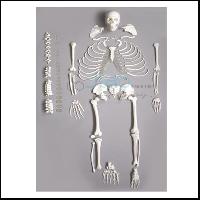
Deluxe Human Disarticulated Skeleton
Product Code : EL-SFMS-321
Disarticulated human skeleton for medical students and institutes, with all parts made near to the original bones and a three-part skull with mandible.
View Details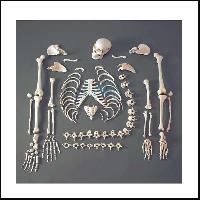
Human Skeleton Dis-articulated
Product Code : EL-SFMS-322
The identification of individual bones is easy enough for students using a fully constructed skeleton, but can your students recognize a femur on its own.
View Details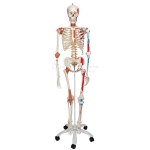
Human Skeleton
Product Code : EL-SFMS-13327
Detachable human skeleton (model JL209) on a steel stand with rolling casters; movable major joints, removable limbs, skull and jaw, and muscle origins and insertions painted on one side.
View Details