

Heat Transfer Through Composite Wall Manufacturer,Supplier and Exporter in India
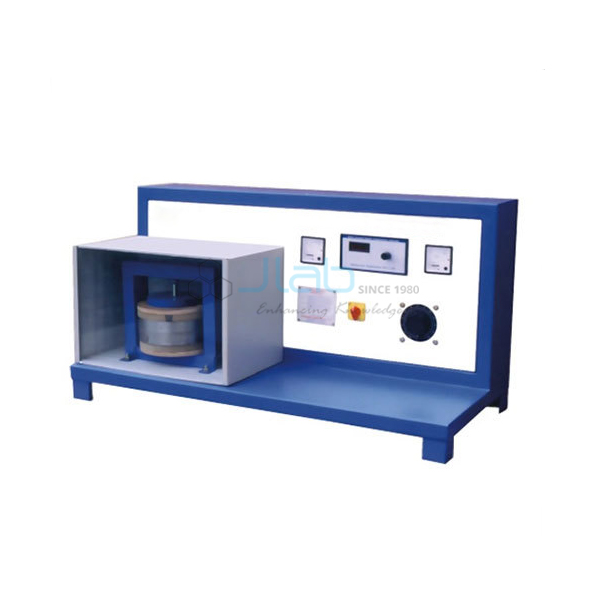
Product Code : EL-HTTCW-7370
Jlab Export is a leading Heat Transfer Through Composite Wall Manufacturer,and suppliers in India
Heat Transfer Through Composite Wall (code EL-HTTCW-7370) is a conduction set-up in which pairs of MS, Bakelite and wood specimens, held between clamp plates with a heater assembly, form a composite wall whose total thermal resistance and thermal conductivity students determine. A 12-channel digital temperature indicator reads the thermocouples, and an ammeter, voltmeter and dimmerstat set and measure the heater input. JLab builds the composite wall apparatus in Ambala, India.
Specifications
| Parameter | Detail |
|---|---|
| Test specimens | MS (2), Bakelite (2), wood (2) |
| Assembly | Heater assembly, mounting frame and 2 clamp plates |
| Thermocouples | Set of thermocouples |
| Temperature indicator | 12-channel digital |
| Ammeter | 0–3 A |
| Dimmerstat | 0–2 A |
| Voltmeter | 0–250 V |
| Control panel | Mains on/off switch with the indicator and meters |
| Quality check | Each composite wall set-up is visually inspected before dispatch |
| Pack quantity | Each (sold individually) |
| Minimum order quantity | 1 unit |
| Dispatch time | Usually 14–18 working days |
| Product code | EL-HTTCW-7370 |
| Manufacturer | Jain Laboratory Instruments Pvt Ltd (JLab) — OEM |
| Country of origin | India (made in Ambala, Haryana) |
Series Resistances in a Composite Wall
Each layer obeys steady one-dimensional conduction, Q = kA(T1 − T2)/L, so it has a thermal resistance of L/(kA), where L is its thickness. Because the same heat passes through every layer in turn, the resistances add like resistors in series: R_total = L1/(k1A) + L2/(k2A) + L3/(k3A), and Q = (hot-face temperature − cold-face temperature)/R_total. The thermal conductivity of the wall as a whole then follows from k = Q × (total thickness)/(A × overall temperature drop).
Readings, Gradients and Plots
At each dimmerstat setting the voltmeter and ammeter give the electrical input (voltage × current) once the temperatures settle, and the thermocouples give the temperatures through the wall. Temperature falls in a straight line across each layer, and far more steeply across the wood and Bakelite than across the MS, because the gradient is the heat flux divided by the conductivity. Repeating the test at several inputs gives the data to plot the temperature gradient along the wall and heat flux against thermal conductivity.
Other Conduction Experiments: Walls, Pipe, Rod and Spheres
- Composite Walls Apparatus — MS, Bakelite and brass or aluminium plates around a mica heater.
- Heat Transfer Through Lagged Pipe — radial conduction outward through the lagging on a G.I. pipe.
- Thermal Conductivity of Metal Rod — heated bar with a water-cooled end and an insulated middle section.
- Thermal Conductivity of Insulating Powder — powder between concentric copper spheres, heated from the inner sphere.
The apparatus has its own category, Heat Transfer Through Composite Wall, inside Heat Transfer Lab Equipment and Engineering Lab Equipment.
Request a Quote
To order, add it to your enquiry with Add To Cart or write through the contact page, stating the quantity and the delivery address for the composite wall apparatus.
Last updated: 30 October 2026