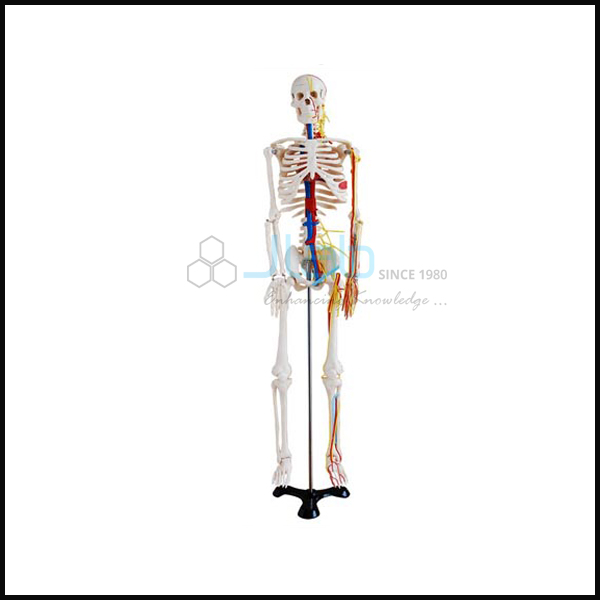
Human Skeleton with Nerves and Blood Vessels Tall 85cm Manufacturer,Supplier and Exporter in India
Product Code : EL-HM-135
Jlab Export is a leading Human Skeleton with Nerves and Blood Vessels Tall 85cm Manufacturer,and suppliers in India
Main arteries and peripheral nerves are added to this 85 cm PVC skeleton, so students can follow each vessel and nerve along the bones it runs beside. The model shows their position, course and distribution in the body. It serves as a visual aid when anatomy is taught to medical students.
Specifications
| Height | 85 cm |
| Material | PVC |
| Shows | Position, course and distribution of the main arteries and peripheral nerves |
| Use | Visual aid for anatomy teaching |
| Minimum order quantity | 10 units |
| Dispatch time | Usually 4–6 working days |
| Manufacturer | JLab (Jain Laboratory Instruments Pvt Ltd), Ambala, India |
Tracing Nerves and Arteries in Practicals
A common practical is to name the bone each nerve lies against. On the arm, students look for the nerve that winds round the back of the humerus and the one that passes behind the medial epicondyle at the elbow. They then mark the same routes on the Nervous System Chart and name each nerve.
For the arteries, students follow the main vessel of the upper limb from the shoulder to the wrist. They name it as it changes from axillary to brachial and then splits into radial and ulnar. In the lower limb they trace the femoral artery down to the back of the knee. The Skeleton and Circulatory System Chart gives the whole circuit for comparison.
Frequently Asked Questions
How do students tell nerves from arteries on the model?
Teaching models normally colour arteries red and nerves yellow. Before the lesson, check the colours on this model against a labelled chart. Then have students trace one system at a time so the two are not mixed up.
Which nerves lie close to the humerus?
Students usually learn three. The axillary nerve curves round the surgical neck, and the radial nerve runs in the spiral groove with the profunda brachii artery. The ulnar nerve passes behind the medial epicondyle. Students find each point on the arm of the skeleton.
What do course and distribution mean on this model?
Course is the path a vessel or nerve takes from where it starts to where it ends. Distribution is the region its branches supply. On the model, students follow a nerve from the spine into a limb and see which area its branches reach.
Is an 85 cm model detailed enough for medical students?
It shows the main arteries and peripheral nerves, which is the level of first-year anatomy. At 85 cm it sits on a bench in the practical room. Fine branches are learned later from dissection, atlases and regional models.
Other 85 cm and Desk Skeletons
- Human Skeleton Medium Tall 85cm (removable arms and legs)
- Transparent Human Skeleton Tall 85cm
- Mini Human Skeleton 42cm
For a quote, use Add To Cart or send us a message through the contact page.
Last updated: 14 November 2026