Interlocking Cubes Manufacturer,Supplier and Exporter in India
Product Code : EL-MLE-1796
Jlab Export is a leading Interlocking Cubes Manufacturer,and suppliers in India
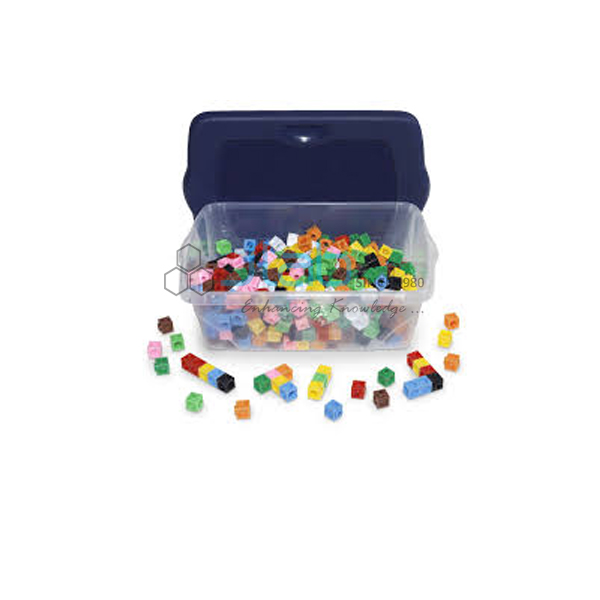
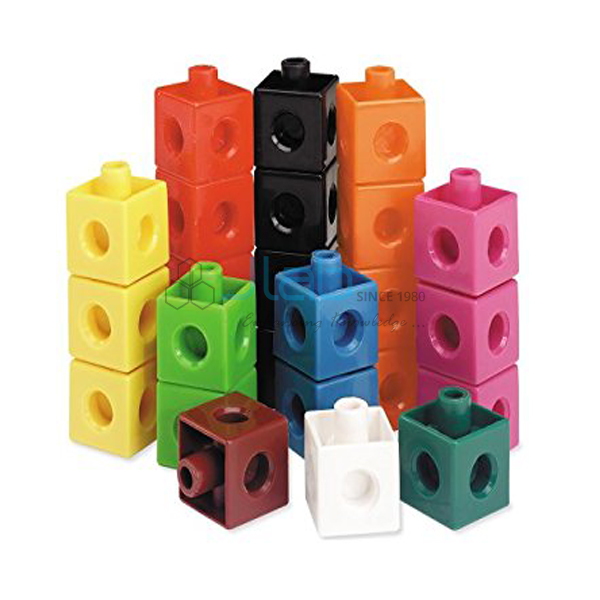
Interlocking Cubes (code EL-MLE-1796) is a set of 625 solid plastic interlocking cubes in different colours, moulded to the standard one-centimetre size, for counting, sorting, measuring and patterning in primary and middle-school maths. Each cube weighs one gram, so the same cubes work as units of length, area and volume and as gram masses. It is made by Jain Laboratory Instruments Pvt Ltd (JLab) at its works in Ambala, India.
Specifications
| Parameter | Detail |
|---|---|
| Cubes in the set | 625 |
| Material | Solid plastic |
| Cube size | Standard one-centimetre size, accurately moulded |
| Mass of each cube | One gram |
| Colours | Different colours |
| Type | Interlocking |
| Learning focus | Measuring; creating and extending patterns; sorting; classifying; graphing |
| Quality check | Each set is visually inspected before dispatch |
| Pack quantity | Set of 625 cubes |
| Minimum order quantity | 10 units |
| Dispatch time | Usually 7–10 working days |
| Product code | EL-MLE-1796 |
| Manufacturer | Jain Laboratory Instruments Pvt Ltd (JLab) — OEM |
| Country of origin | India (made in Ambala, Haryana) |
How Does It Compare with Other JLab Centimetre Cubes?
| Cubes | Cube size | Joining | Other details |
|---|---|---|---|
| This set (EL-MLE-1796) | One centimetre | Interlocking | 625 solid plastic cubes in different colours; one gram each |
| 1 CM Interlocking Cubes | 1 cm | Interlocking | Plastic cubes in 10 colours, in a reusable box |
| Unit Cubes | 1 cm x 1 cm x 1 cm | Interlocking, link in all directions | Colourful cubes that represent units |
| Centimeter Cubes | 1 cubic centimetre | Non-interlocking | Ten bright colours; 1 g each |
| Interlocking Cubes, 2 cm | 2 cm | Interlocking, connect on all sides | 5 bright colours |
Choose this set when you want a large quantity of one-centimetre interlocking cubes with a known one-gram mass. The non-interlocking centimetre cubes suit weighing activities where the cubes are not joined, and the 2 cm cubes are larger.
What Are Interlocking Cubes Used For?
Centimetre cubes are a common maths manipulative. Children count them, sort and classify them by colour, and build colour patterns that they then extend. Joined into towers, they become bars for simple graphs. Because each cube is one centimetre along each edge, a row of cubes measures length in centimetres, a single layer shows area in square centimetres, and a solid block shows volume in cubic centimetres — a direct way to show that the volume of a cuboid is length x breadth x height.
The one-gram mass links measurement with weighing: placed on a balance, the cubes act as gram masses. The set is used in primary maths, middle-school mensuration and maths lab activities on measurement and data handling.
What to Specify When Ordering
- Number of sets — each set holds 625 cubes; plan by the number of groups that will use the cubes at the same time.
- Cube type — this interlocking set, the non-interlocking centimetre cubes or the 2 cm interlocking cubes compared above.
- Other measuring items — balances and base-ten blocks are separate items that can be quoted on the same enquiry.
Frequently Asked Questions
How many cubes are in the set?
625 cubes, in different colours.
What size is each cube?
Each cube is accurately moulded to the standard one-centimetre size, so its volume is one cubic centimetre.
How much does each cube weigh?
One gram. This lets the cubes be used as gram masses on a balance as well as units of length, area and volume.
What are the cubes made of?
Solid plastic.
Which maths topics does the set support?
Counting, sorting and classifying, creating and extending patterns, measuring, and graphing — for example building cube towers as bars in a bar graph.
How do these differ from the Centimeter Cubes?
Both are centimetre cubes with a one-gram mass, but these cubes interlock, so they can be joined into rods, towers and solid shapes; the Centimeter Cubes are non-interlocking.
What information is needed for an export quotation?
Send the quantity, the destination country and port or city, your preferred delivery terms (for example FOB or CIF), any packing or labelling requirements, and the tender reference if the order is for a tender.
Who manufactures these interlocking cubes?
Jain Laboratory Instruments Pvt Ltd (JLab) makes them at its works in Ambala, Haryana, India.
OEM Manufacturer
JLab is the trading name of Jain Laboratory Instruments Pvt Ltd, a manufacturer of maths manipulatives and educational laboratory equipment in India, incorporated in 2017 and based on Hargolal Road, Ambala, Haryana. These cubes are made at JLab’s own works and not bought in from a trader, so schools, distributors and importers buy direct from the maker; every set is inspected by eye before dispatch, and repeat orders come from the same works. The company holds GSTIN 06AADCJ9848D1ZE and Legal Entity Identifier 549300DTGS77DGYD6N03. JLab exports worldwide and ships to buyers in every region — for example Canada in North America, Mozambique in East Africa, Morocco in North Africa, Brunei in Southeast Asia and Fiji in Oceania.
Related Maths Manipulatives
- Unit Cubes — colourful interlocking cubic-centimetre units that link in all directions.
- Centimeter Cubes — non-interlocking centimetre cubes of known mass for measuring and weighing.
- 1 CM Interlocking Cubes — plastic centimetre cubes in a reusable box, for counting, measuring and patterning.
- Orange Interlocking Base — place-value blocks indented in whole centimetre units, also used for length, area and volume work.
More counting and measuring aids are in the Maths lab Equipments range and the full Maths Lab Equipment section.
Request a Quote
Use the Add To Cart enquiry button to request a quotation, or tell us the number of sets, the cube types you are comparing and your delivery city and country through the contact page.
Last updated: 16 October 2026