Judging Distance Chart Manufacturer,Supplier and Exporter in India

Product Code : EL-MS-3287
Jlab Export is a leading Judging Distance Chart Manufacturer,and suppliers in India
Judging distance is the field craft skill of estimating, by eye, how far away an object or target is. This chart is used to teach the methods to NCC cadets and scouts in the training room before they practise outdoors. It measures 50 x 75 cm, is laminated with thick plastic film on both sides and has plastic rollers.
Specifications
| Topic | Judging distance by eye in field craft |
| Size | 50 x 75 cm |
| Finish | Laminated with thick plastic film on both sides |
| Rollers | Plastic |
| Minimum order quantity | 10 units |
| Dispatch time | Usually 4–6 working days |
| Manufacturer | JLab (Jain Laboratory Instruments Pvt Ltd), Ambala, India |
Outdoor Practicals for NCC Students
On a sports field, the instructor lays out a hundred-metre reference with a Measuring Tape, and cadets walk it to fix the distance in their minds. They then estimate the range to posts, trees and buildings by the unit of measure method, write down their figures and compare them with the true distances.
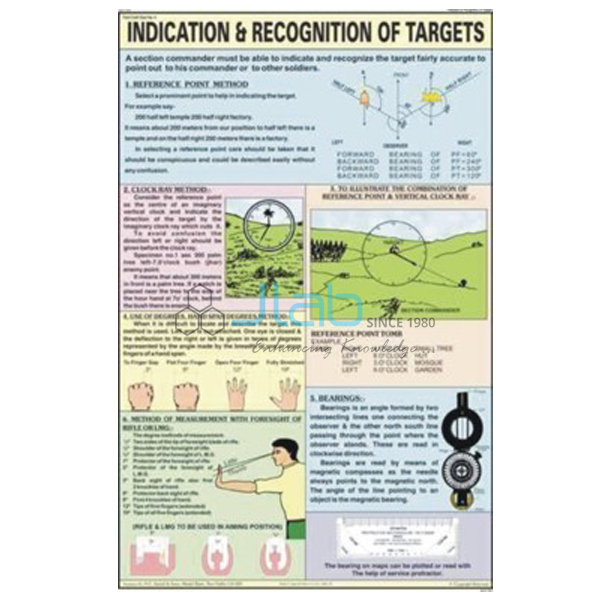
With the naked eye, pupils note which details they can make out on a person standing at different marked distances, the basis of the appearance method. Looking again through Student Binoculars shows how much nearer the same person seems, which is why appearance estimates are made by eye. The Indication and Recognition of Targets Chart follows naturally, since a range estimate is part of describing a target.
Frequently Asked Questions
Which binoculars suit judging-distance practice, 8x or 10x?
For cadets, 8x is usually easier: the view is wider and steadier, so a target is found quickly and hand shake shows less. 10x brings out more detail at long range but needs a firm rest. The Student Binoculars are offered in both powers.
Does a unit need a laser rangefinder for this lesson?
Not to teach it. Judging distance trains the eye, so cadets learn the methods without instruments first. A rangefinder or a measured course is useful afterwards to check estimates and to show each cadet whether they tend to guess short or long.
Why do objects sometimes look nearer or farther than they are?
Bright light, a sharp outline and strong contrast with the background make an object seem nearer, as does looking across a valley or flat open ground. Poor light, mist, camouflage or partial cover by bushes make it seem farther away. Cadets should allow for these before giving a figure.
How does the unit of measure method work?
Picture a distance you know well, such as a hundred metres or the length of a football ground. Then count how many times it fits between you and the object. It works well over open ground at shorter ranges, but becomes hard when part of the ground is hidden.
What is the unit average method?
Each cadet in the section makes an estimate alone, and the commander takes the average of all the figures. Individual errors in either direction tend to cancel out, so the average is usually closer to the true range than most single guesses.
More Field Craft Charts
For a quote, use Add To Cart or send us a message through the contact page.
Last updated: 16 November 2026