

Microprocessor Colony Counter Manufacturer,Supplier and Exporter in India
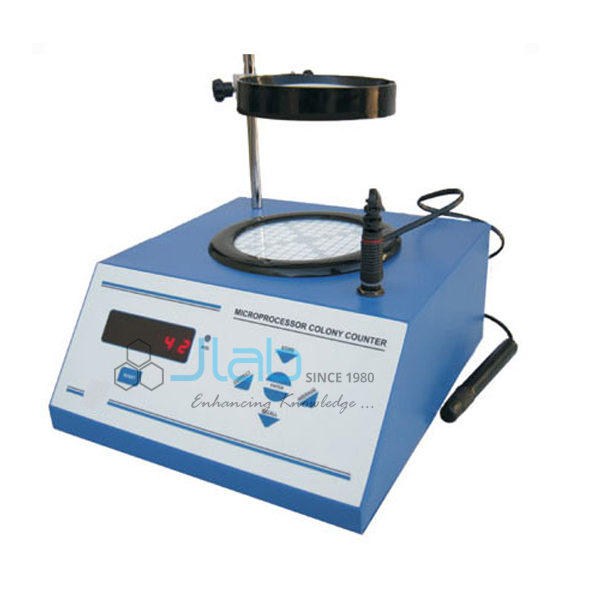
Product Code : EL-CC-2205
Jlab Export is a leading Microprocessor Colony Counter Manufacturer,and suppliers in India
Counting plates from a dilution series goes faster when the counter does the arithmetic. This microprocessor model registers each colony as you mark it with the pen, beeps to confirm, and lets you cancel a wrong mark with the Correct key. It averages counts from several dishes and keeps 100 results in memory, even after switch-off, for recall later.
Specifications
| Display options | 3, 4 or 6 digit 7-segment LED (999, 9999 or 999999 counts) |
| Keys | 6 soft-touch membrane keys, including Reset, Correct and Recall |
| Count correction | Cancels an unwanted count |
| Average mode | Mean count over several dishes |
| Memory | 100 result-counts, kept when switched off |
| Counting | Auto marker pen with audible confirmation of each count |
| Viewing | Glare-free LED illumination, Wolffhugel glass grid with focusing, x1.7 magnifier |
| Dish size | 110 mm |
| Power, size and weight | 230 V ±10% AC, 50 Hz, 225 x 250 x 280 mm, 4 kg (approx.) |
| Supplied with | Marking pen, magnifying lens, lens holder, dust cover and operation manual |
| Minimum order quantity | 1 unit |
| Dispatch time | Usually 7–10 working days |
| Manufacturer | JLab (Jain Laboratory Instruments Pvt Ltd), Ambala, India |
Viable Count Practicals in Microbiology
The standard plate count is the main exercise for this counter. Students make a tenfold dilution series of a culture, milk or soil suspension and plate each dilution in a sterile Petri Dish. The plates then go into an Incubator Bacteriological. Media and glassware are sterilised beforehand in a Laboratory Autoclave.
At the counting stage, students pick the dilution whose plates show well-separated colonies and count each replicate. Average mode gives the mean straight away. Comparing raw and boiled milk, or soil from two sites, makes a good class project.
Frequently Asked Questions
How does average mode help with replicate plates?
Count each replicate dish in turn and the counter works out the mean. Multiply that mean by the dilution factor and divide by the volume plated to get colony-forming units (CFU) per ml of the original sample.
What happens if I mark the same colony twice?
Press the Correct key to cancel the unwanted count and carry on. The marker pen also leaves a dot on the dish, so you can see which colonies have already been counted.
How many results can it store?
Up to 100 result-counts stay in memory even when the counter is switched off. The Recall key brings stored counts back to the display, for example to copy a whole class’s results into the record book at the end of a session.
Which display version do I need?
The counter is offered with a 3, 4 or 6 digit LED display, reading up to 999, 9999 or 999999. One countable plate seldom needs more than three digits, while running totals across many dishes call for the larger displays.
How do I count a crowded plate?
Use the Wolffhugel grid. Count the colonies in several squares, find the mean per square and multiply by the number of squares that cover the dish. For routine work, a plate this crowded is usually replaced by one from a higher dilution.
Other Colony Counters and Culture Plates
- Digital Colony Counter (pen-touch counting with reset only)
- Colony Counter (4 Digit)
- Gridded Petri Plate
For a quote, use Add To Cart or send us a message through the contact page.
Last updated: 6 November 2026
