Properties of a Magnet, Making a Magnet Manufacturer,Supplier and Exporter in India
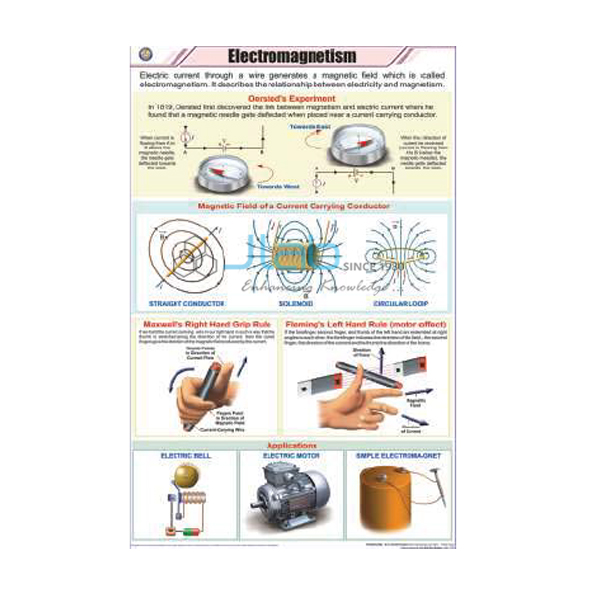
Product Code : EL-PC-2911
Jlab Export is a leading Properties of a Magnet, Making a Magnet Manufacturer,and suppliers in India
Properties of a Magnet, Making a Magnet (code EL-PC-2911) is a two-topic physics wall chart — what magnets do, and how an ordinary iron or steel bar can be turned into one — used in school science lessons on magnetism. It measures 58 x 90 cm, is printed in full colour on 130 gsm coated art paper and is laminated on both sides with a markable, washable finish. It is made by Jain Laboratory Instruments Pvt Ltd (JLab) at its works in Ambala, India.
Specifications
| Parameter | Detail |
|---|---|
| Topics | Properties of a magnet; making a magnet |
| Size (overall) | 58 x 90 cm |
| Paper | Coated art paper, 130 gsm |
| Printing | Full colour, offset printed using CTP technology |
| Lamination | Both sides, 30 micron heat-sealable polyester |
| Rollers | Plastic rollers for wall hanging |
| Surface | Markable and washable |
| Weight | 228 g |
| Rolled size | 58 x 4 x 2 cm |
| Language | English only |
| Quality check | Each chart is visually inspected before dispatch |
| Pack quantity | Each (sold individually) |
| Minimum order quantity | 10 units |
| Dispatch time | Usually 7–10 working days |
| Product code | EL-PC-2911 |
| Manufacturer | Jain Laboratory Instruments Pvt Ltd (JLab) — OEM |
| Country of origin | India (made in Ambala, Haryana) |
What Is the Properties of a Magnet Chart Used For?
The chart supports the lessons in which pupils first test magnets for themselves. The properties usually taught are that a magnet attracts iron, nickel and cobalt; that its pull is strongest near the poles; that poles always come in north–south pairs; that like poles repel and unlike poles attract; and that a freely suspended magnet comes to rest pointing north–south. The second topic, making a magnet, covers how an iron or steel bar becomes magnetised — for example by stroking it repeatedly in one direction with one pole of a magnet, or by placing it inside a coil carrying a direct current — and why magnets weaken when they are heated, hammered or dropped.
Magnets are introduced in class 6 science in the NCERT syllabus, the electrical method leads on to the magnetic effects of current in class 10, and the ideas return in class 12 physics. Because the laminated face can be written on and wiped, teachers can use the chart for a quick quiz — marking the poles or the stroking direction — and clean it for the next class. The listing does not itemise the chart’s illustrations, so ask JLab for a preview image if you need to check the layout.
What to Specify When Ordering
- How many charts — the minimum order is 10; science departments often order for both the middle and senior sections.
- Follow-on titles — the Magnetism and Electromagnetism charts cover the surrounding topics.
- Activity items — bar magnets with iron filings, a magnetic needle on stand and an electromagnet let students repeat what the chart shows.
- Delivery — destination and delivery terms for the quotation.
Frequently Asked Questions
Which two topics does the chart combine?
The properties of a magnet and the methods of making a magnet, as named in its title. Individual panels are not listed, so ask JLab for a preview if you need the details.
Which classes is it suited to?
It is pitched at the stage where magnets are introduced, around class 6 in the NCERT syllabus, and is also useful for revision before electromagnetism in class 10.
Can it be written on?
Yes. The double-sided 30 micron heat-sealable polyester lamination is listed as markable and washable.
What does the chart weigh, and how big is it rolled?
It weighs 228 g and rolls to 58 x 4 x 2 cm; opened out, it is 58 x 90 cm.
Are bar magnets supplied with it?
No. The chart is sold on its own; magnets, a magnetic needle and an electromagnet are separate items you can add to the enquiry.
What should an export quotation request include?
Quantity, destination country and port or city, the delivery terms you prefer (for example FOB or CIF), packing or labelling needs and any tender reference.
Who manufactures it?
JLab (Jain Laboratory Instruments Pvt Ltd) at its works in Ambala, Haryana, India.
OEM Manufacturer
JLab is the trade name of Jain Laboratory Instruments Pvt Ltd, a science education equipment manufacturer in India whose range runs from physics apparatus to printed teaching charts. Incorporated in 2017, it operates from Hargolal Road, Ambala, Haryana, where this chart is produced in-house rather than sourced through a trader, so schools, colleges, dealers and importers deal with the maker directly; every chart is visually inspected before dispatch and repeat orders come from the same works. JLab exports worldwide, with buyers in every region — Portugal in Southern Europe, Benin in West Africa, Denmark in Northern Europe, the Philippines in Southeast Asia and Chad in Central Africa among them. Institutional buyers can find tender information on the lab tenders page.
Magnetism Charts and Apparatus
- Magnetism — the companion chart on magnets and magnetic fields.
- Electromagnetism — the magnetic effect of electric current, behind electromagnets, bells and motors.
- Set of Steel Bar Magnets Pairs with Iron Filings — poles marked N and S for attraction and repulsion activities.
- Magnetic Needle on Stand — shows the north–south direction a freely pivoted magnet takes.
- Electromagnet — a U-shaped soft iron core wound with copper wire, for the electrical method.
Browse the Physics Charts series or the full Charts range.
Request a Quote
JLab quotes as the manufacturer. Use the Add To Cart enquiry button on this page, or send the number of charts (minimum 10 units), any magnets or companion charts and your delivery location through the contact page.
Last updated: 4 October 2026