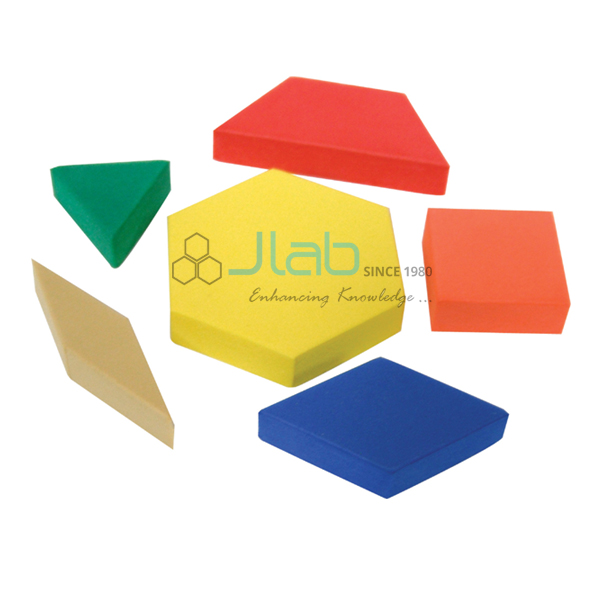
Sorting Rings Manufacturer,Supplier and Exporter in India
Product Code : EL-S-3489
Jlab Export is a leading Sorting Rings Manufacturer,and suppliers in India
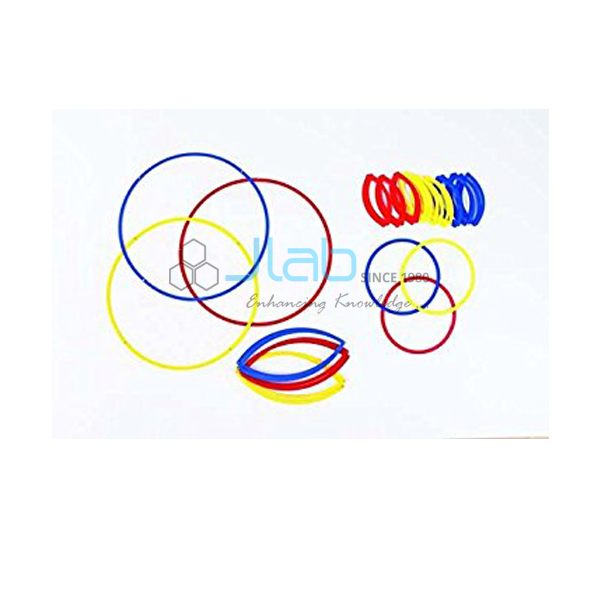
Sorting Rings (code EL-S-3489) are foldable plastic circle rings, 15 inches in diameter, supplied as a set of 6 — two in each of three colours. Teachers use them in different ways from elementary to higher secondary classes: for grouping objects, for teaching set theory and for demonstrating Venn diagrams. They are made by Jain Laboratory Instruments Pvt Ltd (JLab) at its works in Ambala, India.
Specifications
| Parameter | Detail |
|---|---|
| Type | Foldable circle rings |
| Material | Plastic |
| Diameter | 15 inches (about 38.1 cm) |
| Colours | Three |
| Rings per set | 6 (two in each colour) |
| Uses | Grouping, set theory and Venn diagram demonstration |
| Level | Elementary to higher secondary |
| Quality check | Each set is visually inspected before dispatch |
| Pack quantity | Set of 6 rings (two in each of three colours) |
| Minimum order quantity | 10 units |
| Dispatch time | Usually 7–10 working days |
| Product code | EL-S-3489 |
| Manufacturer | Jain Laboratory Instruments Pvt Ltd (JLab) — OEM |
| Country of origin | India (made in Ambala, Haryana) |
What Are Sorting Rings Used For?
A sorting ring gives a group a visible boundary. Younger children place objects or picture cards inside a ring to sort them by a rule, and two overlapping rings show at a glance which items belong to both groups — the idea behind a Venn diagram. In higher classes the same rings model sets, subsets, union, intersection and complement, topics of the Sets chapter in class 11 mathematics. With three colours in the set, a teacher can overlap three rings of different colours for three-set problems, and because the rings fold, the set takes little space when it is put away.
What to Specify When Ordering
- Number of sets — for example one per group table, or one for the teacher’s demonstrations.
- Sorting materials for the same enquiry — Attribute Block, Pattern Block and Color Tiles are separate catalogue items.
- Delivery details — destination city or port and any school or tender labelling.
Frequently Asked Questions
What size are the sorting rings?
Each ring is 15 inches, about 38.1 cm, in diameter, made of foldable plastic.
How many rings come in a set?
Six: two rings in each of three colours.
Which classes can use them?
Elementary to higher secondary. Younger pupils use them for grouping, and older students for set theory and Venn diagrams, including the Sets topic of class 11 mathematics.
What should an export enquiry include?
The number of sets, the destination country and port or city, delivery terms such as FOB or CIF, packing or labelling needs, and any tender reference.
Who manufactures the Sorting Rings?
JLab, the trading name of Jain Laboratory Instruments Pvt Ltd, makes them in Ambala, Haryana, India.
OEM Manufacturer
JLab is the trading name of Jain Laboratory Instruments Pvt Ltd, a manufacturer of maths and science teaching equipment in India, incorporated in 2017 and based on Hargolal Road, Ambala, Haryana. The rings are produced in JLab’s own works instead of being sourced from a trader, so schools, dealers and importers order directly from the manufacturer, including for later top-up sets. JLab exports worldwide and ships to buyers in every region — for example the USA in North America, Myanmar in Southeast Asia, Cameroon in Central Africa, Tajikistan in Central Asia and Samoa in Oceania.
Related Sorting Materials
- Attribute Block — red, yellow and blue circles, hexagons, rectangles, squares and triangles that differ in shape, size, thickness and colour.
- Pattern Block — a set of 250 blocks in six shapes and six colours.
- 2D Shape — a hands-on teaching aid for two-dimensional shape names and properties.
- Color Tiles — square plastic tiles in five colours.
More items are in the Sorting range of JLab’s Maths Lab Equipment.
Request a Quote
To receive a quotation, click Add To Cart or contact JLab through the contact page, listing the number of sets, the delivery location and any other sorting materials required.
Last updated: 16 October 2026